---
title: "9 technologies to protect your emails from cyber actors | DMARC Report"
description: "9 technologies to protect your emails from cyber actors from DMARC Report explains practical steps for email authentication, domain protection."
image: "https://dmarcreport.com/og/blog/9-technologies-to-protect-your-emails-from-cyber-actors.png"
canonical: "https://dmarcreport.com/blog/9-technologies-to-protect-your-emails-from-cyber-actors/"
---
Quick Answer
\_According to the FBI's 2022 Internet Crime Report (IC3), 300,497 US-based victims reported phishing incidents in a single year, and Business Email Compromise (BEC) caused more than $2.7 billion in direct losses. DMARC Report 9 technologies to protect your emails from cyber actors
Related: [Free DMARC Checker](/tools/dmarc-checker/) ·[How to Create an SPF Record](/tools/spf-record-generator/) ·[SPF Record Format](/blog/spf-format-checker-dos-and-donts-for-email-authentication/)
Share
[ ](https://www.linkedin.com/sharing/share-offsite/?url=undefined%2Fblog%2F9-technologies-to-protect-your-emails-from-cyber-actors%2F "Share on LinkedIn") [ ](https://twitter.com/intent/tweet?text=9%20technologies%20to%20protect%20your%20emails%20from%20cyber%20actors&url=undefined%2Fblog%2F9-technologies-to-protect-your-emails-from-cyber-actors%2F "Share on X/Twitter") [ ](https://www.facebook.com/sharer/sharer.php?u=undefined%2Fblog%2F9-technologies-to-protect-your-emails-from-cyber-actors%2F "Share on Facebook") [ ](https://reddit.com/submit?url=undefined%2Fblog%2F9-technologies-to-protect-your-emails-from-cyber-actors%2F&title=9%20technologies%20to%20protect%20your%20emails%20from%20cyber%20actors "Share on Reddit") [ ](mailto:?subject=9%20technologies%20to%20protect%20your%20emails%20from%20cyber%20actors&body=Check out this article: undefined%2Fblog%2F9-technologies-to-protect-your-emails-from-cyber-actors%2F "Share via Email")
> From a product strategy perspective, DMARC reporting is evolving from a security tool to a business intelligence platform, says Brad Slavin, General Manager of DuoCircle. The data in aggregate reports tells you not just who’s spoofing you, but who’s sending legitimate email on your behalf - and whether they’re doing it correctly.
\_According to the [FBI’s 2022 Internet Crime Report (IC3)](https://www.ic3.gov/Media/PDF/AnnualReport/2022IC3Report.pdf), 300,497 US-based victims reported phishing incidents in a single year, and Business Email Compromise (BEC) caused more than $2.7 billion in direct losses. DMARC Report
9 technologies to protect your emails from cyber actors
```
```
/
```
```
RSS Feed
```
Share
Link
Embed
```
/\*! This file is auto-generated \*/ ’ title=“Embed Code” class=“input-embed input-embed-18999” readonly/>
```
```
In the fourth quarter of 2023, email threats continued to dominate the [cyberattack](https://www.nbcnews.com/tech/security/us-officials-urge-americans-use-encrypted-apps-cyberattack-rcna182694) landscape, with [86%](https://www.statista.com/statistics/1493126/detected-e-mail-threats-distribution-global-by-type/) identified as scams and another 9% as phishing emails. These statistics highlight the critical role email plays as a \*\*primary target for [cybercriminals](https://www.voanews.com/a/alleged-leader-of-cybercriminals-extradited-to-us/7741605.html). Despite these alarming figures, millions of organizations still underestimate the importance of robust [email security](https://dmarcreport.com/blog/why-email-security-matters-and-how-to-get-it-right/) measures, leaving their systems and [sensitive information](https://www.nist.gov/news-events/news/2024/05/nist-finalizes-updated-guidelines-protecting-sensitive-information) vulnerable to exploitation.
_Emails are not just a communication tool; they are a gateway to business operations, customer trust, and financial security_. Without the right protections in place, your organization could face data breaches, [financial losses](https://www.usnews.com/news/business/articles/2024-11-18/spirit-airlines-files-for-bankruptcy-as-financial-losses-pile-up-and-debt-payments-loom), and reputational damage. To help you stay ahead of these threats, we’ve compiled a list of \*\*nine essential technologies that can safeguard your email infrastructure and protect you from evolving cyber actors.
## 1\. End-to-end encryption
End-to-end encryption prevents unauthorized entities from accessing content in an email message during its transmission. This method encrypts emails on the \*\*sender’s system so that only the intended recipients can decrypt them. [Cryptographic keys](https://www.cloudflare.com/learning/ssl/what-is-a-cryptographic-key/#:~:text=In%20cryptography%2C%20a%20key%20is,can%20unlock%20%28decrypt%29%20it.) change the readable text into indecipherable, gibberish combinations of random characters. So, even if a [malicious actor](https://cybernews.com/news/malicious-actors-leak-us-criminal-database/) gets access to the message, they won’t be able to make out its meaning.
Remember the fact that [email encryption](https://thehackernews.com/2015/02/gnupg-email-encryption-project-relies.html) only secures the content of emails and doesn’t prevent malicious messages. For example, an attacker can send a fully encrypted phishing email, and encryption won’t be able to stop the recipient from getting tricked. Hence, it should be paired with other \*\*technologies for holistic email protection.
## 2\. Multifactor authentication (MFA)
[Multifactor authentication](https://www.ibm.com/topics/multi-factor-authentication) adds additional layers of security to emails over and above a standard login password. This extra layer makes it difficult for [threat actors](https://www.scworld.com/news/fbi-warns-of-email-spoofing-by-north-korean-threat-actor-kimsuky) to infiltrate your \*\*email system even if they break the primary password associated with the username.
_Authentication usually relies on knowledge, possession, and inheritance. Knowledge refers to something the user knows, such as a secondary password_. Possession involves something the user owns, like a phone or security token, which provides additional credentials, such as a [One-Time Password ](https://www.forbes.com/councils/forbestechcouncil/2024/07/12/under-the-microscope-the-risks-of-one-time-passwords-vulnerabilities/)(OTP). Inherence is tied to the user’s unique physical traits, such as fingerprints, facial features, or retinal patterns, verified through biometric devices like scanners or **facial recognition systems**.
## 3\. Artificial intelligence and machine learning-based threat detection
[AI and ML](https://community.aws/content/2drbbXokwrIXivItJ8ZeCk3gT5F/introduction-to-artificial-intelligence-and-machine-learning?lang=en) are rapidly getting integrated across most industries, including cybersecurity. With AI and ML, you can **detect anomalies**, discrepancies, and early signs of phishing attacks, helping you effectively manage these risks before they mature into [havoc-wreaking threats](https://www.npr.org/2024/01/31/1228153857/wray-chinese-hackers-national-security).
Here’s how AI identifies phishing content-
## Behavioral analysis
AI tools can [analyze email traffic](https://www.sender.net/blog/email-traffic/) and learn typical communication patterns. They can detect [phishing emails](https://www.techtarget.com/searchsecurity/news/366547912/Researchers-put-LLMs-to-the-test-in-phishing-email-experiment) by spotting unusual deviations from these patterns.
## Natural language processing
_NLP allows AI to read and understand email content, helping it spot phishing signs like urgent language or prompts to click links or open attachments_.
## Attachment analysis
AI can analyze attachments in a secure environment to detect malware before they reach the recipient. It can be done in a **sandboxed environment** (discussed later in this blog) to understand if the attachment is safe to open.
## Malicious URL detection
AI can detect [malicious websites](https://techcrunch.com/2022/11/03/hundreds-news-websites-malware/) linked in phishing emails by \*\*analyzing the URLs and evaluating if the sites are likely to be [phishing attempts](https://www.utilitydive.com/news/utilities-on-high-alert-as-phishing-attempts-cyber-probing-spike-related-t/573698/).
## Threat intelligence
Organizations can access threat intelligence feeds to gather [Indicators of Compromise (IoCs)](https://www.fortinet.com/resources/cyberglossary/indicators-of-compromise). AI can utilize these IoCs to detect malicious attachments, URLs, and [phishing campaigns](https://www.cbsnews.com/news/black-friday-phishing-scam-how-to-spot/) or create its own IoCs based on newly identified threats.
## Incident response
AI can automate responses to phishing attacks, such as isolating \*\*compromised accounts or computers to minimize risk. For example, if a [phishing attack](https://www.wired.com/story/qr-codes-phishing-attack/) is detected, AI can quarantine affected user accounts or devices to limit its impact on the organization.
## 4\. Secure email gateways
[Secure email gateways](https://www.computing.co.uk/news/4337570/cisco-patches-critical-flaw-secure-email-gateway-appliances) (SEGs) prevent spam, phishing, and email-borne malware by filtering malicious actors among incoming emails using a combination of algorithmic and heuristic analysis . This ensures that all (or at least most) emails entering your \*\*email infrastructure are legitimate.
_The techniques used in secure email gateways include content analysis, URL scanning, attachment inspection, and reputation checks to spot suspicious emails_. Advanced SEGs leverage artificial intelligence and machine learning to recognize patterns of malicious behavior and adapt to emerging threats. Additionally, they enforce policies like [DMARC](https://dmarcreport.com/), SPF, and DKIM to verify sender authenticity, ensuring that only [legitimate emails](https://www.usatoday.com/story/tech/2021/08/23/gmail-spam-filter-email-inbox-google/8242847002/) are delivered. By preventing threats at the **gateway level**, SEGs help protect email infrastructures from being exploited by threat actors.
## 5\. Sandboxing
Email sandboxing refers to the practice of intercepting a suspicious message and storing it in a \*\*safe location called a sandbox. The sandbox isn’t accessible by everyone, and emails tested in it don’t affect the network and [email infrastructure](https://www.voilanorbert.com/blog/email-infrastructure/) as they’re stored in an external area.
Email security solutions detect and block threats using several methods. They often keep a list of malicious server [IP addresses](https://www.investopedia.com/terms/i/ip-address.asp), blocking any messages from these sources and placing them in a sandbox for review. Attachments and emails are also scanned for threats using [antivirus software](https://www.bbc.com/news/articles/ceqq7663wd2o). If a potential threat is found, the email is sent to the sandbox, where it can’t affect the system.\_ While antivirus software detects known threats, it struggles with new or altered malware, as attackers frequently change their code to bypass detection\_. Businesses need to adapt their security measures to defend against these evolving threats.
## 6\. Data loss prevention
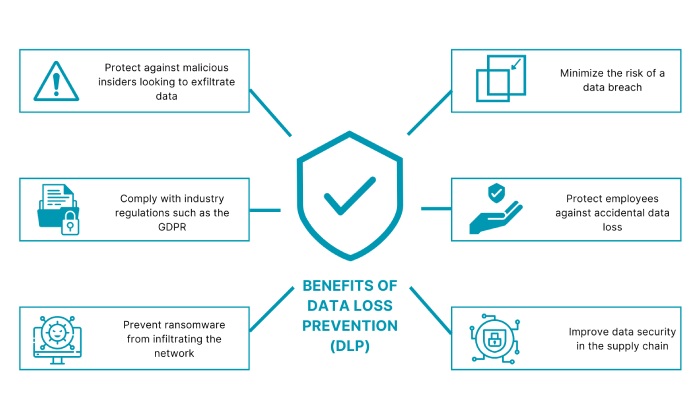
[Data loss prevention](https://www.globenewswire.com/news-release/2024/09/16/2946735/28124/en/Data-Loss-Prevention-Business-Analysis-Report-2023-2030-Global-Market-to-Reach-7-Billion-Growth-in-Remote-Work-Trends-Expands-to-Secure-Dispersed-Networks.html) (DLP) is an email security technique that \*\*prevents sensitive data within an email from getting leaked, lost, misused, or accessed by unauthorized and potentially malicious people and systems.\_ In this technique, all inbound and outbound emails are monitored to find attachments or content that may be sensitive, confidential, private, or protected by regulation. When such an email is found, email DLPs flag, block, or delete it based on the policies\_.
Its rule-based search techniques spot \*\*sensitive information such as credit card numbers, telephone numbers, banking details, and [Social Security Numbers](https://www.syracuse.com/us-news/2024/08/massive-data-breach-includes-social-security-numbers-more-heres-what-you-should-do.html).
## 7\. Email archiving solutions
Email archiving solutions store email data for disaster recovery or remove useless data to speed up daily email operations and reduce server storage space. Some of the top \*\*email archiving solutions offer-
- Quick and easy search of stored email data
- Simple management of large volumes of critical email data
- Comprehensive regulatory compliance
- Cost-effective operations There are primarily two types of email archiving : on-premise and cloud-based. In on-premise archiving, emails are captured and stored in an indexed physical database. In [cloud-based archiving](https://www.donomasoftware.com/cloud-based-archiving/), emails are captured and stored in the cloud, which can be private to your organization or public for multiple users\*\*.
## 8\. Zero trust email security models
[Zero trust](https://www.trendmicro.com/en%5Fus/research/24/h/secure-genai.html) security is the opposite of the ‘trust but verify’ approach. In this, you don’t trust anything or anyone and verify each of them. _It’s a combination of four features that work together to offer email security- email authentication, multifactor authentication, password management, and email encryption_. It includes mapping the transaction flows between \*\*internal and external users to determine what type of access users need and which ones they don’t. Once this is done, all requests are verified before accessing resources or services.
## 9\. Email authentication
Email authentication is a \*\*process of verifying whether the email sender is actually who they claim to be. It’s done using three protocols: Sender Policy Framework (SPF), DomainKeys Identified Mail ([DKIM](https://dmarcreport.com/what-is-dkim/)), and Domain-based Message Authentication Reporting and Conformance (DMARC).
So, basically, domain owners deploy these protocols so that emails maliciously sent by unauthorized people get flagged in the recipients’ inboxes. While email authentication protocols don’t stop potentially fraudulent and [unsolicited emails](https://www.foxnews.com/tech/outsmart-spammers-finally-end-unsolicited-emails) from going out of your **email system**, they do help the recipients’ [mail servers](https://www.activecampaign.com/glossary/mail-server) to identify such emails sent from your domain and flag them. This way, recipients have very low chances of opening potentially fraudulent emails sent from your domain, which ultimately means low chances of them falling into the trap.
Let’s understand what are SPF, DKIM, and DMARC, and how they work to \*\*prevent domains from [phishing and spoofing](https://www.channelinsider.com/news-and-trends/us/proofpoint-flaw-echospoofing/)\-
## SPF
[SPF](https://dmarcreport.com/what-is-spf/) is one of the primitive [email authentication](https://dmarcreport.com/blog/why-email-security-matters-and-how-to-get-it-right/) protocols. You have to create an SPF record and specify all the servers you allow to be used for sending emails from your domain. Any email from the server not mentioned in the SPF record fails the **authentication checks**. In the same SPF record, you have to mention the action you want recipients’ mailboxes to take with emails that fail the SPF check.
You can either subject such emails to ‘**SoftFail’ or ‘HardFail**.’ If you mention SoftFail, then recipients’ mailboxes will mark the unauthorized emails sent from your domain as spam. If you mention HardFail, such emails will simply be bounced back (rejected) by the recipients’ mailboxes.
## DKIM
DKIM is a cryptography-based protocol that ensures emails from your domain haven’t been altered during transit. It works by adding a [digital signature](https://en.wikipedia.org/wiki/Digital%5Fsignature), created with your [private key](https://www.1kosmos.com/authentication/private-key/), to the email’s header. The corresponding [public key](https://www.techopedia.com/definition/16139/public-key), stored in your **domain’s DNS**, lets receiving servers verify the email’s authenticity and integrity.
## DMARC
DMARC works by aligning SPF and DKIM authentication results with the sender’s domain in the email’s ‘From’ header. Domain owners publish a [DMARC record](https://dmarcreport.com/dmarc-record/) in their DNS, specifying one of **three policies**: none (monitor email traffic without taking action), quarantine (mark suspicious [emails as spam](https://www.techradar.com/pro/ai-arms-race-the-evolving-battle-between-email-spam-and-spam-filters)), or reject (block unauthorized emails). DMARC also provides reports to help domain owners monitor and improve their email security .
We at \*\*DMARCReport can help you manage these frequently received reports and offer an easy-to-read compiled report. [Contact us](https://dmarcreport.com/contact/) to know more about our services.
## Topics
[ dkim ](/tags/dkim/)[ DMARC ](/tags/dmarc/)[ dmarc record ](/tags/dmarc-record/)[ email security ](/tags/email-security/)[ SPF ](/tags/spf/)

[ Vasile Diaconu ](/authors/vasile-diaconu/)
Operations Lead
Operations Lead at DuoCircle. Runs project management, developer coordination, and technical support execution for DMARC Report.
[LinkedIn Profile →](https://www.linkedin.com/in/vasile-diaconu/)
## Take control of your DMARC reports
Turn raw XML into actionable dashboards. Start free - no credit card required.
[Start Free Trial](https://app.dmarcreport.com/) [Check Your DMARC Record](/tools/dmarc-checker/)
## Related Articles
[ Foundational 7m 4 sectors that need email authentication the most and why Oct 15, 2024 ](/blog/4-sectors-that-need-email-authentication-the-most-and-why/)[ Foundational 4m 8 Misconceptions About DMARC and its Deployment for Businesses Dec 4, 2023 ](/blog/8-misconceptions-about-dmarc-and-its-deployment-for-businesses/)[ Foundational 14m Add TXT Record on Namecheap (SPF, DKIM & DMARC) - 2026 Mar 5, 2025 ](/blog/add-txt-record-on-namecheap-a-complete-dns-guide/)[ Foundational 12m Adding SPF Records To Your Domain For Outlook Email Authentication Sep 25, 2025 ](/blog/adding-spf-records-to-your-domain-for-outlook-email-authentication/)
```json
{"@context":"https://schema.org","@type":"Organization","@id":"https://www.wikidata.org/wiki/Q138898167","name":"DMARC Report","url":"https://dmarcreport.com","logo":{"@type":"ImageObject","url":"https://dmarcreport.com/images/dmarcreport-logo.png"},"description":"DMARC reporting and email authentication management. Monitor aggregate and forensic DMARC reports, analyze authentication results, and enforce DMARC policies across all your domains.","parentOrganization":{"@type":"Organization","@id":"https://www.wikidata.org/wiki/Q138883901","name":"DuoCircle LLC","url":"https://www.duocircle.com","sameAs":["https://www.wikidata.org/wiki/Q138883901","https://www.crunchbase.com/organization/duocircle-llc","https://www.linkedin.com/company/duocircle","https://github.com/duocircle"],"subOrganization":[{"@type":"Organization","@id":"https://www.wikidata.org/wiki/Q138898167","name":"DMARC Report","url":"https://dmarcreport.com"},{"@type":"Organization","@id":"https://www.wikidata.org/wiki/Q138897474","name":"AutoSPF","url":"https://autospf.com"},{"@type":"Organization","@id":"https://www.wikidata.org/wiki/Q138897912","name":"Phish Protection","url":"https://www.phishprotection.com"}]},"sameAs":["https://www.wikidata.org/wiki/Q138898167","https://www.linkedin.com/company/duocircle","https://x.com/duocirclellc","https://www.g2.com/products/dmarc-report/reviews","https://github.com/duocircle","https://www.crunchbase.com/organization/duocircle-llc","https://www.trustradius.com/products/duocircle/reviews"],"aggregateRating":{"@type":"AggregateRating","ratingValue":"4.8","reviewCount":"470","bestRating":"5","worstRating":"1","url":"https://www.g2.com/products/dmarc-report/reviews"},"contactPoint":{"@type":"ContactPoint","contactType":"customer support","url":"https://dmarcreport.com/support/"},"knowsAbout":["DMARC","DMARC Reporting","DMARC Aggregate Reports","DMARC Forensic Reports","Sender Policy Framework","DKIM","Email Authentication","Email Security","DNS Management","Email Deliverability"]}
```
```json
{"@context":"https://schema.org","@type":"WebSite","name":"DMARC Report","url":"https://dmarcreport.com","description":"DMARC reporting and email authentication management. Monitor aggregate and forensic DMARC reports, analyze authentication results, and enforce DMARC policies across all your domains.","publisher":{"@type":"Organization","name":"DMARC Report","url":"https://dmarcreport.com","logo":{"@type":"ImageObject","url":"https://dmarcreport.com/images/dmarcreport-logo.png"},"description":"DMARC reporting and email authentication management. Monitor aggregate and forensic DMARC reports, analyze authentication results, and enforce DMARC policies across all your domains.","parentOrganization":{"@type":"Organization","@id":"https://www.wikidata.org/wiki/Q138883901","name":"DuoCircle LLC","url":"https://www.duocircle.com","sameAs":["https://www.wikidata.org/wiki/Q138883901","https://www.crunchbase.com/organization/duocircle-llc","https://www.linkedin.com/company/duocircle","https://github.com/duocircle"],"subOrganization":[{"@type":"Organization","@id":"https://www.wikidata.org/wiki/Q138898167","name":"DMARC Report","url":"https://dmarcreport.com"},{"@type":"Organization","@id":"https://www.wikidata.org/wiki/Q138897474","name":"AutoSPF","url":"https://autospf.com"},{"@type":"Organization","@id":"https://www.wikidata.org/wiki/Q138897912","name":"Phish Protection","url":"https://www.phishprotection.com"}]}}}
```
```json
[{"@context":"https://schema.org","@type":"BlogPosting","headline":"9 technologies to protect your emails from cyber actors","description":"9 technologies to protect your emails from cyber actors from DMARC Report explains practical steps for email authentication, domain protection.","url":"https://dmarcreport.com/blog/9-technologies-to-protect-your-emails-from-cyber-actors/","datePublished":"2024-12-10T09:48:49.000Z","dateModified":"2026-04-16T15:53:43.000Z","dateCreated":"2024-12-10T09:48:49.000Z","author":{"@type":"Person","@id":"https://dmarcreport.com/authors/vasile-diaconu/#person","name":"Vasile Diaconu","url":"https://dmarcreport.com/authors/vasile-diaconu/","jobTitle":"Operations Lead","description":"Vasile Diaconu is the Operations Lead at DuoCircle, the company behind DMARC Report and AutoSPF. He coordinates between engineering, product, and technical support - running project management, interfacing with developers on customer-reported issues, and making sure work that comes in through the support channel actually gets closed out. Vasile sits at the intersection of customer feedback and engineering execution, giving him a direct view of which email authentication problems customers hit most often in production.","image":"https://media.mailhop.org/dmarcreport/images/team/vasile-diaconu.jpg","knowsAbout":["SaaS Operations","Technical Support Coordination","Customer Issue Resolution","Engineering Program Management","Deployment Operations"],"worksFor":{"@type":"Organization","name":"DMARC Report","url":"https://dmarcreport.com"},"sameAs":["https://www.linkedin.com/in/vasile-diaconu/"]},"publisher":{"@type":"Organization","@id":"https://www.wikidata.org/wiki/Q138898167","name":"DMARC Report","url":"https://dmarcreport.com","logo":{"@type":"ImageObject","url":"https://dmarcreport.com/images/dmarcreport-logo.png"},"description":"DMARC reporting and email authentication management. Monitor aggregate and forensic DMARC reports, analyze authentication results, and enforce DMARC policies across all your domains.","parentOrganization":{"@type":"Organization","@id":"https://www.wikidata.org/wiki/Q138883901","name":"DuoCircle LLC","url":"https://www.duocircle.com","sameAs":["https://www.wikidata.org/wiki/Q138883901","https://www.crunchbase.com/organization/duocircle-llc","https://www.linkedin.com/company/duocircle","https://github.com/duocircle"],"subOrganization":[{"@type":"Organization","@id":"https://www.wikidata.org/wiki/Q138898167","name":"DMARC Report","url":"https://dmarcreport.com"},{"@type":"Organization","@id":"https://www.wikidata.org/wiki/Q138897474","name":"AutoSPF","url":"https://autospf.com"},{"@type":"Organization","@id":"https://www.wikidata.org/wiki/Q138897912","name":"Phish Protection","url":"https://www.phishprotection.com"}]},"sameAs":["https://www.wikidata.org/wiki/Q138898167","https://www.linkedin.com/company/duocircle","https://x.com/duocirclellc","https://www.g2.com/products/dmarc-report/reviews","https://github.com/duocircle","https://www.crunchbase.com/organization/duocircle-llc","https://www.trustradius.com/products/duocircle/reviews"],"aggregateRating":{"@type":"AggregateRating","ratingValue":"4.8","reviewCount":"470","bestRating":"5","worstRating":"1","url":"https://www.g2.com/products/dmarc-report/reviews"},"contactPoint":{"@type":"ContactPoint","contactType":"customer support","url":"https://dmarcreport.com/support/"},"knowsAbout":["DMARC","DMARC Reporting","DMARC Aggregate Reports","DMARC Forensic Reports","Sender Policy Framework","DKIM","Email Authentication","Email Security","DNS Management","Email Deliverability"]},"mainEntityOfPage":{"@type":"WebPage","@id":"https://dmarcreport.com/blog/9-technologies-to-protect-your-emails-from-cyber-actors/"},"articleSection":"foundational","keywords":"dkim, DMARC, dmarc record, email security, SPF","wordCount":1988,"image":{"@type":"ImageObject","url":"https://media.mailhop.org/dmarcreport/images/2022/04/dmarc-alignment-6379.jpg","caption":"9 technologies to protect your emails from cyber actors","width":900,"height":600},"speakable":{"@type":"SpeakableSpecification","cssSelector":[".answer-block","h1"]}}]
```
```json
{"@context":"https://schema.org","@type":"BreadcrumbList","itemListElement":[{"@type":"ListItem","position":1,"name":"Home","item":"https://dmarcreport.com/"},{"@type":"ListItem","position":2,"name":"Blog","item":"https://dmarcreport.com/blog/"},{"@type":"ListItem","position":3,"name":"Foundational","item":"https://dmarcreport.com/foundational/"},{"@type":"ListItem","position":4,"name":"9 technologies to protect your emails from cyber actors","item":"https://dmarcreport.com/blog/9-technologies-to-protect-your-emails-from-cyber-actors/"}]}
```