DMARC and Email Deliverability:The Revenue Impact No One Is Measuring

Quick Answer
Every email marketer obsesses over subject lines, send times, and segmentation. They A/B test copy, optimize preview text, and agonize over button colors. Meanwhile, the single largest factor determining whether their email reaches the inbox at all, email authentication, sits unmanaged in a DNS record that marketing has never seen.
Related: Free DMARC Checker
Try Our Free DMARC Checker
Validate your DMARC policy, check alignment settings, and verify reporting configuration.
Check DMARC Record →The 45-Point Deliverability Gap Hiding in Your DNS
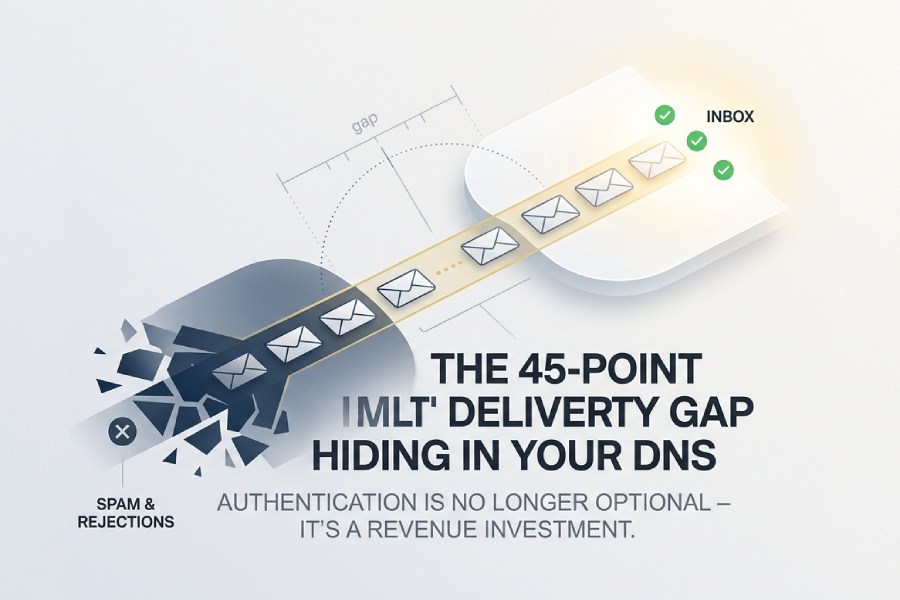
Every email marketer obsesses over subject lines, send times, and segmentation. They A/B test copy, optimize preview text, and agonize over button colors. Meanwhile, the single largest factor determining whether their email reaches the inbox at all, email authentication, sits unmanaged in a DNS record that marketing has never seen.
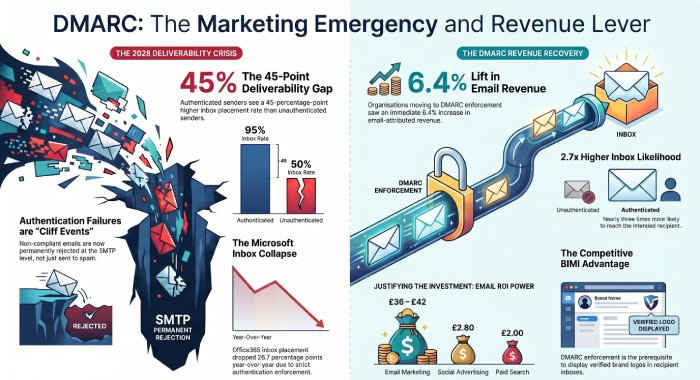
The data is stark. According to Digital Applied’s 2026 email marketing analysis, the inbox placement gap between authenticated and unauthenticated senders is 45 percentage points. That is not a minor optimization. It is the difference between reaching your audience and vanishing into spam. The Digital Bloom’s B2B deliverability benchmark confirms the pattern: fully authenticated domains (SPF+DKIM+DMARC) achieve 2.7 times higher likelihood of inbox placement compared to unauthenticated senders.
In a channel that delivers $36-42 return per dollar spent, outperforming paid search ($2), social advertising ($2.80), and display ads ($1.35), a 45-point deliverability gap is not a security concern. It is a revenue emergency.
This report examines the measurable business impact of DMARC on email deliverability, quantifies the revenue at stake, and demonstrates why DMARC enforcement is a marketing investment, not just a security expenditure.
The 2026 Email Deliverability Crisis: What Changed
Email deliverability in 2026 is fundamentally different from even two years ago. A convergence of enforcement actions by the world’s largest mailbox providers has created what Mailbird calls the “2026 Email Deliverability Crisis”, a period where legitimate business communications face rejection at rates never seen before, while sophisticated phishing paradoxically bypasses filters with increasing success.
The Enforcement Timeline
In February 2024, Google and Yahoo began requiring SPF, DKIM, and DMARC for any domain sending more than 5,000 emails per day. In November 2025, Gmail escalated from soft warnings to actively rejecting non-compliant emails at the SMTP level, meaning non-compliant messages are permanently rejected before reaching the recipient’s infrastructure. The recipient never sees the message, receives no notification, and the sender often gets no clear bounce message. In May 2025, Microsoft followed with identical enforcement for Outlook.com, Hotmail.com, and Live.com. France’s La Poste joined in September 2025.
The result: Google, Microsoft, and Yahoo together control the majority of consumer and business inboxes worldwide. If your email fails DMARC, it does not reach the inbox. It does not go to spam. It ceases to exist.
The Average Inbox Placement Problem
Landbase’s analysis of 35 deliverability statistics reports an average inbox placement rate of 83.1% in 2025. That means roughly 1 in 6 marketing emails never reaches the intended inbox. The Validity 2025 Email Deliverability Benchmark Report (PDF) provides the most comprehensive global dataset, showing significant variation by provider, region, and authentication status. For marketers sending millions of emails monthly, a 17% loss rate translates directly into lost revenue, wasted creative investment, and distorted performance metrics.
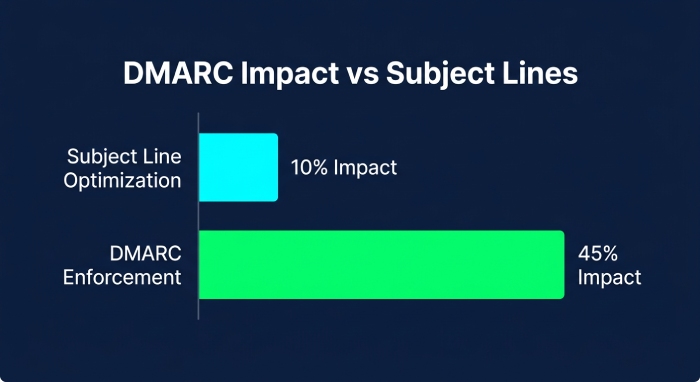
The paradigm shift: Email authentication is no longer an IT task that marketing can ignore. It is the single largest deliverability variable. Subject line optimization might improve open rates by 5-10%. DMARC enforcement can improve inbox placement by 45 percentage points. The ROI calculation is not close.
The Deliverability Impact of DMARC: What the Data Shows
Multiple independent sources quantify the deliverability advantage of email authentication. The consistency of the findings across different methodologies and sample sizes makes the conclusion difficult to dispute.
| Finding | Impact | Source |
|---|---|---|
| Authenticated vs unauthenticated inbox gap | 45 percentage points | Digital Applied |
| Full authentication (SPF+DKIM+DMARC) inbox likelihood | 2.7x higher vs unauthenticated | Digital Bloom B2B Report |
| Full auth + enforcement gap vs none | 38.76 pp combined impact | Digital Bloom |
| DMARC-enforced domains inbox placement | 85-95% achievable | Digital Bloom/Landbase |
| Proper DMARC inbox improvement | 10-20% better placement | Genesys Growth |
| B2C case: inbox placement post-enforcement | 86% → 92% (+6pp) | DMARCReport |
| Same case: email-attributed revenue lift | 6.4% increase | DMARCReport |
| Office365 inbox placement YoY decline | Down 26.7 pp | Digital Bloom |
| High-volume senders (1M+/mo) inbox collapse | -22.35 pp decline | Digital Bloom |
| Gmail unauthenticated email reduction | 265 billion fewer emails (65%) | Google/Dark Reading |
| Deliverability post-DMARC enforcement | 5-10% improvement | Valimail/Patronum |
The Revenue Math: What DMARC Enforcement Is Worth
Let’s translate the deliverability data into revenue impact.
The Direct Revenue Calculation
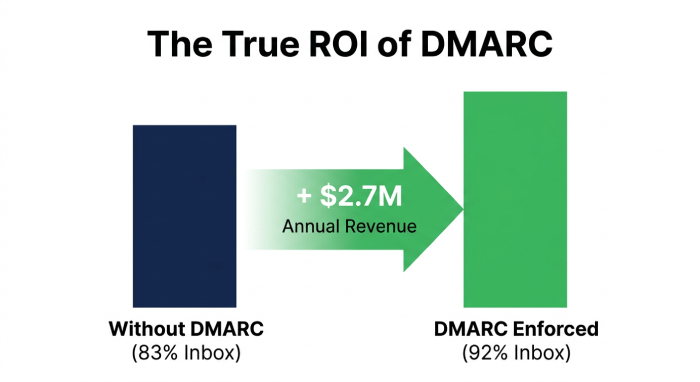
Consider an organization sending 10 million marketing emails per month with an average inbox placement of 83% (the global average per Landbase). At that rate, 1.7 million emails per month never reach the inbox. If DMARC enforcement moves inbox placement to 92% (consistent with DMARCReport’s B2C case study), that recovers 900,000 additional emails per month into recipient inboxes.
At an industry-average revenue per email of $0.10-$0.25, recovering 900,000 emails per month translates to $90,000-$225,000 in additional monthly revenue, or $1.08-$2.7 million annually. The DMARCReport case study documented a 6.4% lift in email-attributed revenue for a B2C retailer sending 45 million emails monthly after moving to p=reject. For a retailer generating $50 million annually through email, a 6.4% lift equals $3.2 million in additional revenue.
The Competitive Advantage
Here is the strategic opportunity: only 33.4% of top domains have valid DMARC records, and of those, 57.2% use ineffective p=none policies. Only 7.6% of domains enforce DMARC. This means that organizations implementing DMARC at enforcement gain a measurable inbox placement advantage over 92.4% of all senders. In a world where email delivers $36-42 per dollar spent, the highest ROI of any digital channel, even a modest improvement in inbox placement compounds into significant revenue.
The Hidden Tax of p=none
Organizations at DMARC p=none (monitoring-only) are paying a hidden deliverability tax every day. Their legitimate marketing emails compete with spoofed emails in recipients’ inboxes, degrading sender reputation. ISPs see unauthenticated traffic from the domain and lower its reputation score. As DmarcDkim.com explains, delivery is often throttled or suppressed without notification, problems are noticed only after engagement drops or customers complain about missing emails. The Sinch Mailgun State of Email 2025 report (PDF) found that 50% of senders familiar with the new requirements made changes, meaning the other half are silently losing inbox placement.
The business case: DMARC enforcement is not a cost center. It is a revenue generator. The 45-percentage-point deliverability gap, the 2.7x inbox likelihood, and the 6.4% revenue lift are not security metrics, they are marketing metrics. Every month without enforcement is a month of revenue left on the table.
The Microsoft Deliverability Crisis: A Case Study in Authentication Impact
The Digital Bloom’s B2B benchmark documents what may be the most dramatic deliverability decline in email marketing history: Office365 inbox placement dropped 26.7 percentage points year-over-year, and Outlook/Hotmail dropped 22.6 percentage points. Organizations sending 1 million or more emails monthly experienced a catastrophic 22.35 percentage point decline in inbox placement, dropping to just 27.63%.
The cause is directly tied to authentication enforcement. Microsoft’s May 2025 DMARC requirements moved from routing non-compliant mail to junk to permanently rejecting it. Organizations without proper SPF, DKIM, and DMARC alignment saw their email to Microsoft recipients essentially disappear overnight.
For B2B organizations, where Microsoft controls a significant share of corporate inboxes through Office365, this decline is existential. As a SaaS startup described to NicheAdvertiser, their cold outreach pipeline collapsed in 72 hours. Open rates dropped from 38% to under 2%. The culprit was three lines of broken DNS configuration: invalid SPF, missing DKIM, and DMARC set to none.
The recovery took eight weeks of disciplined work: fixing authentication, cleaning lists, rebuilding reputation. By month three, open rates were back above 30% and revenue per send had improved, even though their list was 60,000 contacts smaller. The smaller, authenticated list outperformed the larger, unauthenticated one.
The lesson: Authentication failures are not gradual declines. They are cliff events. One day your emails arrive. The next day, 26 percentage points of your inbox placement evaporates. A DMARC report analyzer provides continuous monitoring that catches these failures before they impact revenue, not after.
BIMI: The Revenue Upside of DMARC Enforcement
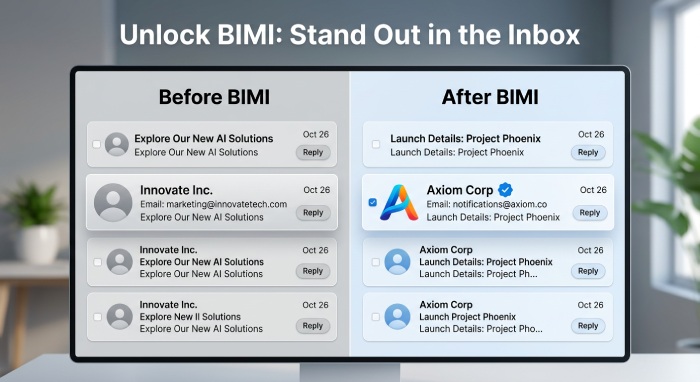
Beyond inbox placement, DMARC enforcement unlocks a powerful marketing tool: Brand Indicators for Message Identification (BIMI). BIMI displays a verified brand logo next to your emails in recipient inboxes. But it requires DMARC at enforcement (p=quarantine or p=reject) as a prerequisite.
DMARCReport’s analysis includes a BIMI Readiness Check that validates DMARC enforcement, logo format, DNS correctness, and VMC (Verified Mark Certificate) status, and estimates the expected uplift in opens from brand logo display. Early data from BIMI adopters shows measurable improvements in brand recognition, open rates, and recipient trust.
The strategic implication is clear: DMARC enforcement is not just the price of admission to the inbox. It is the prerequisite for the next generation of email marketing differentiation. Organizations that reach p=reject gain both deliverability improvements and the ability to display their verified brand in every inbox that supports BIMI, a visual trust signal that competitors at p=none cannot access.
What Marketing Teams Should Do: The Deliverability-First DMARC Roadmap
Step 1: Audit Your Current Authentication Posture
Before optimizing subject lines or segmentation, check your SPF, DKIM, and DMARC records. Use a free checker like DMARCReport’s DMARC Checker or MXToolbox to verify your configuration. If the fundamentals are new to you, learn about DMARC before you start. If you have no DMARC record, or if it is at p=none, you are leaving deliverability on the table. The Validity 2025 Benchmark (PDF) provides global inbox placement baselines to compare against.
Step 2: Deploy a DMARC Report Analyzer
DMARC aggregate reports reveal which services are sending email on your behalf and whether they are properly authenticated. This is the sender discovery phase that most marketing teams have never done. You will almost certainly find marketing platforms, CRMs, and transactional services that are failing authentication, silently reducing your inbox placement without any visible error.
Step 3: Fix Authentication for Every Sending Service
Work with your ESP, marketing automation platform, CRM, and any other sender to configure custom DKIM signing and Return-Path alignment. Understanding how DMARC alignment works makes these fixes faster. The DMARC analyzer shows exactly which senders are failing and what DNS changes to make. This is the step that recovers the deliverability you have been losing.
Step 4: Move to Enforcement and Measure the Revenue Impact
Advance your DMARC policy from p=none to p=quarantine to p=reject using the phased approach. At each stage, measure the impact on inbox placement rates, open rates, click-through rates, and email-attributed revenue. The data consistently shows improvement at each enforcement level. Document the ROI to build the internal business case for ongoing DMARC investment.
Step 5: Implement BIMI for Brand Differentiation
Once at p=reject, implement BIMI to display your verified brand logo in supported inboxes. This provides a visible competitive advantage that reinforces brand recognition and trust with every email you send.
The mindset shift: DMARC is not an IT project that marketing waits for. It is a marketing project that IT executes. The revenue impact belongs to marketing. The technical implementation belongs to IT. The DMARC analyzer is the tool that bridges both teams with shared visibility into sender authentication, deliverability impact, and enforcement readiness.
The Bottom Line: Authentication Is the New Deliverability
The era of optional email authentication is over. Google rejects unauthenticated email. Microsoft rejects it. Yahoo rejects it. And only 7.6% of domains enforce DMARC, which means the vast majority of organizations are operating with a permanent, invisible deliverability handicap.
The data is consistent across every major benchmark:45-point inbox placement gap.2.7x inbox likelihood. 6.4% revenue lift. $36-42 ROI per dollar spent at stake. These are not theoretical projections. They are measured outcomes from organizations that moved from monitoring to enforcement.
For marketing teams, DMARC enforcement is the highest-ROI deliverability initiative available. No subject line test, no send-time optimization, no segmentation strategy can close a 45-percentage-point inbox placement gap. Only authentication can. And the tool that makes authentication manageable, discovering senders, diagnosing failures, guiding enforcement, and measuring revenue impact, is the DMARC report analyzer.
Your competitors are almost certainly not enforcing DMARC. That means every month you delay is a month they could close the gap. And every month you enforce is a month your emails reach inboxes theirs do not.
References and Sources
All sources referenced, with full URLs:
1. Digital Applied: Email Marketing Statistics 2026 ($36-42 ROI, 45pp gap)
https://www.digitalapplied.com/blog/email-marketing-statistics-2026-data-points
2. Digital Bloom: B2B Email Deliverability Benchmarks 2025 (2.7x, 38.76pp)
https://thedigitalbloom.com/learn/b2b-email-deliverability-benchmarks-2025
3. Validity 2025 Email Deliverability Benchmark Report (PDF)
https://www.validity.com/wp-content/uploads/2025/03/2025-Benchmark-Report-FINAL.pdf
4. Sinch Mailgun: State of Email Deliverability 2025 (PDF)
https://www.mailgun.com/wp-content/uploads/pdf/SI-State_of_Email-2024_-_v3_1.pdf
5. Landbase: 35 Email Deliverability Statistics (83.1% avg)
https://www.landbase.com/blog/email-deliverability-statistics
6. DMARCReport: DMARC Deliverability & Phishing (6.4% revenue case)
https://dmarcreport.com/blog/how-can-dmarc-improve-email-deliverability-and-reduce-phishing-risks
7. DMARCReport: Microsoft DMARC Requirements May 2025
https://dmarcreport.com/blog/microsoft-outlook-dmarc-requirements-may-2025
8. Genesys Growth: Email Open Rate Stats 2026 (10-20%, 33.4% DMARC)
https://genesysgrowth.com/blog/email-open-rates-stats-for-marketing-leaders
9. NicheAdvertiser: Email Deliverability Guide 2026 (SaaS case study)
https://nicheadvertiser.com/email-deliverability-guide/
10. DmarcDkim.com: DMARC Enforcement in 2026
https://dmarcdkim.com/blog/dmarc-enforcement-in-2026
11. Mailbird: 2026 Email Authentication Crisis (Cofense data)
https://www.getmailbird.com/email-authentication-crisis-fix-spam-deliverability
12. Mailbird: Email Alias Authentication Failure (Gmail rejections)
https://www.getmailbird.com/email-alias-outbound-authentication-failure
13. MailReach: Email Deliverability Statistics 2025
https://www.mailreach.co/blog/email-deliverability-statistics
14. Red Sift: Email Authentication Requirements 2026
15. DMARCian: Google/Yahoo DMARC Required
https://dmarcian.com/yahoo-and-google-dmarc-required/
16. Patronum/Valimail: DMARC for Retailers (5-10% improvement)
https://www.patronum.io/dmarc-for-retailers
17. Dark Reading: Google DMARC Push (265B fewer emails)
https://www.darkreading.com/remote-workforce/google-dmarc-push-email-security-challenges
18. EasyDMARC 2026 DMARC Adoption Report
https://easydmarc.com/blog/ebook/dmarc-adoption-report-2026
Topics
General Manager
General Manager of DuoCircle. Product strategy and commercial lead for DMARC Report's 2,000+ customer base.
LinkedIn Profile →Take control of your DMARC reports
Turn raw XML into actionable dashboards. Start free - no credit card required.