Google Postmaster Tools Introduces Deliverability Analysis: What Email Senders Need to Know

Quick Answer
Google Postmaster Tools’ new Deliverability Analysis feature helps email senders identify delivery issues, monitor inbox placement trends, and improve campaign performance. It provides actionable insights to strengthen email deliverability and sender reputation.

Email deliverability has become increasingly complex as mailbox providers place greater emphasis on sender behavior, authentication, and recipient engagement. To help senders better understand how Gmail evaluates their email programs, Google Postmaster Tools has introduced a Deliverability Analysis feature designed to provide a more consolidated view of inbox performance.
Rather than forcing users to interpret multiple dashboards separately, this new functionality aims to simplify the process of identifying deliverability concerns and understanding what actions may improve email placement.
A Shift Toward Actionable Deliverability Insights
For years, email marketers and deliverability professionals relied on a collection of metrics within Google Postmaster Tools to assess sender health. Spam complaint rates, authentication status, and delivery error reports all provided useful information, but understanding the relationship between these metrics often required experience and manual analysis.
The Deliverability Analysis feature changes that approach by bringing together several signals into a more accessible assessment. Instead of examining individual data points in isolation, senders receive a higher-level evaluation of how Gmail currently views their email traffic.
This allows teams to move more quickly from identifying a problem to investigating its root cause.

Why Deliverability Monitoring Matters More Than Ever
Modern inbox placement depends on much more than technical configuration. While SPF, DKIM, and DMARC authentication remain essential standards, mailbox providers also evaluate user engagement, complaint activity, sending consistency, and overall trustworthiness.
A sender can have perfect authentication records and still experience inbox placement issues if recipients frequently ignore, delete, or report messages as spam.
As a result, organizations need visibility into both technical compliance and recipient behavior. Deliverability Analysis helps bridge that gap by offering a broader view of email performance.
Key Areas Evaluated by Gmail
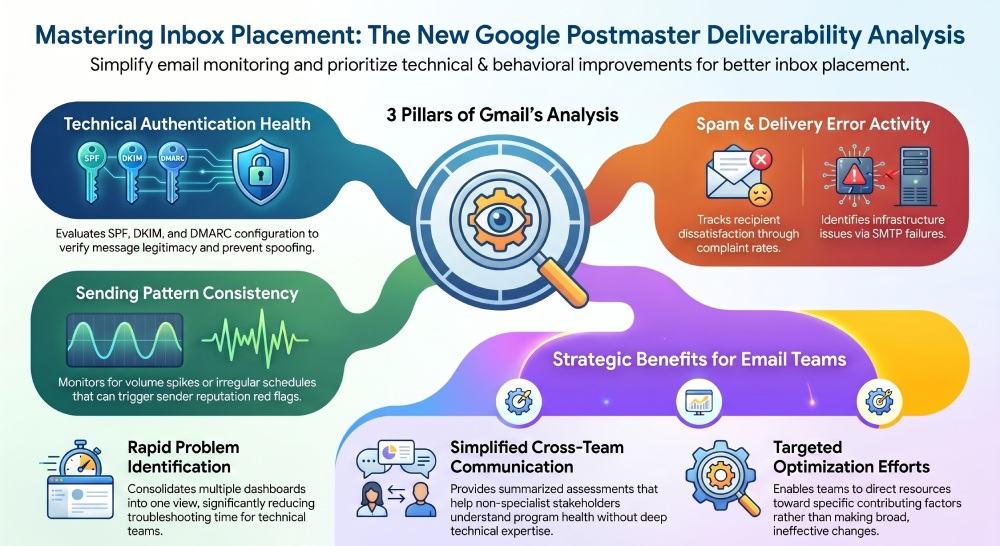
The analysis feature appears to draw from several important categories of deliverability data, including:
Authentication Health
Authentication remains a foundational requirement for successful email delivery. Gmail expects senders to properly configure authentication protocols that verify message legitimacy and protect recipients from spoofing attacks.
When authentication problems exist, they can negatively affect sender trust and reduce inbox placement opportunities.
Spam Complaint Activity
Spam complaints remain one of the strongest indicators of recipient dissatisfaction. Elevated complaint levels often signal that email content, targeting, or frequency is misaligned with subscriber expectations.
Monitoring complaint trends can help organizations identify issues before they become severe enough to impact overall deliverability.
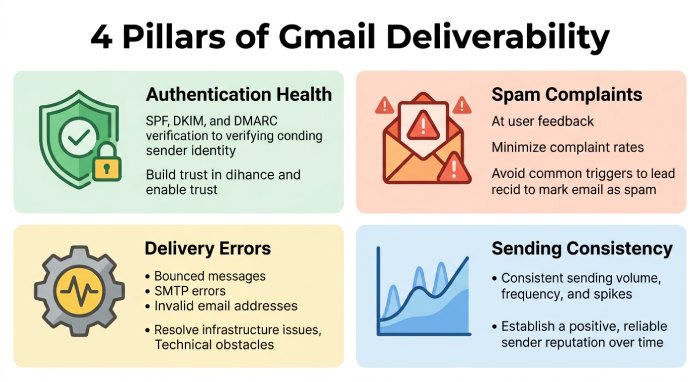
Delivery Errors
SMTP failures, temporary blocks, and other delivery issues provide insight into how receiving systems interact with incoming messages. Persistent delivery errors may indicate infrastructure problems, reputation concerns, or configuration issues that require investigation.
Sending Patterns and Consistency
Mailbox providers generally favor predictable sending behavior. Significant spikes in volume, sudden changes in traffic sources, or inconsistent mailing schedules can raise concerns and affect how messages are treated.
Maintaining stable sending practices helps establish long-term trust.
Benefits for Email Teams
The introduction of Deliverability Analysis offers several practical advantages for marketing, operations, and deliverability teams.
Faster Problem Identification
Instead of reviewing multiple reports individually, teams can quickly identify whether Gmail detects an overall issue. This can reduce troubleshooting time and help prioritize remediation efforts.
Better Communication Across Teams
Deliverability metrics are often difficult for non-specialists to interpret. A summarized assessment makes it easier for marketers, executives, and technical teams to understand the current state of an email program without needing deep expertise in deliverability.
More Focused Optimization Efforts
When deliverability concerns are identified, organizations can direct attention toward the specific factors contributing to poor performance rather than making broad, potentially ineffective changes.

What the Feature Does Not Replace
Although Deliverability Analysis provides valuable guidance, it should not be viewed as a complete replacement for deeper deliverability monitoring.
Successful email programs still require:
- Ongoing SPF, DKIM, and DMARC management
- List hygiene and subscriber engagement monitoring
- Bounce and complaint analysis
- Reputation tracking
- Campaign performance evaluation
- Deliverability testing across multiple mailbox providers
Gmail’s perspective is important, but it represents only one part of the overall email ecosystem.
Best Practices for Using Deliverability Analysis
Organizations can maximize the value of the new feature by incorporating it into their regular monitoring processes.
Review deliverability status consistently rather than waiting for performance problems to emerge. When issues are identified, investigate supporting metrics such as complaint rates, authentication compliance, and delivery errors. If authentication is where things break down, our DMARC questions answered resource covers the most common setup mistakes.
It is also important to compare Gmail insights with data from email service providers, DMARC reports, and internal analytics platforms. Pairing Postmaster data with a DMARC analyzer gives you a fuller picture of authentication failures across every receiver. Combining multiple data sources often produces a more accurate understanding of sender performance.
Finally, focus on recipient experience. Even the most technically compliant email program can struggle if subscribers do not find messages useful or relevant.
Looking Ahead
The addition of Deliverability Analysis reflects a broader industry trend toward more actionable deliverability reporting. As mailbox providers continue refining their filtering systems, senders need tools that not only display data but also help interpret it.
For email marketers, publishers, and businesses that depend on reliable inbox placement, the feature represents a useful step toward understanding how Gmail evaluates sender quality. By pairing these insights with strong authentication practices, audience-focused content, and responsible sending habits, organizations can build healthier email programs and improve long-term deliverability performance.
General Manager
General Manager of DuoCircle. Product strategy and commercial lead for DMARC Report's 2,000+ customer base.
LinkedIn Profile →Take control of your DMARC reports
Turn raw XML into actionable dashboards. Start free - no credit card required.