Top 11 Email Encryption Solutions For Secure Communication In 2026

Quick Answer
Discover the top 11 email encryption solutions for 2026 that help protect sensitive communications, prevent data breaches, ensure compliance, and provide secure email exchanges for businesses and individuals.
Email remains one of the most widely used business communication channels, but it is also a major target for cyberattacks, data breaches, and unauthorized access. As organizations handle increasing amounts of sensitive information, implementing reliable email encryption has become essential for protecting privacy, meeting compliance requirements, and reducing security risks. This guide explores the top 11 email encryption solutions for secure communication in 2026, highlighting their key features, security capabilities, and ideal use cases to help businesses and individuals choose the right platform for safeguarding email communications.
Why Email Encryption Matters in 2026: Key Threats, Compliance Requirements, and Business Use Cases
Email remains one of the most common attack vectors for cyberattack, phishing, malware delivery, identity theft, business email compromise, and data exfiltration. In 2026, email encryption is no longer optional for organizations that exchange sensitive information, customer records, contracts, financial documents, intellectual property, healthcare data, or legal files.
A strong email encryption service protects outgoing email communication and, in some cases, incoming email communication by converting readable content into ciphertext. Without the proper encryption keys, attackers cannot read the message, even if they intercept it during a man-in-the-middle attack or access a compromised mailbox.
The Core Security Problem: Plaintext Messages Are Still Common
Many organizations still send plaintext messages containing login credentials, payment details, employee data, or confidential attachments. This creates unnecessary email security risk, especially when users rely only on passwords or basic transport layer security.
Transport layer security, commonly known as TLS, helps protect messages in transit between mail servers. STARTTLS, standardized through IETF-related email security work, can upgrade an unencrypted SMTP connection to an encrypted one. However, TLS and STARTTLS do not always provide true end-to-end encryption because messages may still be readable on mail servers or by administrators.
That is why modern email encryption solutions increasingly combine TLS, S/MIME, PGP, web portal encryption, encrypted attachments, and policy-based encryption.
Compliance and Business Drivers
Regulatory compliance is a major reason companies invest in enterprise email encryption. Healthcare, financial services, government, education, and legal teams must often meet compliance standards such as HIPAA, GDPR, FINRA, PCI DSS, or CJIS. A single data breach involving sensitive information can trigger fines, lawsuits, reputational damage, and mandatory reporting.
For business use cases, email encryption software supports:
Secure Document Exchange
Teams can send a secure document, encrypted PDF, Zip archive, contract, medical record, invoice, or board report with stronger protection than standard email.
Identity and Trust Verification
A digital signature helps verify sender identity and message integrity. In S/MIME environments, a digital certificate issued by a Certificate Authority supports trust validation through public key infrastructure.
Automated Protection
Policy-based encryption can automatically encrypt messages containing regulated data, keywords, file types, or recipient domains—reducing dependence on user judgment.
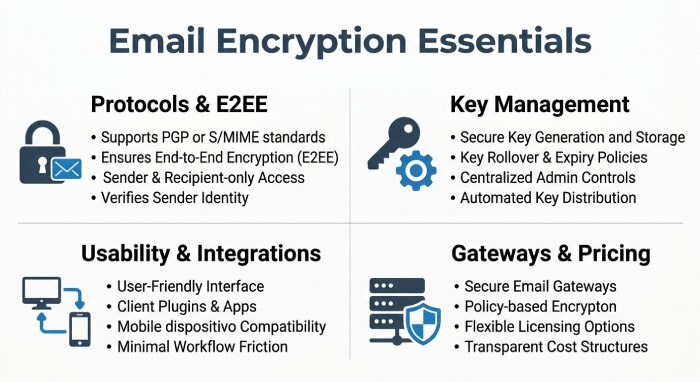
How to Choose an Email Encryption Solution: End-to-End Encryption, Key Management, Usability, Integrations, and Pricing
Choosing among email encryption solutions requires more than comparing prices. The best email encryption solution depends on security architecture, user experience, compliance needs, platform support, and administrative control.
End-to-End Encryption and Encryption Protocols
End-to-end encryption ensures only the sender and intended recipient can read the message. Many encrypted email platforms rely on public-key cryptography, where an asymmetric key pair includes a public key for encryption and a private key for decryption. PGP and S/MIME are the best-known models.
PGP was originally popularized by Phil Zimmermann and later associated with standards influenced by RSA Data Security and OpenPGP work. S/MIME uses public key infrastructure, a certificate authority, and a digital certificate to support encryption and a digital signature. Both are strong encryption protocols, but they differ in usability and administration.
Some platforms also use a symmetric key for message encryption and public-key cryptography to protect that key. This hybrid approach improves performance while preserving strong security.
Key Management and Administrative Control
Key management is one of the most important factors in email encryption software. Enterprises need lifecycle controls for encryption keys, recovery options, user provisioning, revocation, auditing, and policy-based encryption. Cloud encryption capabilities should also align with internal security policies and compliance standards.
For enterprise email encryption, look for:
Centralized Key Administration
Admins should be able to manage public and private keys, rotate keys, revoke compromised keys, and integrate with identity providers.
Policy-Based Encryption Rules
Policy-based encryption should detect sensitive information automatically, including protected health information, payment card data, legal terms, or confidential labels.
Secure Email Gateway Integration
A secure email gateway can apply encryption, malware scanning, DMARC, DKIM, anti-phishing controls, sandboxing, and data loss prevention before messages leave the organization. Pairing encryption with dedicated email authentication tools closes the gap that TLS alone leaves open.
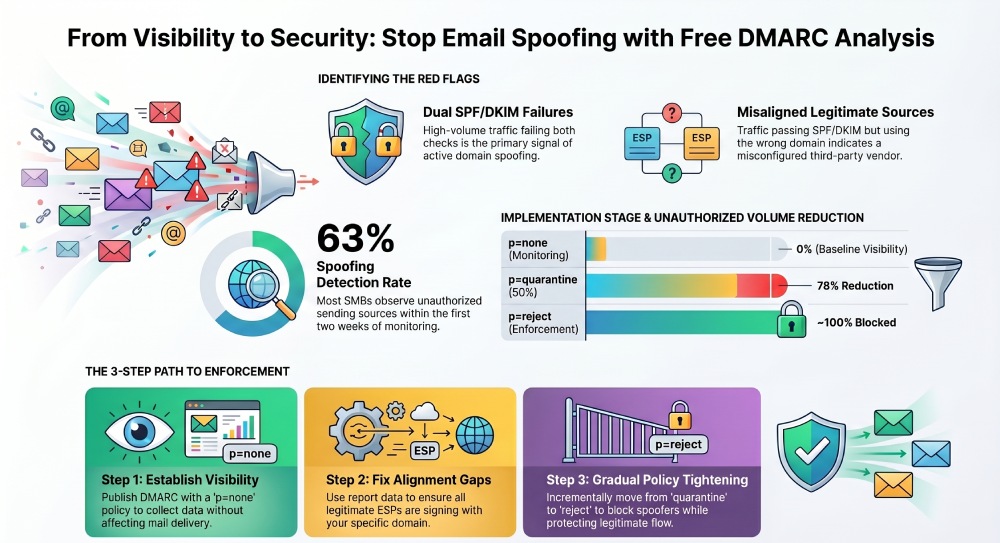
While email encryption protects message confidentiality, SPF, DKIM, and DMARC help ensure email authenticity by preventing unauthorized senders from impersonating trusted domains and reducing the risk of phishing attacks. Once those records are live, analyze your DMARC reports to see exactly who is sending mail as your domain. A DMARC record generator can produce a correctly formatted policy for organizations without dedicated IT staff.
Usability, Integrations, and Pricing
An email encryption service must be easy for employees and external recipients. If encrypted email is difficult to open, users will find workarounds.
Prioritize integrations with Outlook, Microsoft Office, Microsoft Cloud environments, Google Workspace, Mailbird, mobile clients, and API-driven workflows. Also consider whether recipients need accounts, whether web portal encryption is available, and whether encrypted attachments can be opened without friction.
Pricing varies by cloud-based service, user count, storage, compliance features, support, and administrative tooling.
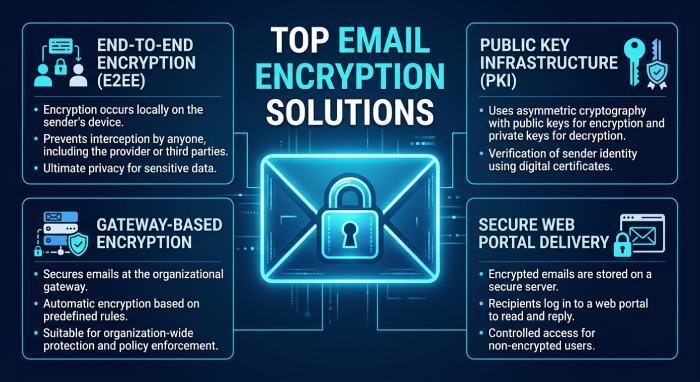
Top 11 Email Encryption Solutions for Secure Communication: Feature-by-Feature Overview
1. Fortinet FortiMail
Fortinet FortiMail is a strong option for enterprise email encryption and email security. It combines a secure email gateway, policy-based encryption, malware defense, anti-spam, phishing protection, and data loss prevention. FortiMail integrates well into broader Fortinet ecosystems, including FortiGate, FortiCNAPP, FortiGuard, AI-Driven SecOps, SecOps operations, and Phishing Email Analysis workflows. It is ideal for organizations that want email encryption solutions plus advanced threat protection.
2. Microsoft Purview Message Encryption
Microsoft Purview Message Encryption is a natural choice for Microsoft 365 and Office users. It supports encrypted email, rights management, policy-based encryption, and integration with Outlook. For companies already standardized on Microsoft Cloud, it offers good usability, centralized administration, and compliance reporting.
3. Google Workspace Client-Side Encryption
Google Workspace offers client-side encryption for selected plans, helping organizations protect sensitive information before it reaches Google servers. It is useful for companies that need cloud encryption, secure communication, and stronger control over data access in Workspace.
4. Proton Mail
Proton Mail is a privacy-focused encrypted email service with end-to-end encryption, zero-access architecture, encrypted attachments, and user-friendly apps. It is popular with individuals, journalists, small businesses, and teams that want simple encrypted email without complex infrastructure.
5. Virtru
Virtru provides email encryption software with strong usability, granular access controls, revocation, expiration, and audit logs. It integrates with Gmail, Google Workspace, and Outlook. Virtru is excellent for organizations that need secure document sharing and easy recipient access.
6. Proofpoint Email Encryption
Proofpoint offers enterprise-grade email security and email encryption solutions focused on threat protection, compliance, and data loss prevention. It is well suited for large organizations concerned about phishing, business email compromise, data exfiltration, and regulatory compliance.
7. Mimecast Secure Messaging
Mimecast provides encrypted email, web portal encryption, continuity, archiving, and secure email gateway capabilities. It is often evaluated alongside vendors recognized in Gartner research and Magic Quadrant-style market analysis for email security platforms.
8. Cisco Secure Email Encryption
Cisco Secure Email Encryption combines gateway-based controls, policy-based encryption, data protection, and threat intelligence. It is a good fit for organizations already using Cisco security infrastructure and needing scalable enterprise email encryption.
9. Zix / OpenText Email Encryption
Zix, now part of OpenText, is a mature email encryption service with automated policy enforcement, transparent delivery, and compliance-focused controls. It is commonly used in healthcare, finance, and regulated industries.
10. Paubox
Paubox specializes in HIPAA-compliant encrypted email for healthcare. It emphasizes ease of use by allowing recipients to read secure messages without portals in many cases. It is a strong choice for clinics, hospitals, and healthcare SaaS (Software as a Service) providers.
11. Mailfence
Mailfence offers encrypted email with OpenPGP support, digital signature features, calendar, contacts, and document storage. It appeals to privacy-conscious individuals and small teams that want PGP-based email encryption without relying on large Cloud platforms.
Comparison Table: Best Email Encryption Tools by Security Level, Platform Support, Ease of Use, and Ideal User
| Solution | Security Level | Platform Support | Ease of Use | Ideal User |
|---|---|---|---|---|
| Fortinet FortiMail | Very high | Enterprise mail systems, gateways, hybrid environments | Moderate | Enterprises needing email security, FortiGuard intelligence, and policy-based encryption |
| Microsoft Purview Message Encryption | High | Outlook, Office, Microsoft 365 | High | Microsoft-centric businesses |
| Google Workspace Client-Side Encryption | High | Gmail, Workspace | Moderate | Google Workspace organizations |
| Proton Mail | High | Web, mobile, desktop bridge | High | Individuals and privacy-focused teams |
| Virtru | High | Gmail, Outlook, Workspace | Very high | SMBs and regulated teams |
| Proofpoint Email Encryption | Very high | Enterprise email platforms | Moderate | Large enterprises and compliance-heavy sectors |
| Mimecast Secure Messaging | High | Cloud and gateway environments | Moderate | Organizations needing archiving and secure messaging |
| Cisco Secure Email Encryption | Very high | Cisco security ecosystem | Moderate | Large security-mature enterprises |
| Zix / OpenText | High | Microsoft, Google, enterprise mail | High | Healthcare, finance, legal |
| Paubox | High | Healthcare email environments | Very high | HIPAA-regulated providers |
| Mailfence | Medium-high | Web, mobile, OpenPGP tools | Moderate | Individuals and small teams |
Final Recommendations: Best Email Encryption Solutions for Enterprises, Small Businesses, Healthcare, Legal Teams, and Individuals
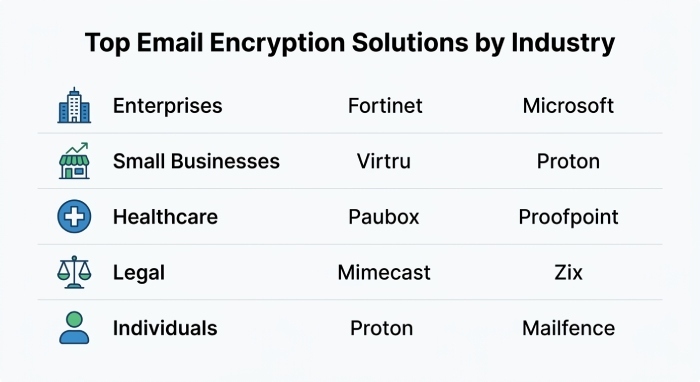
Best for Enterprises
Fortinet FortiMail, Proofpoint, Cisco Secure Email Encryption, and Microsoft Purview are leading choices for enterprise email encryption. Fortinet is especially compelling when email encryption must operate alongside firewall protection, FortiGate, FortiCNAPP, FortiGuard threat intelligence, AI-Driven SecOps, and broader SecOps workflows.
Enterprises should conduct an email risk assessment before selecting email encryption software. Review attack vectors, PST File exposure, archive requirements, VoIP-related communications, phishing rates, malware incidents, business email compromise history, and compliance standards.
Best for Small Businesses
Virtru, Proton Mail, Microsoft Purview, and Mailfence are practical email encryption solutions for smaller organizations. They balance secure communication, usability, and price without requiring deep cryptographic expertise. For teams using Outlook, Mailbird, or Microsoft Office, integration quality should be a key deciding factor.
Best for Healthcare
Paubox, Zix / OpenText, Fortinet FortiMail, and Proofpoint are strong options for healthcare organizations. These platforms help protect sensitive information, reduce data breach exposure, support regulatory compliance, and secure encrypted attachments such as PDF records, encrypted PDF forms, lab reports, and secure document exchanges.
Best for Legal Teams
Legal teams should prioritize end-to-end encryption, digital signature support, audit logs, access revocation, web portal encryption, and strong key management. Virtru, Mimecast, Microsoft Purview, and Zix / OpenText are well suited for law firms handling privileged communications, discovery files, Zip archives, and client evidence.
Best for Individuals
Proton Mail and Mailfence are strong encrypted email options for individuals who want privacy, PGP support, and protection from identity theft. Users who frequently exchange secure communication with nontechnical recipients should choose an email encryption service that minimizes setup complexity while still using public-key cryptography, strong encryption protocols, and reliable digital signature verification.
General Manager
General Manager of DuoCircle. Product strategy and commercial lead for DMARC Report's 2,000+ customer base.
LinkedIn Profile →Take control of your DMARC reports
Turn raw XML into actionable dashboards. Start free - no credit card required.