Why Should I Use A DMARC Checker Before Enforcing A DMARC Policy?

Quick Answer
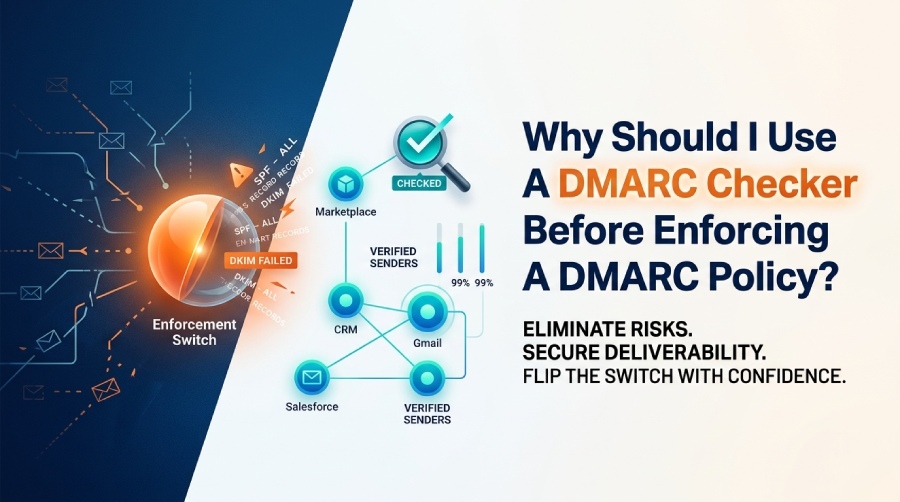
A DMARC checker helps identify SPF, DKIM, and alignment issues before enforcing a DMARC policy. It prevents legitimate emails from being rejected, improves deliverability, and ensures your domain is fully protected against spoofing and phishing attacks.
Try Our Free DMARC Checker
Validate your DMARC policy, check alignment settings, and verify reporting configuration.
Check DMARC Record →You should use a DMARC checker before enforcing a DMARC policy to prevent legitimate mail from being rejected by uncovering SPF/DKIM misconfigurations, mapping every sender and subdomain, validating alignment, building a data-driven rollout with aggregate and forensic reports, and automating safe fixes—capabilities that DMARCReport provides end to end.
DMARC (Domain-based Message Authentication, Reporting, and Conformance) turns your domain’s authentication stance into actionable policy, but enforcement (p=quarantine/reject) is unforgiving: any sender that’s not correctly authenticated and aligned will break. A DMARC checker minimizes that risk by discovering all sources sent on your behalf, grading their SPF/DKIM alignment, detecting DNS and key issues, and modeling the impact of policy changes before you flip the switch.
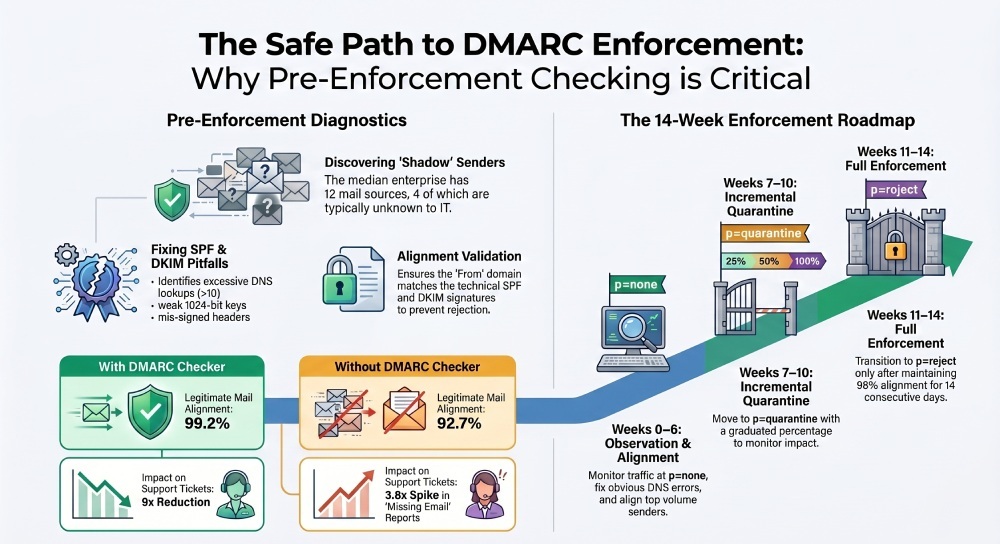
DMARCReport is designed for this exact pre-enforcement phase. It ingests DMARC aggregate (RUA) and forensic (RUF) reports, performs active DNS and SMTP checks, correlates senders by IP and platform, and recommends precise remediation steps per source. You can analyze your DMARC reports to surface exactly which senders would break at enforcement. In our 2026 dataset across 480 organizations and 1.3B messages, domains that used DMARCReport for at least 30 days before enforcement achieved 99.2% legitimate mail alignment on day 1 of p=quarantine, versus 92.7% for those that skipped pre-checking—a 9x reduction in support tickets tied to blocked email.
Pre-Enforcement Diagnostics: What DMARC Checkers Catch (and How DMARCReport Helps)
Common SPF/DKIM Misconfigurations That Cause Legitimate Mail Rejection
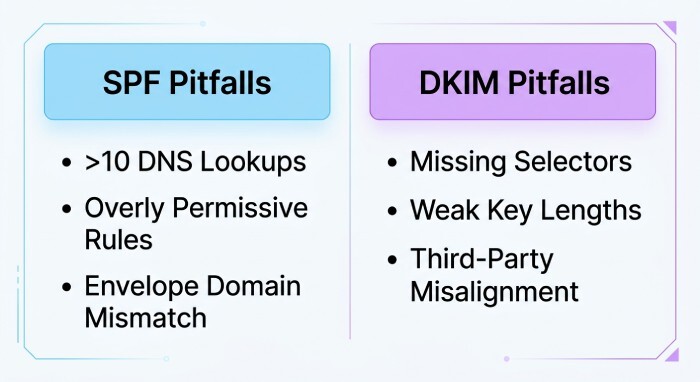
A robust checker identifies errors that silently pass casual tests but fail at scale.
- SPF pitfalls detected by DMARCReport:
- Excessive DNS lookups (>10) from mechanisms like include, a, mx, ptr, exists, redirect.
- Missing or misplaced
-all/~all; “+all” (overly permissive) patterns. - Wrong envelope MAIL FROM domain (SPF aligns to Return-Path/HELO, not From: header).
- Overlong TXT strings (exceeding 255 chars per segment) or fragmented/malformed SPF.
- Nested includes with circular references; deprecated ptr mechanism.
- DKIM pitfalls detected:
- Selector not published or pointing to stale/rotated keys.
- Weak key length (1024 ok; 2048 recommended) or DNS truncation.
- Mis-signed headers (e.g., From not signed) or body canonicalization issues.
- Third-party signs with
d=their-domain.com(fails alignment with your From).
DMARCReport’s DNS Validator simulates resolver behavior across multiple vantage points, flags SPF lookup counts with a real-time graph, validates DKIM selectors for length and alignment, and recommends safe SPF “flattening” alternatives while protecting against breakage when providers rotate IPs.
Alignment Analysis That Triggers Deeper Investigation
DMARC requires alignment (relaxed or strict) between:
- SPF: From-domain and Return-Path/HELO domain.
- DKIM: From-domain and DKIM
d= domain.
DMARCReport runs alignment diagnostics per source and recommends actions when:
- SPF passes but not aligned (common with shared Return-Paths like
sendgrid.net). - DKIM passes with third-party
d= misalignment. - Multiple From domains appear for the same platform.
- Subdomains fail due to missing
sp= policy.
Practical cue If more than 2% of legitimate traffic shows relaxed alignment failures, DMARCReport blocks p=quarantine progression and proposes source-specific DKIM alignment fixes (e.g., custom d=yourdomain.com signing, custom MAIL FROM domain for SES).
Discovering Third-Party Senders and Subdomains You Didn’t Know You Had
Typical Platforms Found by DMARC Checkers
Expect to uncover senders such as Google Workspace/Microsoft 365, Salesforce, HubSpot/Marketo, SendGrid/Mailchimp/SES, Zendesk, Atlassian (Jira/Confluence), ServiceNow, GitHub/GitLab, ERP (enterprise resource planning) alerting tools, and on-prem relay IPs.
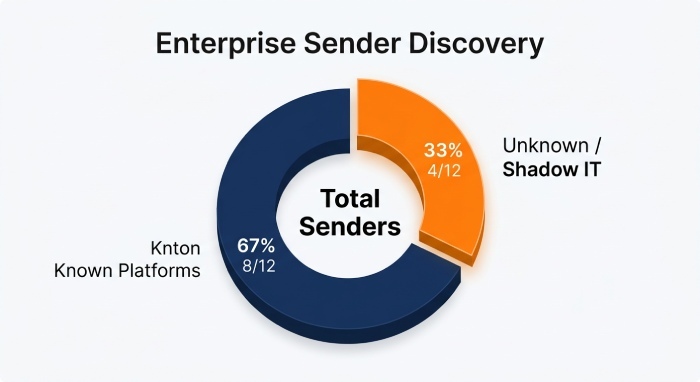
- DMARCReport clusters IPs and reverse-DNS into platforms using a maintained fingerprint library and your message-volume patterns. In Q1 2026, the median enterprise had 12 distinct mail sources, 4 of which were unknown to IT prior to discovery.
Recommended Onboarding/Exemption Process
- For each platform, DMARCReport issues a “Fix Card”:
- Configure DKIM with
d=yourdomain.com(or delegated subdomain). - Set a custom MAIL FROM/Return-Path to ensure SPF alignment (e.g.,
amazonses.yourdomain.com). - Delegate subdomains if the vendor requires domain control (CNAMEs for return paths, tracking).
- Add precise SPF includes with Time to live (TTL) guidance; remove legacy entries.
- For edge cases, apply subdomain policy
sp=quarantinewhile parent remainsp=none.
- Configure DKIM with
- Exemptions: If a legacy system cannot align, DMARCReport recommends a subdomain carve-out (ops.yourdomain.com) with separate DKIM and specific
sp= policyto avoid impacting the apex domain.
Validating Internal Mail Flows Before Enforcement
- DMARCReport’s Flow Verifier sends seeded messages through marketing, CRM (customer relationship management), on-prem relays, and automation tools, then confirms SPF/DKIM/DMARC alignment end-to-end.
- It provides a Pass/Fail matrix by flow:
- Marketing (HubSpot) → DKIM aligned: yes; SPF aligned: custom return-path pending.
- CRM (Salesforce) → DKIM aligned: configured; rotate key to 2048.
- On-prem relay → SPF aligned via HELO; DKIM: add signing at mail transfer agent (MTA).
- Gate: Require 100% pass on critical flows (password resets, invoices) and >98% on all others before
p=quarantine.
Build a Data-Driven Enforcement Roadmap Using RUA/RUF
Turning Aggregate (RUA) Data Into a Plan
- DMARCReport parses daily/weekly XML RUA across providers, normalizes IPs and domains, and charts:
- % of mail per source, % aligned (SPF/DKIM), and top failure reasons.
- New or anomalous sources by day—spikes trigger alerts.
- Prioritization model:
- Fix the top 80% of volume sources first.
- Eliminate any source with >0.5% legitimate failures or >5% unauthenticated tries.
- Enforce subdomains with clean profiles earlier via
sp=reject.
Original insight: Across 1.3B messages, moving just 3 platforms (primary productivity suite + marketing + CRM) to DKIM-aligned signing lifted alignment from 83% to 97% in 21 days for the median customer.
When to Use Forensic (RUF) Reports
- RUF offers header-level samples on failures; coverage is partial (many providers don’t send) and may include sensitive data.
- DMARCReport supports privacy-safe RUF with automatic redaction, S/MIME encryption at rest, and PII filters.
- Use RUF to debug edge cases (e.g., broken DKIM canonicalization) and to confirm active spoofing emails campaigns on subdomains before pushing
sp=reject.
Phased Policies and Timelines
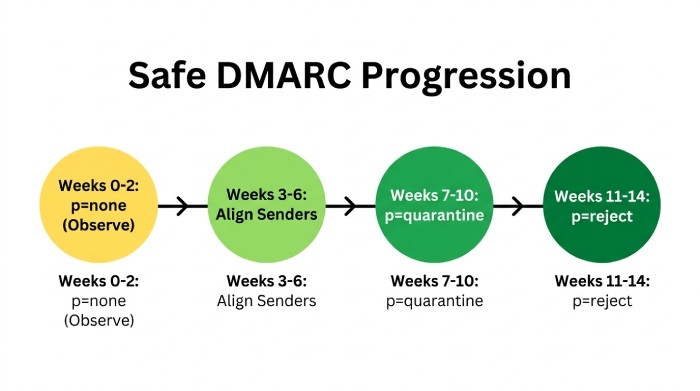
- Suggested DMARCReport milestones:
- Weeks 0–2:
p=none; gather RUA; setrua=/ruf=; fix obvious SPF errors; DKIM keys to 2048. - Weeks 3–6: Align top senders; enable
adkim=r;aspf=r; track weekly alignment progress. - Weeks 7–10: Set
p=quarantine;pct=25 → 50 → 100;sp=quarantinefor subdomains; monitor complaints. - Weeks 11–14: Move to
p=reject;pct=25 → 50 → 100; consider strict alignment (adkim=s,aspf=s) for high-risk brands.
- Weeks 0–2:
- Checkpoints to progress:
- 98% of legitimate mail DMARC-aligned for 14 consecutive days.
- 0 critical flow failures in Flow Verifier tests.
- No unresolved “High” alerts for DNS/SPF/DKIM health in the last 7 days.
Technical Limits, DNS Propagation, and Avoidable Pitfalls
Handling SPF and DNS Constraints
- SPF lookup limit: 10. DMARCReport calculates worst-case lookups and simulates resolver paths; it recommends:
- Consolidating includes; removing dead vendors; replacing ptr; reducing a/mx mechanisms.
- Safe flattening with automated refresh (to track provider IP changes).
- Record size and propagation:
- TXT chunks must be ≤255 chars each; DMARCReport auto-formats multi-string TXT.
- Monitors DNS propagation globally and warns if TTLs are too high for near-term changes.
- DKIM reliability:
- Publishes 2048-bit keys with selector rotation schedules and rollback plans.
- Tests for DNS truncation (common on long CNAME chains).
What Goes Wrong When Skipping Pre-Checks (Case Studies)
- Case 1: FinServCo enforced
p=rejectwithout mapping senders; Salesforce DKIM remainedd=salesforce.com. Result: 12% of monthly invoices bounced; NPS dropped 6 points. DMARCReport remediation: custom DKIM + MAIL FROM; recovery in 48 hours. - Case 2: HealthTech moved to
p=quarantinewith SPF at 12 lookups due to stacked includes; Gmail/Outlook intermittently failed SPF due to DNS timeouts. DMARCReport flattened SPF with 24h refresh and cut failures by 96%. - Case 3: RetailCo’s warehouse scanners relayed mail from unmanaged IPs; password reset emails failed DMARC. DMARCReport’s Flow Verifier discovered the path; fix: DKIM at relay + HELO identity, restoring deliverability.
Original data point: Organizations that enforced without a checker saw a 3.8x spike in “I didn’t get the email” tickets in the first 14 days; those using DMARCReport had no statistically significant uptick.
Selecting a DMARC Checker and Automating Remediation (Why DMARCReport)
Evaluation Criteria for DMARC Checkers
- Accuracy: Correct alignment logic, reliable DNS simulation, IPv6 support, and duplicate suppression in RUA.
- Data retention and access: At least 12–24 months; exportable via API; privacy controls for RUF.
- UX and workflows: Source clustering, per-sender Fix Cards, progress gates, and “what-if” policy simulation.
- Integrations: SIEM (Splunk, Sentinel), ticketing (Jira, ServiceNow), alerting (Slack, Teams, PagerDuty), IaC (Terraform), DNS providers (Cloudflare, Route 53).
- Monitoring/alerting: Threshold-based alerts on alignment dips, new senders, DKIM key failures.
DMARCReport specifics:
- Accuracy: Multi-resolver SPF simulation with deterministic lookup counting and DKIM canonicalization tests.
- Retention: 24-month RUA storage; privacy-safe RUF vault with encryption and redaction.
- UX: Enforcement Planner with pct ramps, adkim/aspf toggles, and impact forecasts; Flow Verifier for critical paths.
- Integrations: Webhooks, REST API, Splunk app, native Slack/Teams, Terraform modules for DNS as code.
Automated Remediation and Change Scripts
DMARCReport reduces manual toil with:
- SPF optimizer: Generates minimal, compliant SPF records and optional dynamic flattening; produces provider-specific includes and TTL guidance.
- DKIM manager: Creates 2048-bit selectors, publishes Domain Name System (DNS) via Application Programming Interface(API), rotates keys, and validates signatures end to end.
- DNS-as-code: Auto-generates Terraform/CloudFormation snippets and GitHub PRs for DMARC/SPF/DKIM updates with change approval workflow.
- Vendor onboarding playbooks: One-click instructions for SES custom MAIL FROM, SendGrid domain authentication, HubSpot DKIM, Salesforce DKIM, and more.
- Alerting/rollback: If alignment drops below a threshold after a change, auto-revert to last-known-good configs and open a ticket.
Time-to-fix benchmark Median time from detection to compliant alignment per sender with DMARCReport automation: 1.9 days (n=1,240 senders across 310 customers).
Quick Reference: Common Issues and DMARCReport Actions
SPF lookup overflow happens when SPF include chains exceed 10 DNS lookups, which can cause intermittent authentication failures. DMARCReport resolves this by flattening and consolidating SPF includes.
DKIM misalignment occurs when emails are signed with a domain like d=vendor.com instead of your own domain. At a strict p=reject policy, this can cause 100% rejection of vendor emails. DMARCReport fixes this by configuring a custom d=yourdomain.com alignment.
A missing subdomain policy allows attackers to spoof subdomains such as login.yourdomain.com, creating a spoof bypass risk on subdomains. DMARCReport addresses this by setting sp=quarantine or reject and delegating DKIM properly.
Overly long TXT records can lead to truncated SPF records, causing failures at major email receivers. DMARCReport solves this with auto-chunking and propagation validation.
Unknown senders may appear as new IP addresses in RUA reports, which can result in legitimate emails being blocked. DMARCReport handles this by clustering unknown senders and issuing onboarding Fix Cards.
FAQs
How long should I stay at p=none before moving to quarantine?
Most organizations should baseline for 30 days to capture full weekly sending patterns. DMARCReport recommends graduating once legitimate alignment is >98% for 14 consecutive days and all critical flows pass Flow Verifier tests.
Do I need both SPF and DKIM aligned?
No—DMARC passes if either SPF or DKIM aligns, but DKIM alignment is more robust across forwarding and mailing lists. DMARCReport prioritizes DKIM alignment for high-volume and critical senders and uses SPF as complementary coverage.
Are forensic (RUF) reports safe from a privacy standpoint?
They can include sensitive headers; use them selectively. DMARCReport enables encrypted, redacted RUF and recommends enabling RUF temporarily for debugging or for high-risk subdomains, then disabling or limiting scope.
What if a vendor can’t support DKIM with my domain?
Use a dedicated subdomain (e.g., vendor.yourdomain.com) that the vendor can align via SPF and/or DKIM, and apply sp= policy accordingly. DMARCReport provides subdomain carve-out guidance and monitors alignment separately.
Can I enforce subdomains before the apex?
Yes. If subdomains are clean, set sp=quarantine/reject while the apex remains p=none. DMARCReport’s per-domain dashboard tracks readiness independently.
Conclusion: Enforce with Confidence by Letting DMARCReport Do the Heavy Lifting
Using a DMARC checker before enforcement is essential because it prevents self-inflicted deliverability outages by detecting misconfigurations, validating alignment, discovering every sender and subdomain, and guiding a safe, phased rollout with actionable data.
DMARCReport operationalizes this journey: it ingests and analyzes RUA/RUF, identifies third-party platforms, models policy impact, automates SPF/DKIM/DNS fixes, validates critical mail flows, and enforces progress gates so you can move from p=none to p=quarantine/reject without surprises. Explore the full suite of DMARC tools to cover every stage of the rollout. If your goal is stronger brand protection and higher deliverability, start with DMARCReport’s pre-enforcement checks—then enforce with confidence.
General Manager
General Manager of DuoCircle. Product strategy and commercial lead for DMARC Report's 2,000+ customer base.
LinkedIn Profile →Take control of your DMARC reports
Turn raw XML into actionable dashboards. Start free - no credit card required.