Blockchain and Email Security: Exploring the Future of Trusted Digital Communication

Quick Answer
Blockchain and email security are reshaping digital communication by improving trust, transparency, and data integrity. By using decentralized verification methods, blockchain can help prevent email spoofing, phishing, and fraud, creating a more secure and reliable future for online messaging.
Email remains one of the most widely used communication tools in the world. Businesses, government agencies, and individuals rely on it every day to exchange information, send documents, and conduct transactions. Unfortunately, email is also one of the most common targets for cybercriminals. Phishing attacks, domain spoofing, malware distribution, and account compromise continue to threaten organizations of every size.
As cybersecurity challenges evolve, organizations are exploring emerging technologies that can strengthen trust and authenticity in digital communications. One technology frequently mentioned in these discussions is blockchain. Known primarily for its role in cryptocurrency ecosystems, blockchain offers characteristics such as decentralization, transparency, and tamper resistance that may have applications far beyond digital assets.
This article examines how blockchain could contribute to stronger email security, the benefits it may offer, the obstacles it faces, and what the future could look like for blockchain-enabled email systems.
Understanding Blockchain Fundamentals
Blockchain is a distributed ledger technology that stores information across a network of participating computers rather than in a single centralized database. Every transaction or record is grouped into a block and linked to previous blocks through cryptographic methods, creating a chain of verified information.
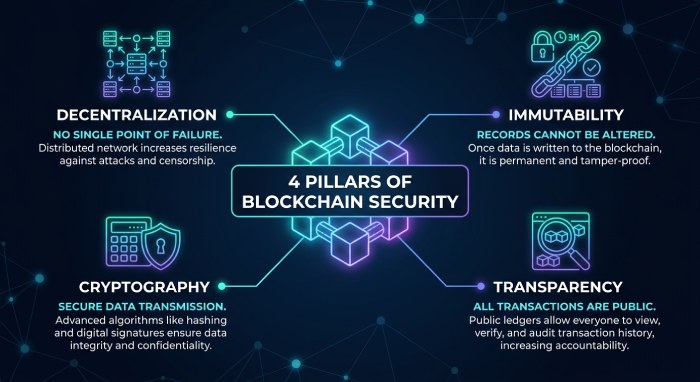 Several characteristics make blockchain noteworthy from a security perspective:
- Decentralization: Traditional systems often rely on centralized servers or databases. Blockchain distributes records across multiple participants, reducing dependence on a single authority.
- Immutability: Once information has been validated and added to the blockchain, altering it becomes extremely difficult without network-wide consensus. This creates a reliable record of events and transactions.
- Cryptographic Verification: Blockchain systems use advanced cryptographic techniques to verify identities, secure records, and protect data integrity.
- Transparency and Auditability: Depending on the implementation, blockchain can provide clear records of actions and transactions, making it easier to track activity and verify authenticity.
These properties have led researchers and technology companies to explore blockchain’s potential in cybersecurity applications, including email protection.
Why Email Security Remains a Major Concern
Despite decades of development, email continues to present significant security challenges. Attackers frequently exploit weaknesses in email systems to deceive users, steal credentials, distribute malware, or impersonate trusted organizations.
Common email-based threats include:
- Phishing: Cybercriminals send deceptive messages designed to trick recipients into revealing passwords, financial information, or other sensitive data.
- Business Email Compromise: Attackers impersonate executives, vendors, or trusted contacts to manipulate employees into transferring funds or disclosing confidential information.
- Domain Spoofing: Fraudsters forge email headers to make messages appear as though they originated from legitimate domains.
- Malware Delivery: Malicious attachments and links remain a popular method for infecting devices and gaining unauthorized access to networks.
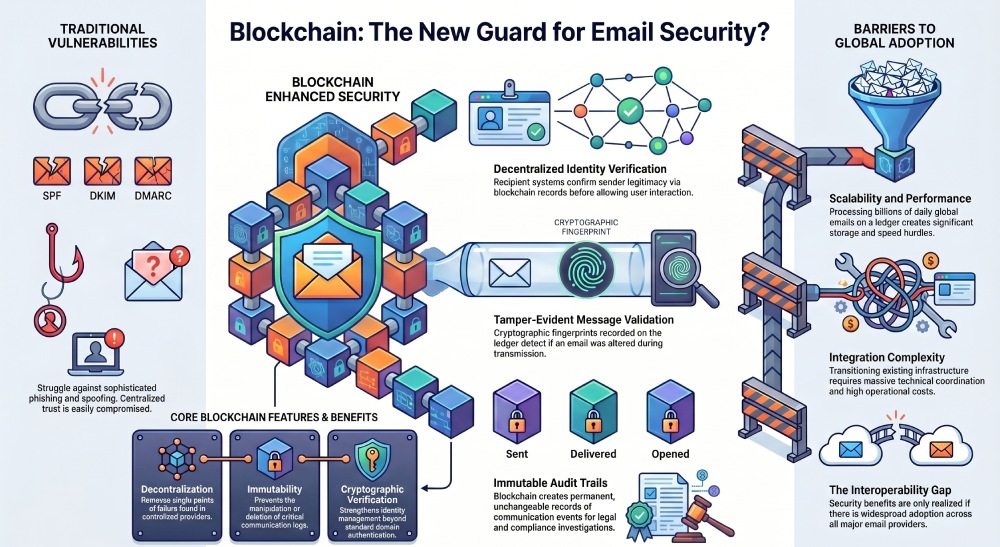
Although authentication standards such as SPF, DKIM, and DMARC authentication help reduce these risks, organizations still struggle with implementation complexity, misconfigurations, and evolving attack techniques.
How Blockchain Could Improve Email Security
Blockchain is not a replacement for existing email security controls. However, it may strengthen certain aspects of authentication, verification, and trust management.
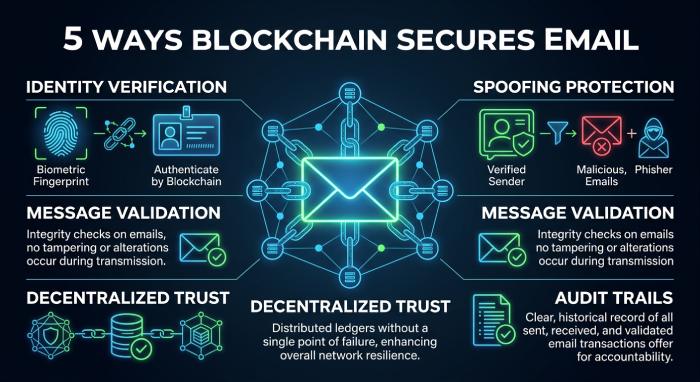
Enhanced Identity Verification
One potential application involves decentralized identity management. Instead of relying exclusively on centralized certificate authorities or service providers, blockchain-based systems could maintain verifiable records of sender identities.
Recipients could confirm whether a sender’s identity has been authenticated through a trusted blockchain network before engaging with the message. This can be done using a public or private blockchain, depending on the level of privacy and control required.
Stronger Protection Against Spoofing
Domain spoofing remains a significant challenge because attackers attempt to mimic legitimate organizations. Blockchain-based identity records could make it easier to validate sender legitimacy and identify unauthorized senders.
By comparing incoming messages against trusted blockchain records, email systems may gain an additional layer of verification beyond traditional authentication protocols.
Tamper-Evident Message Validation
Blockchain could provide mechanisms for verifying whether an email or attachment has been altered after transmission.
A cryptographic fingerprint of a message could be recorded on a blockchain. Upon receipt, the recipient’s system could compare the message against the recorded fingerprint to confirm its integrity.
Decentralized Trust Models
Traditional email infrastructure often depends on centralized providers and certificate authorities. Blockchain introduces the possibility of distributed trust models that reduce reliance on individual entities.
This approach may help decrease the impact of single points of failure and improve resilience against targeted attacks.
Improved Audit Trails
Organizations frequently need detailed records of communications for compliance, legal, or investigative purposes.
Blockchain-based logging systems could create permanent records of email-related events, helping organizations establish clear audit trails while reducing the risk of record manipulation.
Potential Benefits for Organizations
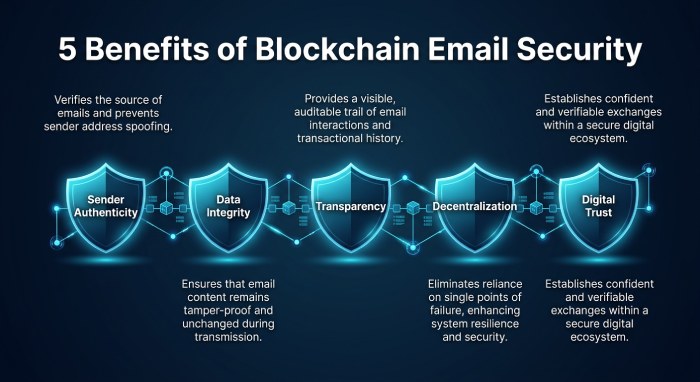 If successfully implemented, blockchain-enabled email security solutions could provide several advantages.
- Greater Confidence in Sender Authenticity: Organizations may be able to verify sender identities more reliably, reducing exposure to phishing and impersonation attacks.
- Improved Data Integrity: Blockchain verification mechanisms can help ensure that messages remain unchanged throughout transmission and storage.
- Enhanced Transparency: Distributed ledgers provide visibility into authentication events and verification processes, making investigations and audits easier.
- Reduced Dependence on Centralized Infrastructure: Decentralized verification systems may increase resilience and lower risks associated with single-provider failures.
- Stronger Trust in Digital Communications: Reliable verification methods can improve confidence among customers, partners, and employees who depend on email for critical business interactions.
Challenges and Limitations
While blockchain presents interesting possibilities, several practical obstacles must be addressed before widespread adoption becomes realistic.
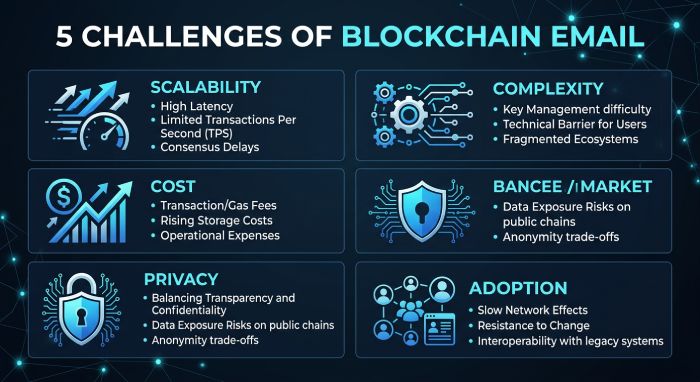
Scalability Concerns
Global email traffic involves billions of messages every day. Recording large volumes of email-related information on a blockchain could create significant performance and storage challenges.
Implementation Complexity
Integrating blockchain technology into existing email infrastructure would require substantial technical changes and coordination among providers.
Cost Considerations
Building, maintaining, and operating blockchain-based systems may introduce additional expenses compared to traditional email security controls.
Privacy Requirements
Organizations must carefully balance transparency with privacy obligations. Sensitive communication data cannot simply be exposed on public ledgers.
Industry Adoption
The effectiveness of blockchain-based email security depends heavily on widespread participation. Without broad adoption among providers and organizations, interoperability challenges could limit effectiveness.
Emerging Use Cases
Several technology companies and developers have explored blockchain-powered communication platforms and decentralized messaging solutions.
Some projects focus on:
- Decentralized identity verification
- Secure peer-to-peer communication
- Blockchain-based encryption management
- Immutable communication records
- Web3-compatible messaging systems
While these initiatives remain relatively early in development, they demonstrate growing interest in combining blockchain capabilities with secure digital communication.
The Role of Existing Security Standards
Even if blockchain becomes more widely adopted, established email security technologies will remain essential. Teams new to these standards can start with our common DMARC questions.
Organizations should continue implementing:
- SPF (Sender Policy Framework)
- DKIM (DomainKeys Identified Mail)
- DMARC (Domain-based Message Authentication, Reporting, and Conformance)
- Multi-factor authentication
- Security awareness training
- Endpoint protection
- Email filtering and threat detection systems
Blockchain is most likely to serve as a complementary layer rather than a complete replacement for existing defenses. A DMARC analyzer helps you monitor these authentication results and catch spoofing attempts early.
Looking Ahead
The future of email security will likely involve a combination of traditional authentication methods, advanced threat detection, artificial intelligence, and emerging technologies such as blockchain.
As cyber threats become increasingly sophisticated, organizations must continue exploring new approaches that strengthen trust, identity verification, and communication integrity. Blockchain offers several promising capabilities that may contribute to these goals, particularly in areas involving authentication, tamper resistance, and decentralized trust.
Although technical and operational challenges remain, ongoing innovation may eventually make blockchain an important component of next-generation email security architectures.
Conclusion
Email continues to play a critical role in personal and business communication, making its protection a top cybersecurity priority. Blockchain technology introduces new possibilities for verifying identities, protecting message integrity, and creating more resilient trust frameworks.
While it is not a standalone solution to all email security challenges, blockchain has the potential to complement existing protections and help organizations build more trustworthy communication environments. As adoption and technological maturity increase, blockchain may become a valuable addition to the broader email security ecosystem.
General Manager
General Manager of DuoCircle. Product strategy and commercial lead for DMARC Report's 2,000+ customer base.
LinkedIn Profile →Take control of your DMARC reports
Turn raw XML into actionable dashboards. Start free - no credit card required.