Email Authentication and Deliverability: How SPF, DKIM, and DMARC Enforcement Directly Impacts Your Inbox Placement Rates

Quick Answer
Email marketing delivers an average return of $36 to $42 for every dollar spent, consistently outperforming paid ads, social media, and SEO as the highest-ROI marketing channel available (Litmus, Statista, Omnisend). But that return depends entirely on one thing: whether your emails actually reach the inbox.
Related: Free DMARC Checker
Try Our Free DMARC Checker
Validate your DMARC policy, check alignment settings, and verify reporting configuration.
Check DMARC Record →Email marketing delivers an average return of $36 to $42 for every dollar spent, consistently outperforming paid ads, social media, and SEO as the highest-ROI marketing channel available (Litmus, Statista, Omnisend). But that return depends entirely on one thing: whether your emails actually reach the inbox. And in 2026, reaching the inbox depends on email authentication more than at any point in the channel’s history.
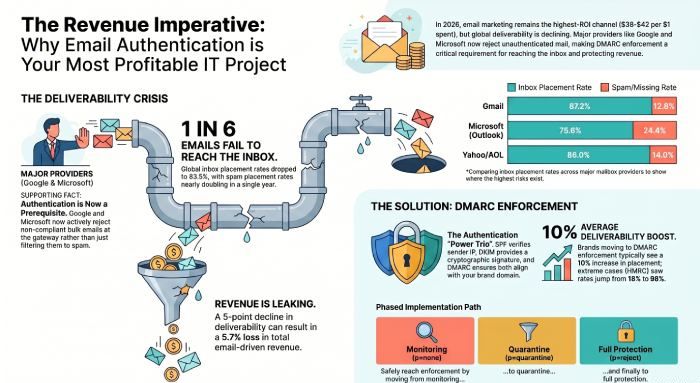
According to Validity’s 2025 Email Deliverability Benchmark Report, the most comprehensive analysis of global inbox placement rates available, one in six legitimate marketing emails now fails to reach the inbox. Global inbox placement rates declined to 83.5% in 2024, down from 84.8% the prior year. Spam placement nearly doubled over the course of the year, rising from 4.5% in Q1 to 8.6% in Q4. And the single biggest factor separating emails that land in the inbox from those that land in spam? Sender reputation, which is built on the foundation of email authentication.
This post connects the dots between SPF, DKIM, and DMARC enforcement on one side and inbox placement, sender reputation, and revenue on the other, using data from Validity, Sinch Mailgun, Valimail, Google, and APWG to build the business case for email authentication that resonates with marketers, operations teams, and SMB owners. (New to the terms? Our guide to SPF vs DKIM vs DMARC breaks them down.)
The Deliverability Landscape in 2026: The Numbers You Need to Know
Validity’s benchmark report, based on their proprietary data network analyzing billions of emails, provides the most granular view of global deliverability performance. Here are the key findings for 2024:
| Mailbox Provider | Inbox Rate | Spam Rate | Missing Rate |
|---|---|---|---|
| Gmail (48.5% market share) | 87.2% | 6.8% | 6.0% |
| Microsoft (16.8% market share) | 75.6% | 14.6% | 9.8% |
| Yahoo/AOL (14.0% market share) | 86.0% | 4.8% | 9.2% |
| Apple (3.8% market share) | 76.3% | 14.3% | 9.4% |
| Global Average | 83.5% | 6.7% | 9.8% |
Source: Validity 2025 Email Deliverability Benchmark Report
Several things stand out. Gmail, which now accounts for nearly half of all consumer mailboxes globally, saw an unexpected deliverability decline of almost 5% over the course of 2024. Microsoft remains the toughest mailbox provider for deliverability, with an inbox placement rate of just 75.6%, meaning nearly one in four emails sent to Outlook/Hotmail addresses lands in spam or goes missing. And globally, spam placement rates almost doubled from Q1 to Q4 2024.
What’s driving these declines? The Sinch Mailgun State of Email Deliverability 2025 report, based on a survey of over 1,000 senders, found that while Google and Yahoo’s new sender requirements pushed many organizations to adopt DMARC, the majority did so at the minimum level (p=none) without proper reporting. Meanwhile, only 25% of senders maintained spam complaint rates below the 0.1% best-practice threshold, and 38.7% of senders rarely or never practice email list hygiene.
One in six legitimate marketing emails fails to reach the inbox. Spam placement nearly doubled over the course of 2024. And 38% of senders never clean their email lists. Authentication is the foundation, but it requires the full stack to work.
How Email Authentication Builds (or Destroys) Your Sender Reputation
Email authentication, SPF, DKIM, and DMARC, serves two distinct functions. The first is security: it prevents attackers from spoofing your domain. The second is deliverability: it signals to mailbox providers that your domain is trustworthy.
As Valimail’s deliverability experts explain, authentication alone does not guarantee inbox placement, but lack of authentication is almost always an impediment to reliable inbox placement (Valimail, 3 Things to Know About DMARC and Deliverability). Here is why:
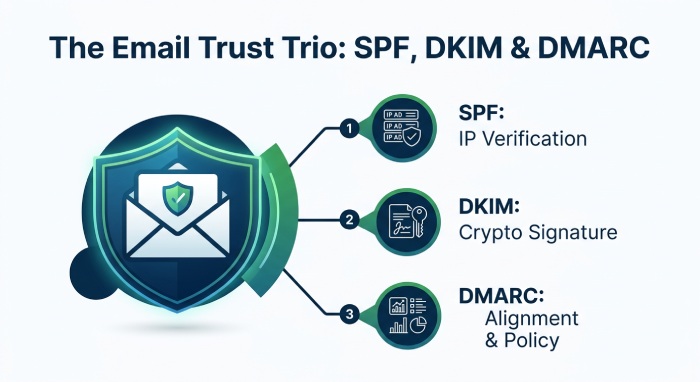
SPF (Sender Policy Framework) verifies that the email comes from an IP address authorized by the domain owner. Without a valid SPF record, receiving servers have no way to confirm that a message from your domain is legitimate, and default to treating it as suspicious.
DKIM (DomainKeys Identified Mail) adds a cryptographic signature to each email, confirming the message has not been tampered with in transit. DKIM provides the cryptographic proof of message integrity that SPF alone cannot.
DMARC (Domain-based Message Authentication, Reporting, and Conformance) ties SPF and DKIM together by aligning them with the visible “From” domain and telling receiving servers what to do when authentication fails. At p=reject, unauthenticated messages are blocked entirely. For a primer on the protocol, see what is DMARC.
The critical insight is that DMARC enforcement protects your domain’s reputation by preventing third parties from spoofing it. When spammers and phishers use your domain to send malicious emails, their activity degrades your domain’s reputation with mailbox providers, even though you did nothing wrong. As Valimail notes, “A properly implemented restrictive DMARC policy makes your domains less appetizing and less valuable for bad guys” (Valimail, Is DMARC Right for Everyone?).
The Measurable Deliverability Impact of DMARC Enforcement
What happens to inbox placement when organizations actually move to DMARC enforcement? The data is compelling:
Valimail customer data: Brands can see up to a 10% boost in email deliverability after successfully reaching DMARC enforcement. For organizations whose domains were being heavily spoofed, the improvement can be as high as 10-20% or even greater (Valimail, 8 Ways DMARC Improves Deliverability).
UK HMRC case study: The UK’s tax authority (HMRC) saw deliverability rates jump from 18% to 98% after implementing DMARC at enforcement. While this is an extreme case, HMRC was being heavily spoofed, which had destroyed its domain reputation, it demonstrates the upper bound of what authentication can achieve (Valimail).
Google’s ecosystem impact: Following the February 2024 sender requirements, Google reported a 65% reduction in unauthenticated messages reaching Gmail inboxes and 265 billion fewer unauthenticated messages sent in 2024. During the holiday season, typically the highest-phishing period, Gmail users encountered 35% fewer scams (Google/Valimail).
Valimail on the deliverability equation: “Mailbox providers favor authenticated senders. Moving to DMARC enforcement signals that your domain is trustworthy, which can improve inbox placement” (Valimail DMARC Enforcement Guide).
HMRC went from 18% to 98% deliverability after DMARC enforcement. Valimail customers regularly see 10%+ improvements. Google blocked 265 billion unauthenticated messages. The connection between authentication and deliverability is not theoretical, it is measured and documented.
The New Rules: Why Authentication Is Now a Prerequisite for Delivery
Before February 2024, email authentication was a best practice. After it, authentication became a prerequisite for delivery to the world’s largest mailbox providers:
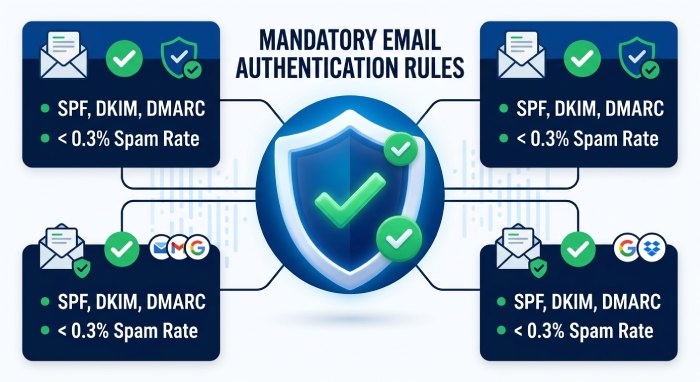
Gmail (2.5 billion users): Bulk senders must implement SPF, DKIM, and DMARC. As of November 2025, Gmail actively rejects non-compliant emails at the SMTP level (Google Sender Guidelines). Spam complaint rates must stay below 0.3%.
Microsoft (Outlook/Hotmail): As of May 2025, non-compliant bulk senders are rejected outright, not just filtered to spam (dmarcreport.com Guide).
Yahoo/AOL: Aligned with Google’s requirements from February 2024. Notably, Yahoo inbox placement actually improved slightly in 2024, suggesting that lighter-touch enforcement combined with strong compliance produced better outcomes.
Apple: Introduced tabbed inboxes and Apple Intelligence email summaries in 2024, adding new layers of filtering that make authentication and engagement even more critical.
As Google summarized its requirements: Authenticate your email. Allow for easy unsubscribe. Send wanted email. Authentication is listed first for a reason, it is the foundational requirement upon which everything else depends.
What This Means for Your Revenue
Let’s translate deliverability percentages into dollars. If email marketing returns $36-$42 for every dollar spent, and your inbox placement rate drops from 87% to 82% (a 5-point decline, well within the range Validity observed in 2024), you are losing roughly 5.7% of your email-driven revenue. For a company generating $500,000 annually from email marketing, that is $28,500 in lost revenue, from emails that were sent, accepted by the server, but routed to spam instead of the inbox.
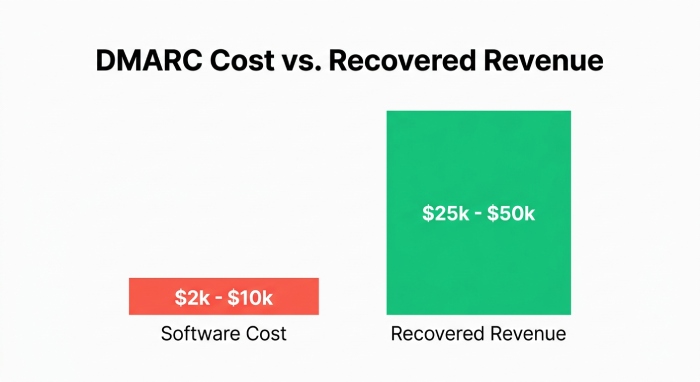
Now consider the upside. If DMARC enforcement can improve deliverability by 5-10% (as Valimail’s customer data suggests), and your email program generates $500,000 per year, enforcement could recover $25,000 to $50,000 in previously lost revenue, while simultaneously protecting your domain from spoofing and meeting compliance requirements from Google, Microsoft, Yahoo, and PCI DSS.
The math is simple. The cost of a DMARC reporting and enforcement platform is typically $2,000-$10,000 per year for an SMB. The revenue at risk from poor deliverability is orders of magnitude larger.
The BIMI Bonus: Brand Visibility as a Reward for Enforcement
BIMI (Brand Indicators for Message Identification) is a standard that allows organizations to display their official logo next to authenticated emails in supported inboxes. BIMI requires DMARC enforcement at p=quarantine or p=reject, it is only available to organizations that have completed their authentication journey.
According to Mailgun’s State of Deliverability 2023 report, the biggest driver for BIMI adoption is protecting brand reputation (24.6%), followed by building brand awareness (23.4%) and increasing customer trust (18%). While only about 8% of senders had implemented BIMI at the time of the survey, the standard represents a tangible, visible reward for organizations that invest in DMARC enforcement (Mailgun State of Deliverability 2023).
A Marketing Team’s Guide to Email Authentication
Email authentication is often treated as an IT project. But its impact on marketing revenue makes it a marketing priority. Here is what marketing and operations teams need to know and do:
Step 1: Verify Your Current Authentication Status
Use a free DMARC checker tool at dmarcreport.com to see your current SPF, DKIM, and DMARC records. You can run a DMARC check in seconds to confirm each record is present and valid. A DKIM lookup confirms your signing keys are published correctly. If any are missing or misconfigured, your deliverability is at risk. Sinch Mailgun’s survey found that 40% of senders using DMARC were unsure of their policy setting, meaning they did not know whether they were at p=none, p=quarantine, or p=reject.
Step 2: Coordinate with IT to Implement SPF, DKIM, and DMARC
Authentication requires DNS record changes that IT or your hosting provider must make. Marketing’s role is to ensure every email-sending service, your ESP, CRM, marketing automation platform, transactional email service, is included in your SPF record and has DKIM signing configured. If a service is missing, its emails will fail DMARC checks.
Step 3: Monitor Aggregate Reports
Once DMARC is in place with an RUA tag, you will receive aggregate reports from every mailbox provider. A platform like DMARC Report turns these raw XML reports into visual dashboards showing which senders are passing or failing authentication. This is the data you need to identify misconfigurations before they impact deliverability.
Step 4: Progress to Enforcement
Move from p=none to p=quarantine to p=reject on a documented timeline. Use the DMARC “pct” tag to apply the policy to a percentage of traffic initially (e.g., pct=25), allowing you to monitor impact before committing to full enforcement. This phased approach minimizes the risk of accidentally blocking legitimate emails.
Step 5: Maintain List Hygiene and Engagement
Authentication is necessary but not sufficient. Validity’s data shows that spam complaint rates are the single biggest factor to deprecate sender reputation. Keep complaints below 0.1%, clean your list regularly, segment for engagement, and make unsubscribe easy. Google’s guidelines are explicit: authenticate, unsubscribe, send wanted email.
The Bottom Line
Email remains the highest-ROI marketing channel, returning $36-$42 for every dollar spent. But that return is built on a foundation of deliverability, and deliverability in 2026 is built on authentication.
The data is clear: Global inbox placement declined to 83.5%. Gmail saw a 5-point drop. Microsoft delivers only 75.6% to the inbox. Spam placement nearly doubled. One in six marketing emails never reaches the inbox.
The solution is proven: DMARC enforcement improves deliverability by 5-10% on average. HMRC went from 18% to 98%. Google blocked 265 billion unauthenticated messages. Valimail customers consistently see measurable improvements.
The stakes are existential: Gmail, Microsoft, Yahoo, and Apple now collectively enforce authentication for approximately 90% of the world’s email users. Non-compliant emails are not just filtered to spam, they are rejected outright. No authentication means no delivery means no revenue.
For any organization that relies on email to communicate with customers, close sales, or build relationships, DMARC enforcement is not a security luxury. It is a revenue imperative.
Sources & References
All statistics are sourced from publicly available reports, official mailbox provider documentation, and industry research.
1. Validity, 2025 Email Deliverability Benchmark Report, Global inbox placement (83.5%), spam rates, mailbox provider breakdown, quarterly trends. Primary deliverability data source.
URL: https://www.validity.com/wp-content/uploads/2025/03/2025-Benchmark-Report-FINAL.pdf
2. Sinch Mailgun, State of Email Deliverability 2025, Survey of 1,000+ senders. Source for 40% DMARC policy uncertainty, 38.7% never clean lists, 25% below 0.1% complaint rate.
URL: https://www.mailgun.com/wp-content/uploads/pdf/SI-State_of_Email-2024_-_v3_1.pdf
3. Sinch Mailgun, State of Email Deliverability 2023, Source for BIMI adoption drivers (24.6% brand reputation, 23.4% awareness), 8% BIMI implementation rate, DMARC awareness gaps.
4. Valimail, 8 Ways DMARC Improves Email Deliverability, Source for up to 10% deliverability boost after enforcement.
URL: https://www.valimail.com/blog/dmarc-improves-email-deliverability/
5. Valimail, Is a DMARC Policy Right for Everyone?, Source for HMRC 18% to 98% deliverability case study and 10-20%+ improvement data.
URL: https://www.valimail.com/blog/dmarc-enforcement-for-everyone/
6. Valimail, How DMARC Helps with Deliverability and Reputation, Source for up to 10% deliverability increase and domain reputation protection mechanics.
URL: https://www.valimail.com/blog/how-does-dmarc-help-with-deliverability/
7. Valimail, 3 Things to Know About DMARC and Deliverability, Source for nuanced analysis: authentication necessary but not sufficient; lack of DMARC impedes placement.
URL: https://www.valimail.com/blog/things-to-know-about-dmarc-and-deliverability/
8. Valimail, DMARC Enforcement Guide, Source for 5-10% deliverability improvement data and enforcement timeline guidance.
URL: https://www.valimail.com/blog/what-is-dmarc-enforcement-and-why-is-it-so-important/
9. Google/Valimail, Gmail Authentication Impact Data, Source for 65% unauthenticated message reduction, 265 billion fewer unauthenticated messages, 35% fewer holiday scams.
URL: https://www.valimail.com/blog/google-stats-dmarc/
10. Google, Email Sender Guidelines FAQ, Official Gmail bulk sender requirements and November 2025 enforcement escalation documentation.
URL: https://support.google.com/a/answer/14229414?hl=en
11. dmarcreport.com, SPF/DKIM/DMARC Implementation Guide, Source for Microsoft May 2025 enforcement date and technical implementation guidance.
12. Valimail, 2026 State of DMARC Report, Industry-wide DMARC adoption trends and the role of authentication in the disinformation age.
URL: https://www.valimail.com/dmarc-report-2026/
13. Validity, 2023 Email Deliverability Benchmark, Prior-year deliverability baseline for comparison with 2024 data.URL: https://www.validity.com/wp-content/uploads/2023/03/2023-Email-Deliverability-Benchmark.pdf
Topics
General Manager
General Manager of DuoCircle. Product strategy and commercial lead for DMARC Report's 2,000+ customer base.
LinkedIn Profile →Take control of your DMARC reports
Turn raw XML into actionable dashboards. Start free - no credit card required.