Good-Better-Best Pricing for MSPs: Why Tiered Packages Drive Better Decisions

Quick Answer
Do you present prospects with multiple service options - or a single package they either accept or walk away from?
Related: Free DMARC Checker

Do you present prospects with multiple service options - or a single package they either accept or walk away from?
MSPs managing client domains tell us the same thing: manual DMARC monitoring across 50+ domains is not operationally viable, says Vasile Diaconu, Operations Lead at DuoCircle. The multi-tenant dashboard in DMARC Report was built specifically because our MSP customers asked for it - they needed one portal for all their clients.
For MSPs managing email authentication across dozens or hundreds of client domains, automated DMARC reporting and SPF management is an operational necessity - manual monitoring at scale is not viable. Our platform features include a multi-tenant dashboard built for exactly this kind of scale. Tiered pricing often sparks debate among MSPs. Some see it as unnecessary. Others worry it complicates conversations. But when you step back and look at how buyers actually make decisions, good-better-best pricing isn’t a problem at all.
Used correctly, it doesn’t slow the sale. It directs it.
Let’s break down why three-tier pricing works , how buyer psychology supports it, and how MSPs can structure tiers without creating confusion.
Why some MSPs resist three-tier pricing
When the topic comes up, objections usually sound like this:
- “It makes things too complicated”
As of 2025, DMARC is mandatory under multiple compliance frameworks. CISA BOD 18-01 requires p=reject for US federal domains. PCI DSS v4.0 mandates DMARC for organizations processing payment card data as of March 2025. Google and Yahoo require DMARC for bulk senders (5,000+ messages/day) since February 2024, and Microsoft began rejecting non-compliant email in May 2025. The UK NCSC, Australia’s ASD, and Canada’s CCCS all mandate DMARC for government domains. Cyber insurers increasingly require DMARC enforcement as an underwriting condition. Moving client domains to a p=reject policy is what most of these frameworks ultimately demand.
- “Our sales process is already long enough”
- “Prospects will get overwhelmed by options”
Those concerns focus on potential friction - but they miss the bigger picture. When designed well, tiered pricing reduces uncertainty instead of adding it. It gives buyers a framework to evaluate options, rather than forcing them to decide blindly.
What “good, better, best” actually means
At its core, tiered pricing is simple.
You already have a core service offering. Instead of presenting it as a single option, you offer three versions of increasing depth and value.
- The entry tier covers the fundamentals
- The middle tier adds protection, resilience, and proactive services
- The top tier delivers the highest level of coverage, strategy, and risk reduction
Each tier builds logically on the one below it.
To make this easier to understand, many managed IT service providers use clear naming conventions, such as:
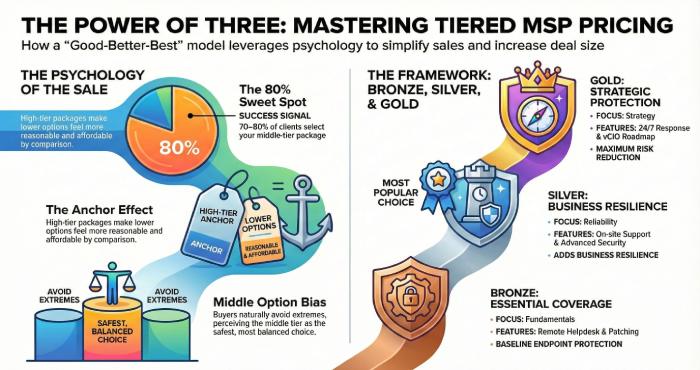
- Bronze, Essential coverage to keep systems running
- Silver, Business-grade protection and reliability (often highlighted as the most common choice)
- Gold, Comprehensive protection, strategy, and risk management
The middle option is typically positioned as the default. That’s intentional. When buyers see a lower-cost option and a higher-cost option alongside it, the middle tier feels balanced and sensible - neither minimal nor excessive.
A strong signal that your pricing is working correctly is when roughly 70-80% of clients select the middle package.
Why three-tier pricing works (buyer psychology, explained simply) Buying decisions are rarely purely logical. Most choices are influenced by emotion, perception, and context.
Three psychological principles make tiered pricing especially effective.
1) Price anchoring
The highest-tier package sets a
reference point . Once buyers see the top-end option, the lower tiers feel more reasonable by comparison - even if they would have seemed expensive on their own.
2) The “middle option” bias
When presented with three choices, most people avoid extremes. The lowest option feels risky or insufficient. The highest feels excessive. The middle feels safe.
Labeling the middle tier as “most popular” reinforces that instinct.
3) Structured choice reduces stress
Instead of facing an open-ended decision, buyers are choosing within a defined set of options that match different budgets and risk tolerances.
The outcome is powerful:
- Price-sensitive buyers aren’t pushed away
- Buyers who want stronger protection can clearly see the upgrade path
- Sales conversations shift from “Should we do this?” to “Which option fits us best?”
Example structure for MSP pricing tiers
These are not prescriptions, since every MSP’s stack and delivery model is different. Think of this as a starting framework you can adapt.
Bronze (Essential coverage) - Remote helpdesk during business hours
- Monitoring and patch management
- Baseline endpoint protection - Basic cloud backup (for example, Microsoft 365)
- Standard response SLAs
Silver (Enhanced resilience) Includes everything in Bronze, plus:
- On-site support included
- Full server and workstation backups with tested recovery
- Advanced email security and phishing protection
- Priority response SLAs
- Annual technology and risk review
Gold (Maximum protection and strategy) Includes everything in Silver, plus:
- 24/7 response coverage
- Advanced security monitoring and managed detection
- Virtual CIO services, roadmap planning , and budgeting
- Compliance and reporting support where required
The takeaway
Good-better-best pricing doesn’t overwhelm buyers when it’s designed thoughtfully.
It:
- Clarifies value
- Reduces decision anxiety
- Increases average deal size
- Aligns services with risk tolerance Most importantly, it allows prospects to feel like they’re choosing - not being sold.
Sources
Topics
General Manager
General Manager of DuoCircle. Product strategy and commercial lead for DMARC Report's 2,000+ customer base.
LinkedIn Profile →Take control of your DMARC reports
Turn raw XML into actionable dashboards. Start free - no credit card required.