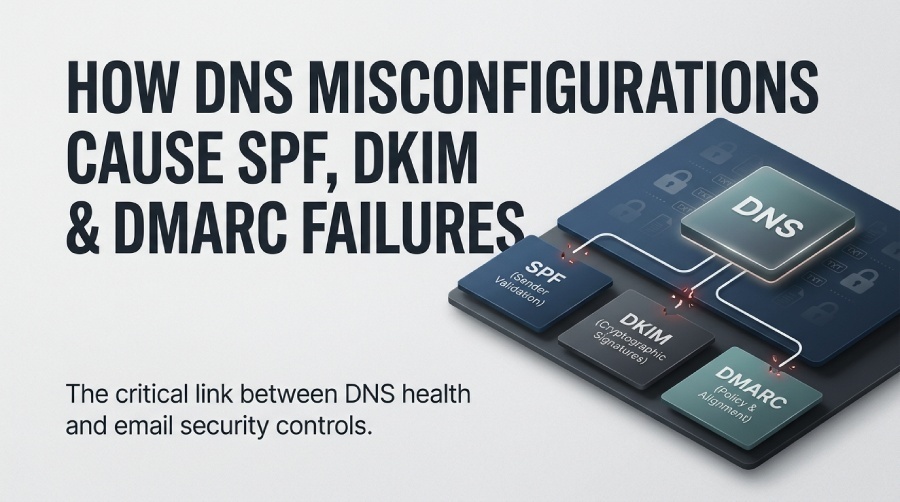
How DNS Misconfigurations Can Cause SPF, DKIM & DMARC Failures

Quick Answer
DNS misconfigurations can cause SPF, DKIM, and DMARC failures by publishing incorrect, missing, or conflicting records. Fixing DNS syntax, selectors, alignment, and authentication settings helps prevent spoofing and improve email deliverability.
Try Our Free DMARC Checker
Validate your DMARC policy, check alignment settings, and verify reporting configuration.
Check DMARC Record →Email authentication depends on DNS. SPF, DKIM and DMARC all publish policy or verification data as DNS TXT records, which means even small DNS errors can create major authentication failures. These failures increase spoofing exposure, weaken cyber security controls, and create avoidable DNS risks for organizations that rely on email for customer communication, service notifications, invoices, password resets and security alerts.
Because email authentication is both a DNS security and security operations issue, teams should treat DNS records as critical data. Misconfigured records can introduce DNS vulnerabilities, expand DNS threats, and reduce network resilience across cloud, hybrid and enterprise environments.
Why DNS Is the Foundation of Email Authentication
SPF, DKIM and DMARC work because receiving mail servers query DNS to verify whether a message is authorized, signed and aligned with the sender’s domain. If DNS records are missing, malformed, duplicated or unreachable, authentication can fail even when the sending system itself is legitimate.
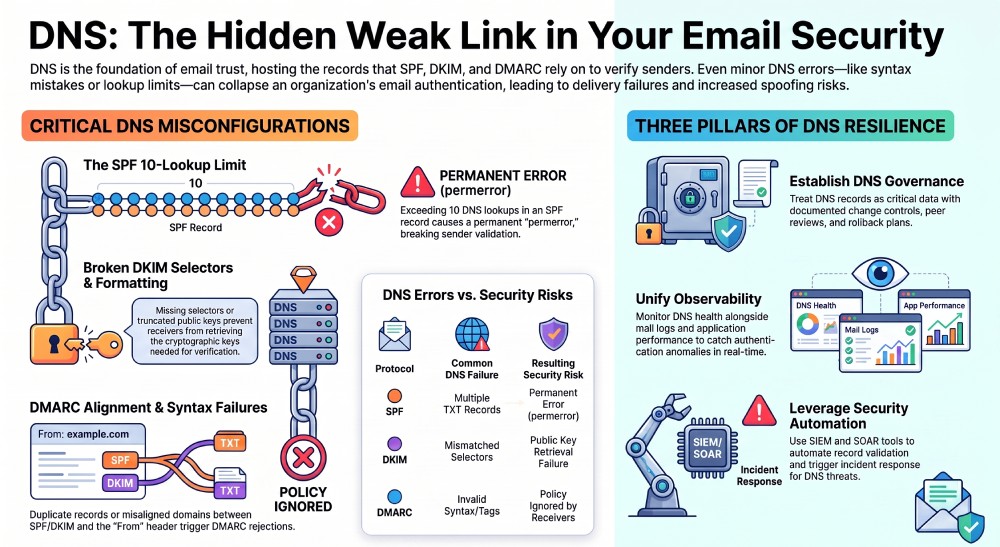
DNS Records Act as the Source of Trust
SPF uses a TXT record to define which IP addresses, domains or third-party senders are allowed to send mail for a domain. DKIM uses DNS to publish a public key that verifies a cryptographic signature added by the sender. DMARC uses DNS to publish policy instructions that tell receivers what to do when SPF or DKIM alignment fails.
This makes DNS security central to email integrity. A weak DNS change process, poor data centralization, or lack of auditing and reporting can cause records to drift out of sync with actual mail infrastructure. These dns vulnerabilities are especially common in organizations using multiple Software as a service (SaaS) tools, marketing platforms, ticketing systems and cloud email providers.
DNS Failures Create Security and Operational Blind Spots
DNS misconfigurations do more than break authentication. They also increase DNS threats such as spoofing, phishing attacks and business email compromise. In mature SecOps programs, security monitoring, SIEM correlation, SOAR playbooks and UEBA analytics help detect authentication anomalies before they become incidents.
Platforms such as Splunk, Splunk Platform, Splunk Cloud Platform and Splunk Enterprise Security can support real-time visibility across DNS activity, mail gateway logs and authentication results. When combined with threat intelligence, anomaly detection and advanced threat detection, teams gain better visibility across environments and stronger network resilience.
Common SPF DNS Misconfigurations That Break Sender Validation
SPF failures often occur because organizations publish records that are too complex, too broad or technically invalid. These are preventable DNS risks, but they require disciplined DNS security practices and continuous security monitoring.
Multiple SPF TXT Records
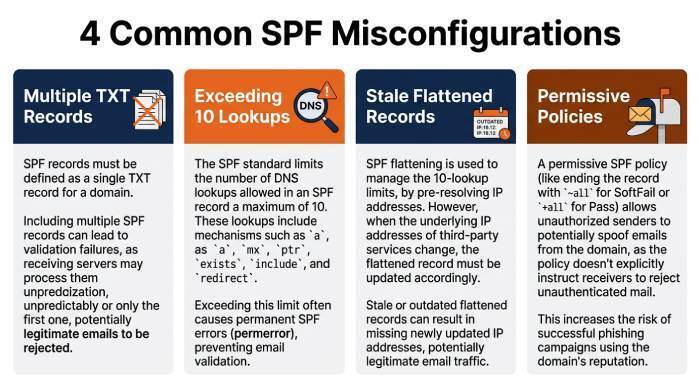
A domain should have only one SPF TXT record. Publishing multiple SPF records causes receivers to return a permanent error, commonly known as permerror. For example, one team may add an SPF record for Microsoft 365 while another adds one for a marketing automation tool. The result is broken sender validation.
A proper SPF record consolidates all authorized senders into one TXT record. SIEM searches, log search workflows and Detection Studio use cases can help identify domains generating SPF errors across mail logs.
Exceeding the SPF 10-Lookup Limit
SPF allows a maximum of 10 DNS lookups. Excessive include, a, mx, ptr or exists mechanisms can exceed that limit and cause SPF to fail. This is common when organizations add many third-party vendors without performing data optimization or storage management of DNS records.
Flattening SPF Must Be Managed Carefully
SPF flattening can reduce lookups by replacing includes with IP ranges, but it can also create stale records if vendor IPs change. Teams should use vulnerability scan results, monitoring and diagnostics, and service diagnostics to verify that SPF updates do not create new DNS vulnerabilities or affect network performance.
Overly Permissive SPF Policies
Records ending in all or overly broad mechanisms such as include: patterns can undermine sender validation. While these may reduce short-term delivery problems, they weaken DNS security and increase DNS threats. A better approach is structured risk management: start with controlled testing, collect authentication data, then move toward ~all or -all when legitimate senders are confirmed.
Security monitoring, SIEM dashboards and UEBA can help distinguish normal email-sending behavior from unusual sender activity, including suspicious use by malicious insiders or compromised systems.
DKIM Failures Caused by Incorrect or Missing DNS Records
DKIM depends on a selector-specific DNS TXT record that stores the public key used to validate the signature in an email header. If the DNS record is missing, incorrectly formatted or mismatched with the private key, DKIM validation fails.
Missing or Incorrect DKIM Selectors
Each DKIM signature references a selector, such as selector1._domainkey.example.com. If the selector does not exist in DNS, receivers cannot retrieve the public key. This often happens during mail platform migrations, domain rebranding, cloud monitoring changes or IT Modernization projects.
A strong DNS security program should track DKIM selectors as critical data assets. Data centralization in a data platform such as Splunk helps teams correlate DNS changes, authentication failures and mail flow disruptions.
Broken Public Key Formatting
DKIM TXT records can be damaged by line wrapping, missing quotation marks, incorrect semicolons or truncated keys. These formatting errors create vulnerabilities that are easy to overlook in manual change processes.
Security operations teams can use Splunk Enterprise Security, Security Monitoring, Advanced Threat Detection and Log Search to identify DKIM failure patterns. Detection Studio content can support advanced detection use cases, while Splunk Lantern, Resource Center, Product Tours and Customer Success resources can help teams operationalize repeatable controls.
Key Rotation and Vendor Changes
DKIM keys should be rotated periodically, but rotation can break authentication if old records are removed too soon or new records are not propagated globally. Vendor changes can also create mismatched keys. Security compliance programs should include DKIM lifecycle checks as part of compliance, auditing and reporting.
SOAR and automation and orchestration can reduce human error by standardizing approval, publication, validation and rollback steps. This supports manual task reduction and strengthens network resilience during mail infrastructure changes.
How DMARC Policies Fail When DNS Records Are Misconfigured
DMARC depends on both SPF or DKIM passing and aligning with the visible From domain. DNS misconfiguration can cause the DMARC record itself to fail, or it can cause SPF and DKIM failures that lead to DMARC rejection.
Invalid DMARC Syntax and Duplicate Records
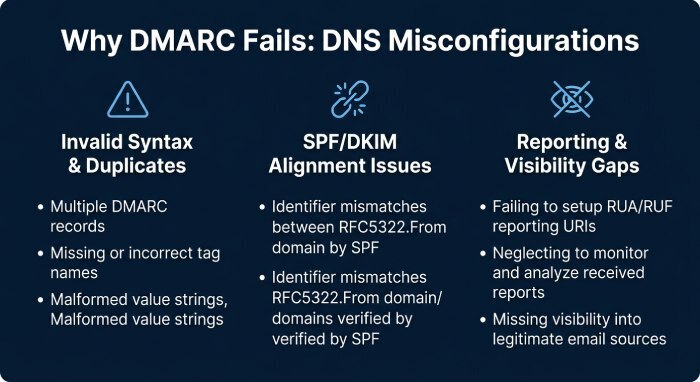
A DMARC record must be published at _dmarc.example.com and must follow valid syntax, such as v=DMARC1; p=none; rua=mailto:dmarc@example.com. Duplicate DMARC records, invalid tags or unsupported values can cause receivers to ignore the policy.
These DNS risks can weaken enforcement and expose the domain to DNS attacks and spoofing. SIEM, SOAR and UEBA tools can support incident response by correlating DMARC failures with phishing reports, suspicious sender infrastructure and user-reported messages.
Alignment Problems Between SPF, DKIM and the From Domain
DMARC alignment fails when the domain authenticated by SPF or DKIM does not align with the domain in the visible From header. This often happens when third-party vendors send email using their own return-path or signing domain instead of the organization’s domain.
Advanced threat detection, ai-powered secops and ai in security can help identify unusual alignment failures at scale. Splunk AI, trusted AI capabilities, AIOps workflows and Artificial Intelligence-assisted analysis can support alert noise reduction by prioritizing failures that indicate real DNS threats rather than routine vendor misconfiguration.
Reporting Gaps and Missed Visibility
DMARC aggregate and forensic reports provide valuable insight, but only if reporting addresses are valid, monitored and analyzed. Without reporting, teams lose real-time visibility into authentication failures and DNS vulnerabilities.
The Splunk Platform, Splunk Cloud Platform, Splunkbase, Community and User Groups, and Security Overview resources can support security workflows that bring DMARC data into SIEM and SOAR processes. This improves security monitoring, advanced threat detection and root cause analysis across email systems.
Best Practices for Preventing DNS-Related SPF, DKIM and DMARC Failures
Preventing DNS-related authentication failures requires governance, observability and automation. Organizations should manage DNS as part of cyber security, service reliability and compliance—not as a static configuration layer.
Establish DNS Change Governance
Every SPF, DKIM or DMARC change should follow a documented process with ownership, peer review, rollback instructions and validation. This reduces dns vulnerabilities and improves DNS security across domains and subdomains.
Include SPF lookup checks, DKIM selector validation and DMARC syntax testing in standard change management. Security compliance teams should also require periodic reviews for abandoned vendors, stale selectors and unused senders.
Monitor DNS, Email and Service Health Together
Email authentication problems often surface as delivery failures, phishing exposure or poor end-user experience. Combining network monitoring, cloud monitoring, it service health, service health analysis and monitoring and diagnostics gives teams a broader view of impact.
Tools such as AppDynamics, Observability Cloud, IT Service Intelligence and Service Operations can connect DNS behavior to application availability, network performance and microservices troubleshooting. This improves root cause analysis when authentication failures affect user-facing systems.

Use SIEM, SOAR and UEBA for Continuous Detection
A modern DNS security strategy should integrate security monitoring with SIEM, SOAR and UEBA. SIEM centralizes authentication logs, SOAR automates remediation steps, and UEBA detects unusual sender or administrator behavior.
This combination improves advanced threat detection, supports incident response and reduces DNS risks caused by delayed investigation. SOAR playbooks can validate DNS records, notify domain owners, open tickets and trigger rollback steps. UEBA can flag malicious insiders or compromised accounts making unusual DNS changes.
Build Resilience Through Automation and Intelligence
To strengthen network resilience, teams should automate recurring validation checks for SPF, DKIM and DMARC. Automation and orchestration reduce manual task reduction opportunities while improving consistency. Data Optimization practices ensure authentication data remains searchable, cost-effective and useful for detection.
By combining security monitoring, advanced threat detection, threat intelligence, SIEM, SOAR and UEBA, organizations can detect dns threats faster, reduce alert noise reduction challenges and preserve network resilience even as mail infrastructure evolves.
General Manager
General Manager of DuoCircle. Product strategy and commercial lead for DMARC Report's 2,000+ customer base.
LinkedIn Profile →Take control of your DMARC reports
Turn raw XML into actionable dashboards. Start free - no credit card required.