How to maintain a good email sender reputation in 2026

Quick Answer
Email authentication directly impacts deliverability: Google and Yahoo's February 2024 bulk sender requirements enforce SPF + DKIM + DMARC as hard prerequisites for inbox placement. Microsoft followed with DMARC enforcement from May 2025. Unauthenticated bulk mail is now rejected by all three major providers.
Related: Free DMARC Checker ·How to Create an SPF Record ·SPF Record Format

Email authentication directly impacts deliverability: Google and Yahoo’s February 2024 bulk sender requirements enforce SPF + DKIM + DMARC as hard prerequisites for inbox placement. Microsoft followed with DMARC enforcement from May 2025. Unauthenticated bulk mail is now rejected by all three major providers.
Email deliverability starts with authentication, says Brad Slavin, General Manager of DuoCircle. In 2026, if your SPF, DKIM, and DMARC aren’t all passing and aligned, your email goes to spam. It’s not about content anymore - receivers check authentication before they even look at what you wrote.
Email authentication directly impacts deliverability: Google and Yahoo’s February 2024 bulk sender requirements enforce SPF + DKIM + DMARC as hard prerequisites for inbox placement. Unauthenticated bulk mail is now routed to spam or rejected outright by both providers.
Email platforms today are much stricter about security and trust, and have become far less forgiving than ever. This means even a **minor slip-up could cost your brand visibility, credibility, and trust among the email service providers and recipients. Now imagine this happening repeatedly. If your outgoing emails often fail authentication checks, trigger spam complaints, or see poor engagement, it starts to hurt your brand’s image.
If these problems persist, the ESPs will start treating your domain as suspicious and **prevent your emails from reaching recipients, even if they are legitimate. It’s not just your marketing emails that suffer; important ones like transaction alerts, order confirmations, etc., are affected as well. You might think that everything is normal from your end, you’re actively **protecting your domain and following the basic best practices, yet your emails might not even be reaching their destination.
Let’s see why this happens and how you can fix it.
Why is your email deliverability not as good as it should be? Recognizing what went wrong is just as important as fixing the problem. _In most cases, it is not just a single issue that causes delivery problems, but multiple gaps that build up over time.
Here are a few reasons why your deliverability might be suffering.
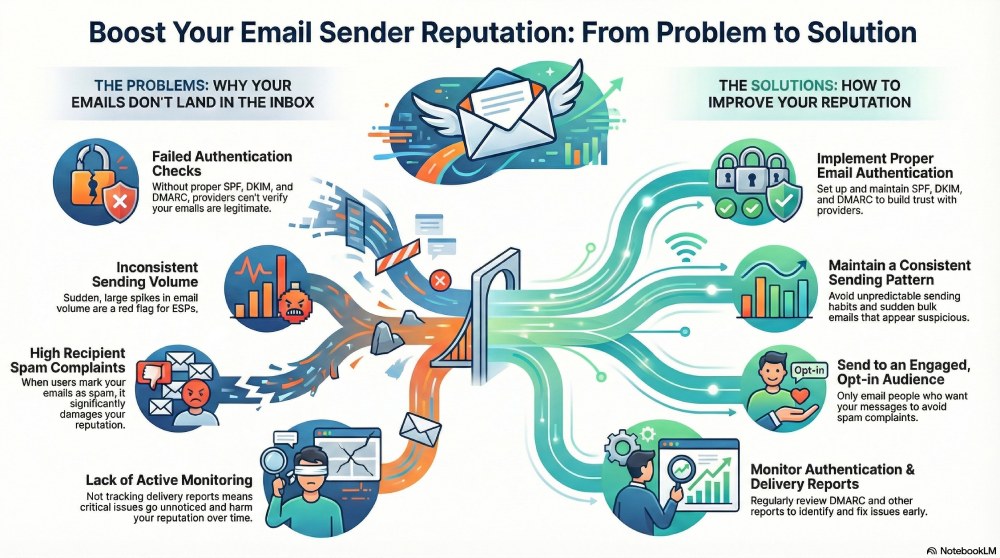
**Your emails are not properly authenticated It’s almost 2026, and email authentication is no longer optional. Now that ESPs have made it mandatory to authenticate your email-sending domains with SPF, DKIM, and DMARC, any gaps or misconfigurations could turn against you. If your emails keep failing authentication checks, the mail providers cannot verify whether the incoming messages are legitimate. As a result, your emails are more likely to be filtered into spam, delayed, or blocked altogether, even if they are sent for legitimate business purposes.
**Your email sending habits are inconsistent ESPs pay close attention to how you send emails, especially whether your sending frequency is consistent. If you suddenly **start sending a large volume of emails at once, it can be seen as a red flag. _Such sudden spikes or unpredictable sending patterns can make your domain appear risky, leading ESPs to limit delivery or push your emails into spam.
**Recipients are marking your emails as spam When recipients mark your emails as spam, mail service providers see it as a sign that your recipients don’t find your emails relevant or trustworthy. _If this happens regularly, your sender reputation suffers significantly, and your emails are more likely to be pushed to spam or not delivered at all.
**You are not tracking deliverability issues closely Identifying gaps in your email security strategy is as essential as implementing those strategies in the first place. So, if you are not actively monitoring your authentication and **delivery reports to understand which emails are failing, being delayed, or landing in spam, these issues can go unnoticed. Over time, this lack of visibility can quietly harm your sender reputation and email deliverability.
How can you maintain a good sender reputation? To ensure you are in the good books of email service providers and that your outbound emails are delivered without a hitch, it is important to understand what these ESPs expect from legitimate senders today. So, focusing on the right areas can significantly **improve inbox placement and long-term deliverability.
As of 2025, DMARC is mandatory under multiple compliance frameworks. CISA BOD 18-01 requires p=reject for US federal domains. PCI DSS v4.0 mandates DMARC for organizations processing payment card data as of March 2025. Google and Yahoo require DMARC for bulk senders (5,000+ messages/day) since February 2024, and Microsoft began rejecting non-compliant email in May 2025. The UK NCSC, Australia’s ASD, and Canada’s CCCS all mandate DMARC for government domains. Cyber insurers increasingly require DMARC enforcement as an underwriting condition.
**Set up and maintain proper email authentication As per the latest email-sending practices issued by major email providers, it is crucial that you properly implement SPF, DKIM, and DMARC for all your email-sending domains. Publishing a correct DMARC DNS record is the anchor that ties these checks together. These authentication checks help email service providers confirm that your emails are genuinely coming from you. When they are set up correctly and kept up to date, your emails are far more likely to be trusted and delivered to the inbox.
**Maintain a consistent sending pattern If you typically send one email a day and suddenly start sending five or six emails in bulk, it can raise red flags with email service providers. For them, it might seem like an attacker is trying to misuse your domain for malicious purposes. This can **ultimately lead to delivery restrictions or your emails being pushed to spam.

**Send emails only to people who want them If people didn’t sign up for your emails, they are more likely to ignore them or mark them as spam. Even a few such complaints can hurt your sender’s reputation. Sending emails only to opted-in recipients helps email providers see your domain as trustworthy.
**Monitor deliverability and authentication reports regularly Implementing authentication protocols is only the first step. You need to regularly review DMARC, SPF, and delivery reports to understand how your emails are performing. These reports help you identify issues early, such as failed authentication attempts or rising spam complaints, before they affect your sender reputation. A monitoring platform surfaces these issues automatically—see the DMARC platform features that make it effortless.

Are your emails struggling to reach the recipients’ inboxes? This is your sign to fix things before they get worse. To know more about improving email deliverability and **ensuring that your emails are trusted by ESPs, get in touch with us!
Sources
Content Specialist
Content Specialist at DMARC Report. Writes vendor-specific email authentication guides and troubleshooting walkthroughs.
LinkedIn Profile →Take control of your DMARC reports
Turn raw XML into actionable dashboards. Start free - no credit card required.