SSL Vs TLS Explained: Key Differences And Why It Matters

Quick Answer
SSL and TLS are encryption protocols that secure data online. SSL is outdated, while TLS is its modern, more secure replacement. TLS powers HTTPS and protects websites, emails, and transactions with stronger encryption, better performance, and improved defense against cyberattacks and data breaches.
Related: How to Create an SPF Record ·SPF Record Format ·Free DKIM Lookup
SSL and TLS are security protocols that protect data exchanged over the internet, helping keep websites, emails, and online transactions secure. While SSL was the original encryption standard, TLS is its more secure and modern replacement used by most websites today. Understanding SSL vs TLS helps you learn how encrypted connections work, why HTTPS matters, and how stronger security protocols protect users from cyber threats and data breaches.
What SSL and TLS Are: The Basics of Secure Internet Communication
When navigating the modern web, establishing a secure connection is vital for protecting sensitive data in transit. At the heart of this protection are SSL (Secure Sockets Layer) and TLS (Transport Layer Security), two fundamental communication protocols that encrypt data exchanged between a client (such as a web browser or IoT device) and a server (like a web server hosting your website). Both SSL and TLS are cryptographic protocols designed to provide authentication, integrity, and confidentiality in client-server communications over insecure networks such as the Internet.
SSL and TLS establish a secure channel that prevents eavesdropping, tampering, or forgery, encrypting everything from HTTP requests to the exchange of cryptographic keys and, ultimately, facilitating HTTPS connections. While these terms are often used interchangeably, understanding their distinctions is crucial for robust web security.
A Brief History: From SSL to Modern TLS Versions
Early Development of Secure Sockets Layer
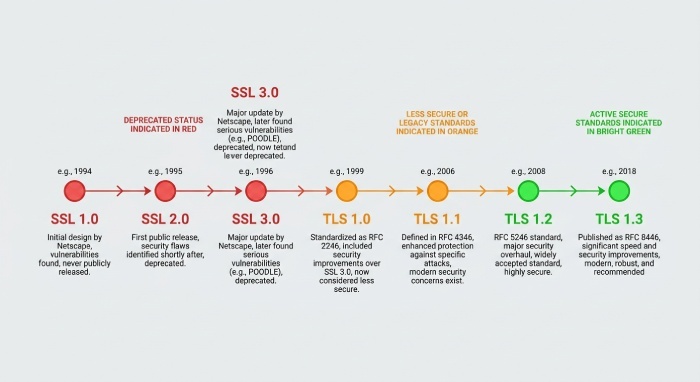
SSL was created in the mid-1990s by Taher Elgamal, a cryptographer regarded as the “father of SSL.” Its initial release, SSL 1.0, was never officially published due to significant security vulnerabilities. SSL 2.0 and SSL 3.0, co-developed by Tim Dierks and Christopher Allen at Netscape, followed but were also eventually found to be vulnerable to a variety of attacks.
The Evolution to Transport Layer Security
Recognizing SSL’s weaknesses, the Internet Engineering Task Force (IETF) introduced TLS (Transport Layer Security) as a direct successor. The first version, TLS 1.0, closely resembled SSL 3.0 but implemented several security and performance enhancements. Over the years, TLS has seen multiple updates—TLS 1.1, TLS 1.2, and the current standard, TLS 1.3—each addressing new threats and optimizing the handshake process and encryption algorithms.
SSL and TLS Version History
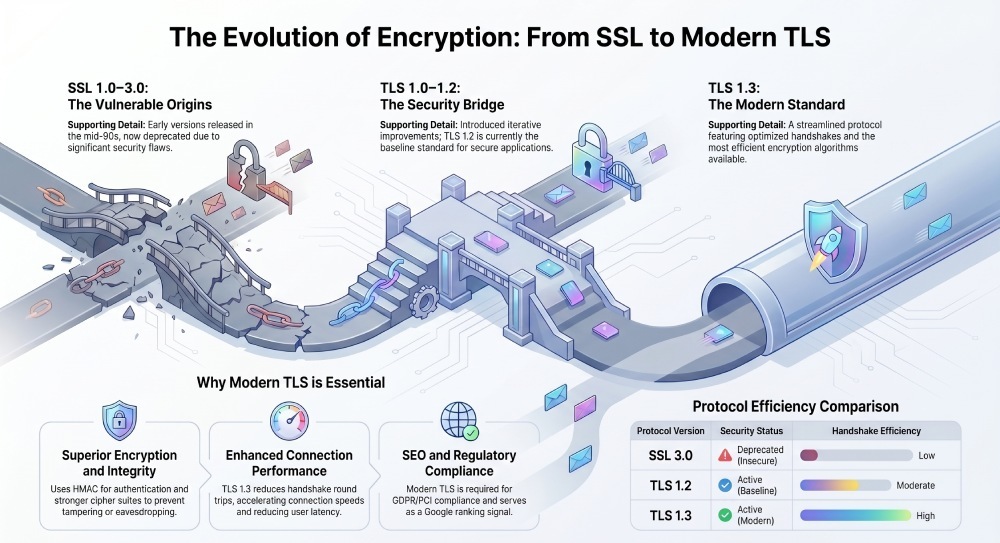
- SSL 1.0—3.0: Early protocols with notable vulnerabilities; deprecation recommended.
- TLS 1.0, 1.1: Iterative improvements, but now deprecated due to outdated security.
- TLS 1.2: Introduced support for stronger cipher suites, now the baseline standard for secure applications.
- TLS 1.3: Modernized protocol with a streamlined handshake, more efficient encryption, and greater security.
Key Differences Between SSL and TLS in Security, Performance, and Compatibility
Security Enhancements and Encryption Strength
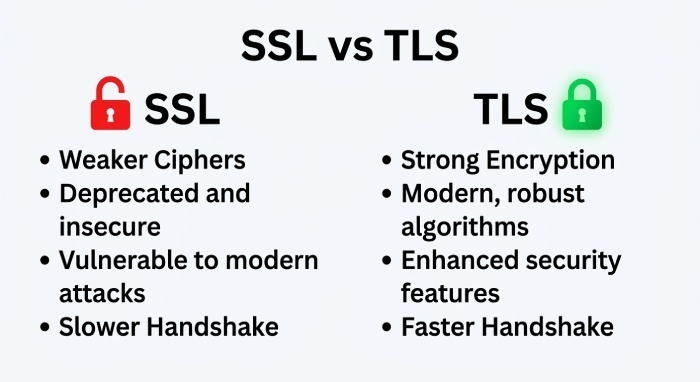
The most significant differences between SSL vs TLS center on encryption and overall protocol security. TLS fixed many of the flaws that plagued SSL, introducing more robust encryption algorithms and improved message authentication using HMAC (Hash-Based Message Authentication Code), unlike the weaker MD5 algorithm used by some SSL implementations.
Differences in the Handshake Process
- SSL handshake protocols are more vulnerable to negotiation and downgrade attacks.
- TLS handshake processes not only authenticate the certificate and exchange cryptographic keys more securely but also offer mechanisms for alert messages (e.g., warning alert, fatal alert, close notify) to handle errors and connection closure more safely.
Cipher Suites and Message Authentication
TLS supports stronger, flexible cipher suite negotiation between server and client, ensuring the most secure combination is used. It also improves the message authentication code, crucial for data integrity, moving from SSL’s less secure methods to HMAC in TLS.
Performance Improvements
TLS 1.3 notably reduces the number of round trips required during the handshake, accelerating connection establishment and enabling faster, more secure HTTP/HTTPS communication. This benefits application scalability and can reduce latency for end users and IoT ecosystems.
Compatibility and Implementation
While SSL is almost entirely deprecated in browsers, servers, and network devices, TLS maintains full support and backward compatibility for a period. Modern operating systems, web browsers, and platforms like Amazon Web Services (AWS) or AWS Certificate Manager (ACM) automatically favor the highest enabled TLS version.
Why TLS Matters for Websites, SEO, Compliance, and User Trust
Securing E-commerce, Personal Data, and Applications
TLS is essential for protecting customer data, transaction details, and personal information during web sessions. Without TLS, any HTTP-based communication is exposed to interception on the network.
SPF, DKIM, and DMARC complement TLS by helping verify email authenticity and preventing spoofing, phishing, and unauthorized message tampering during secure communication. To learn what is DMARC and how it enforces an authentication policy, review our overview of the protocol. You can check DMARC record status for your domain to confirm these anti-spoofing protections are in place.
SEO and Google Ranking Signals
Google explicitly uses HTTPS (which requires a TLS certificate) as a ranking factor in its search algorithms. Migrating your website from HTTP to HTTPS with robust TLS implementation not only secures your visitors but can also boost your SEO, improving discoverability and user trust.
Regulatory Compliance
Global regulations such as the GDPR, HIPAA, and PCI DSS mandate strong encryption and secure communication to protect user data. Implementing and maintaining modern TLS protocols is a compliance necessity for businesses operating in regulated industries. Standards like PCI DSS v4.0 also require email authentication, so it helps to understand the SPF vs DKIM vs DMARC distinction alongside your TLS posture.
User Trust and Browser Indicators
Modern web browsers like Chrome, Firefox, and Edge display clear security indicators (e.g., padlocks) for sites using HTTPS via valid c, signaling safety and authenticity. In contrast, visiting a site running only SSL or outdated protocols often triggers browser warnings, eroding user confidence.
How to Check, Configure, and Maintain TLS for a Secure Website
Verifying Your Website’s TLS Implementation
Use online tools and browser developer consoles to inspect which communication protocols and TLS versions your website supports. Look for a valid TLS certificate, confirm that the connection uses HTTPS, and ensure no fallback to older, insecure SSL variants.
Checking for Configuration and Vulnerabilities
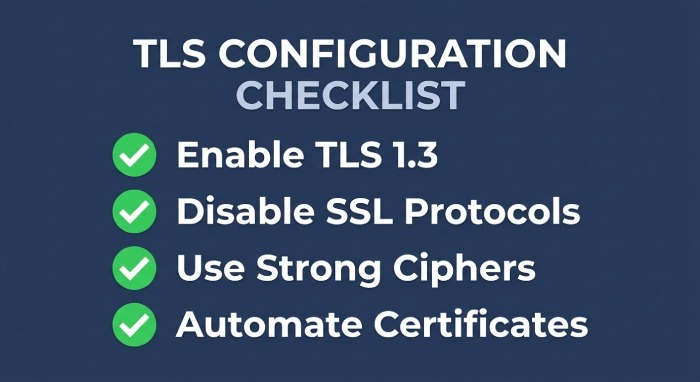
- Verify that only TLS 1.2 and TLS 1.3 are enabled; deprecate SSL and TLS 1.0/1.1.
- Review supported cipher suites and disable weak options.
- Validate that all digital certificates are up-to-date and issued by a trusted certificate authority.
Configuring TLS: Best Practices
Server Configuration for Web Servers
Regularly update your web server software to support the latest TLS protocols and securely handle cryptographic keys. Enforce strong certificate requirements (e.g., minimum 2048-bit public key).
Implementing Automated Certificate Management
Leverage solutions like AWS Certificate Manager (ACM) for automated certificate management. ACM streamlines certificate renewals and deployment for AWS clients and services, minimizing manual errors and service lapses.
Managing the Handshake and Cryptographic Keys
Ensure your server configuration enforces secure handshake processes, properly manages private keys and public keys, and supports secure alert messages like close notify to gracefully terminate sessions without information leakage.
Maintaining TLS Over Time
- Schedule routine scans for security vulnerabilities.
- Monitor certificate expiration and automate certificate renewals using public key infrastructure (PKI) tools.
- Regularly audit your TLS configuration in the AWS Console if hosting on Amazon Web Services, ensuring your cloud environments remain compliant and current.
TLS and its robust, modern architecture have clearly surpassed SSL in every metric of secure internet communication. By understanding, deploying, and maintaining strong TLS practices, you establish a secure connection, build user trust, and safeguard your network’s most vulnerable data exchanges.
General Manager
General Manager of DuoCircle. Product strategy and commercial lead for DMARC Report's 2,000+ customer base.
LinkedIn Profile →Take control of your DMARC reports
Turn raw XML into actionable dashboards. Start free - no credit card required.