Understanding DNS Queries, DNS Servers, and DNS Record Types

Quick Answer
DNS queries help devices find websites by converting domain names into IP addresses. DNS servers handle these requests, while DNS records like A, MX, and TXT manage website routing and email security.

The internet depends on the Domain Name System (DNS) to connect users with websites, applications, and online services. Every time someone types a website address into a browser, DNS works behind the scenes to translate that human-friendly domain into a machine-readable IP address. Without DNS, users would need to remember long strings of numbers instead of simple website names.
DNS is often compared to the internet’s phonebook, but modern DNS infrastructure is much more sophisticated. It manages website traffic, email routing, domain verification, security policies, and service discovery across the internet. Different DNS query methods, server categories, and record types all work together to ensure fast and reliable communication between devices and servers.
What Is DNS and Why Is It Important?
DNS stands for Domain Name System. Its primary purpose is to convert domain names into IP addresses so browsers and applications can locate the correct servers online.
For example, when a user enters a website address into a browser, the DNS process identifies the corresponding IP address associated with that domain. Once the IP address is found, the browser can connect to the hosting server and load the requested website.
DNS is essential because it:
- Simplifies internet navigation
- Enables websites and applications to be accessible
- Supports email delivery systems
- Improves network performance through caching
- Helps enforce security and authentication policies
- Distributes traffic across servers and regions
Today’s DNS infrastructure also plays a major role in cybersecurity, cloud computing, and internet reliability.
How DNS Queries Work
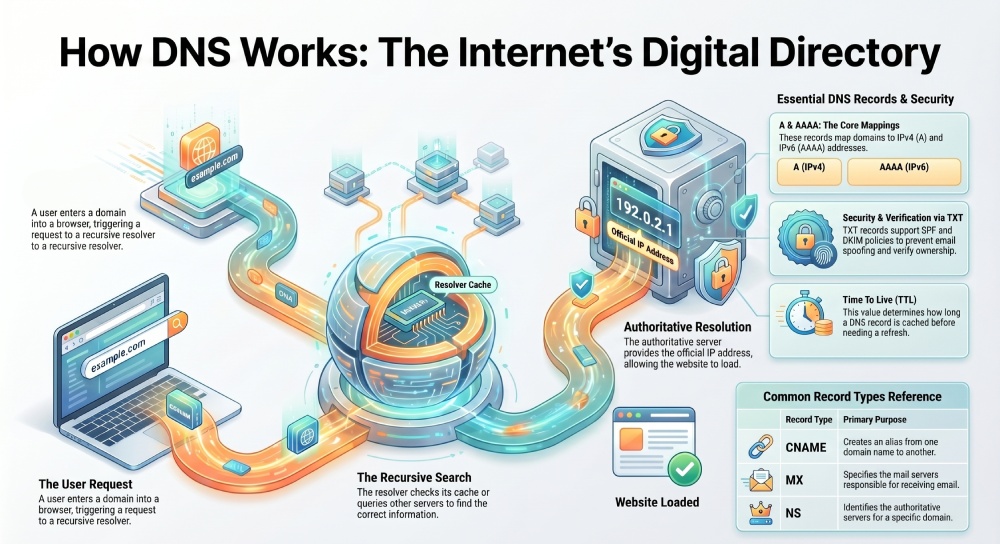
A DNS query is a request sent by a device to obtain DNS information about a domain. Whenever someone visits a website or sends an email, multiple DNS queries may occur in the background.
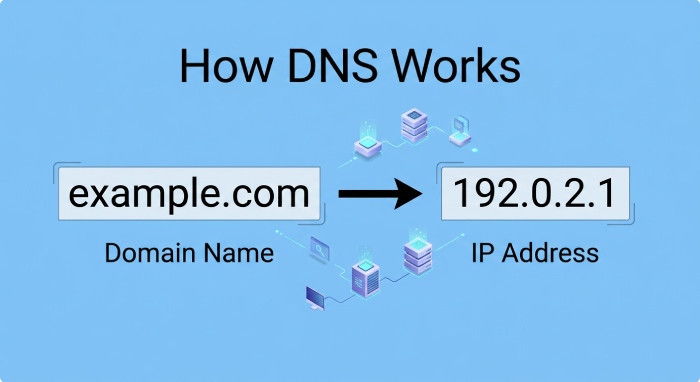 The DNS lookup process usually follows several stages:
- A user enters a domain into a browser
- The request reaches a recursive resolver
- The resolver checks its cache for stored information
- If no cached result exists, additional DNS servers are contacted
- The authoritative server provides the correct DNS record
- The IP address is returned to the browser
- The website loads
This entire process generally happens within milliseconds.
Main Types of DNS Queries
Different DNS query methods are used depending on how much information the requesting system expects from the server.
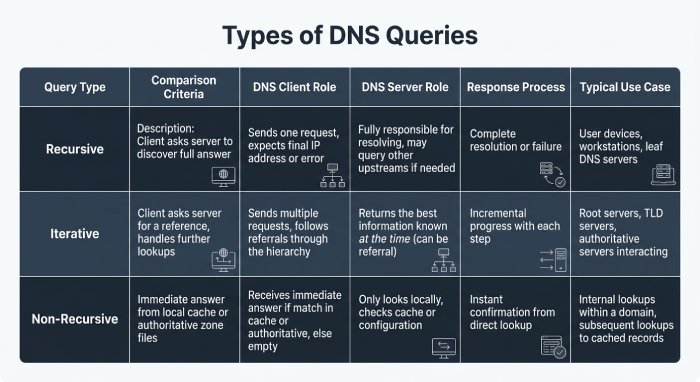
Recursive Queries
In a recursive query, the DNS resolver is responsible for delivering a complete answer to the client. If the resolver does not already know the answer, it must continue searching through other DNS servers until it finds the correct information.
Recursive queries are common in normal internet browsing because they simplify the lookup process for end users.
Iterative Queries
An iterative query works differently. Instead of finding the final answer itself, the DNS server responds with the best information it currently has. This may include referrals to other DNS servers that can continue the lookup process.
The client or resolver must then contact the next server in the chain until the answer is found.
Non-Recursive Queries
Non-recursive queries occur when the DNS server already has the requested information available. This typically happens when the result exists in the server’s cache or when the server is authoritative for the requested domain.
Because no additional lookups are required, non-recursive queries are usually the fastest.
Common DNS Server Types
DNS infrastructure consists of several server categories that each perform specific tasks within the lookup process.
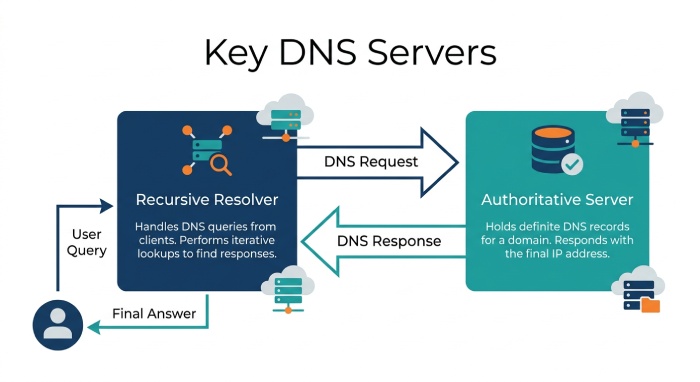
Recursive DNS Resolver
A recursive resolver acts as the intermediary between user devices and the broader DNS infrastructure. Its role is to locate the requested DNS records on behalf of the client.
Internet service providers commonly operate recursive resolvers for their customers, though many users also rely on public DNS services.
Recursive resolvers improve performance by storing cached responses for future requests.
Authoritative DNS Server
Authoritative DNS servers store the official DNS records for a domain. These servers provide the final verified answers to DNS queries.
When a resolver needs accurate information about a domain, it eventually reaches the authoritative server responsible for that domain’s DNS zone.
Authoritative servers are critical because they maintain the source of truth for domain records.
Caching DNS Server
Caching servers temporarily store DNS responses to reduce lookup times and minimize repeated queries to authoritative servers.
Caching helps:
- Improve browsing speed
- Reduce network traffic
- Lower server workloads
- Improve overall DNS efficiency
Cached information remains available until its Time To Live (TTL) expires.
Forwarding DNS Server
Forwarding DNS servers redirect DNS requests to another resolver instead of handling the lookup themselves.
Organizations often use forwarding servers to centralize DNS management, filter traffic, or improve security controls.
Most Common DNS Record Types
DNS records contain instructions that tell servers and applications how to handle requests for a domain. Different record types serve different purposes.
A Record
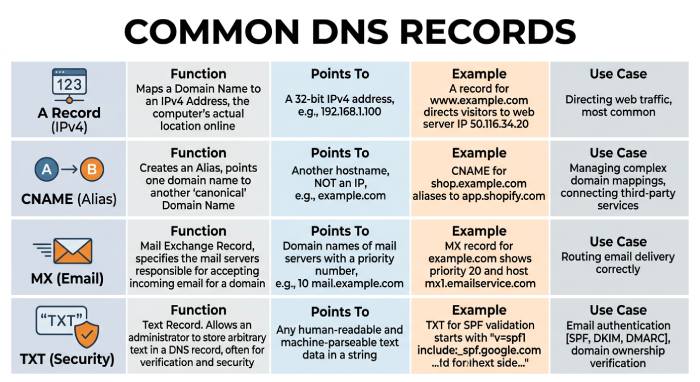
An A record maps a domain name to an IPv4 address. This is one of the most fundamental DNS record types and is commonly used for website hosting.
Example:
- example.com → 192.0.2.1
Without A records, browsers would not know where to find websites hosted on IPv4 servers.
AAAA Record
AAAA records function similarly to A records but point domains to IPv6 addresses instead of IPv4 addresses.
As IPv6 adoption grows, AAAA records are becoming increasingly important.
CNAME Record
A Canonical Name (CNAME) record creates an alias from one domain or subdomain to another domain name.
For example:
- blog.example.com → example.hostingprovider.com
CNAME records simplify DNS management by allowing multiple hostnames to point to the same destination.
MX Record
Mail Exchange (MX) records specify which mail servers are responsible for receiving email messages for a domain.
MX records include priority values that determine which server should receive mail first.
Without MX records, email delivery would not function properly.
TXT Record
TXT records store text-based information associated with a domain.
Modern TXT records are widely used for:
- SPF policies
- DKIM verification
- DMARC configurations
- Domain ownership verification
- Security-related configurations
TXT records have become especially important for email authentication and anti-spoofing protection, since they also hold the DMARC record that tells receivers how to treat unauthenticated mail. You can check DMARC record syntax and publication directly against DNS before relying on it.
NS Record
Name Server (NS) records identify the authoritative DNS servers responsible for a domain.
These records help direct DNS queries to the correct servers for resolution.
SOA Record
The Start of Authority (SOA) record contains administrative details about a DNS zone, including:
- Primary authoritative server
- Zone serial number
- Refresh intervals
- Retry values
- Expiration settings
SOA records help coordinate DNS zone synchronization between servers.
PTR Record
PTR records are used for reverse DNS lookups. Instead of mapping a domain to an IP address, PTR records map an IP address back to a domain name.
PTR records are commonly used in email validation and network troubleshooting.
SRV Record
Service (SRV) records specify servers responsible for particular services such as:
- Voice over IP
- Messaging systems
- Directory services
SRV records help applications discover the correct service endpoints automatically.
CAA Record
Certification Authority Authorization (CAA) records define which certificate authorities are permitted to issue SSL certificates for a domain.
CAA records improve certificate management security and reduce unauthorized certificate issuance risks.
DNS Caching and TTL
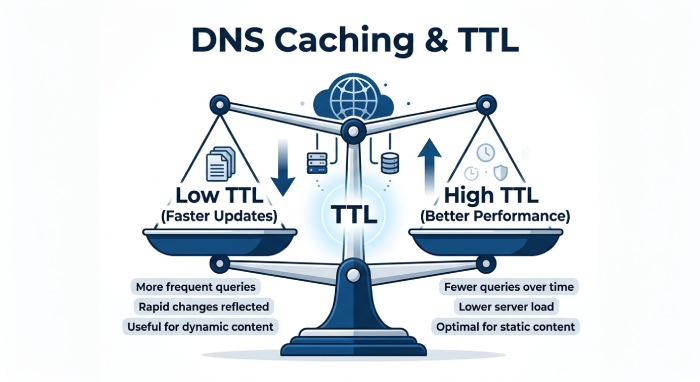
DNS caching helps speed up internet performance by storing recently retrieved DNS information temporarily.
The Time To Live (TTL) value determines how long cached records remain valid before a fresh lookup is required.
Lower TTL values allow quicker DNS updates but increase query traffic. Higher TTL values improve performance but may delay DNS changes during migrations or configuration updates.
Balancing TTL values correctly is important for both reliability and flexibility.
DNS Security Considerations
DNS plays a significant role in internet security. Attackers frequently target DNS infrastructure because it serves as a gateway to websites, email systems, and online services.
Common DNS-related threats include:
- DNS spoofing
- Cache poisoning
- DNS tunneling
- Distributed denial-of-service attacks
- Malicious TXT record abuse
- Domain hijacking
Security-focused DNS practices include:
- DNSSEC implementation
- Encrypted DNS protocols
- DNS traffic monitoring
- Strong access controls
- Email authentication standards like SPF, DKIM, and DMARC - you can build a DMARC record online in minutes
Recent cybersecurity research has also highlighted how attackers increasingly abuse DNS records and DNS traffic to conceal malicious activity or distribute malware.
Public DNS Services
Many users rely on public DNS providers instead of their internet provider’s default DNS servers.
Popular public DNS services include:
- Google Public DNS
- Cloudflare DNS
- Quad9
- OpenDNS
These providers often offer benefits such as:
- Faster query performance
- Enhanced privacy
- Malware filtering
- Improved reliability
- Encrypted DNS support
Encrypted DNS technologies such as DNS-over-HTTPS (DoH) and DNS-over-TLS (DoT) are becoming increasingly popular because they help protect DNS traffic from interception and monitoring.
Why DNS Management Matters
Proper DNS management is essential for maintaining website availability, email delivery, and internet security.
Incorrect DNS configurations can lead to:
- Website outages
- Email delivery failures
- Authentication problems
- Security vulnerabilities
- Slow performance
Businesses often rely on DNS monitoring tools and DNS management platforms to maintain uptime and quickly troubleshoot issues.
As cloud services, remote work, and online applications continue expanding, DNS infrastructure has become even more critical for organizations of all sizes.
Final Thoughts
DNS is one of the foundational technologies that keeps the internet functioning smoothly. Although users rarely see it in action, DNS continuously translates domain names, routes traffic, verifies services, and supports communication between systems worldwide.
Understanding DNS queries, DNS servers, and DNS record types helps organizations improve network reliability, strengthen security, and optimize internet performance. Whether managing websites, configuring email systems, or protecting domains from cyber threats, having a solid understanding of DNS remains essential in today’s connected world.
General Manager
General Manager of DuoCircle. Product strategy and commercial lead for DMARC Report's 2,000+ customer base.
LinkedIn Profile →Take control of your DMARC reports
Turn raw XML into actionable dashboards. Start free - no credit card required.