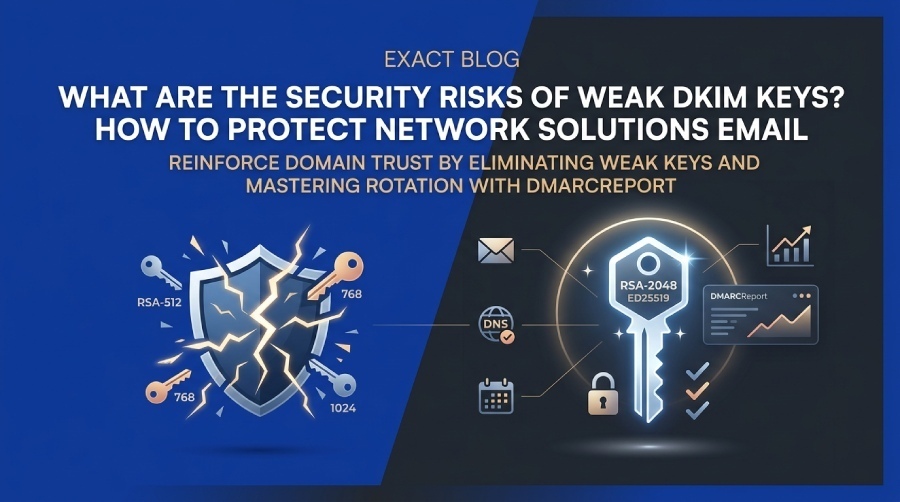
What Are The Security Risks Of Weak DKIM Keys? How To Protect Network Solutions Email

Quick Answer
Weak DKIM keys can make Network Solutions email vulnerable to spoofing, phishing, and unauthorized message signing. Protect your email by using strong DKIM keys, rotating them regularly, publishing secure DNS records, and monitoring authentication results for suspicious activity.
Try Our Free DKIM Lookup
Auto-discover DKIM selectors for any domain - scan 185 common selectors across all major providers.
Discover DKIM Selectors →Weak or short DKIM keys let attackers forge your domain’s signatures, replay or strip signatures to bypass DMARC, and mislead receivers into trusting spoofed messages; to protect Network Solutions email, enforce RSA-2048 (or dual-publish Ed25519 + RSA for compatibility), set strict DMARC alignment with a reject policy, rotate selectors regularly via Network Solutions’ DNS/email controls, and continuously monitor authentication and anomalies with DMARCReport.
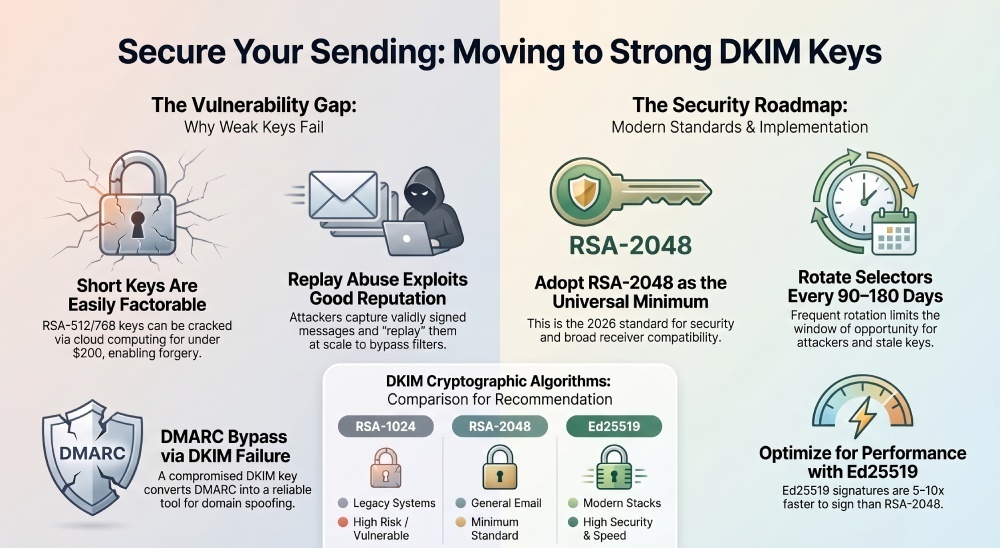
Email authentication with DKIM (DomainKeys Identified Mail) relies on public-key cryptography: your mail system signs headers with a private key, and receivers verify against your DNS-published public key. When keys are too short (e.g., RSA-512/768 or even aging RSA-1024), adversaries can feasibly recover the private key or mount downgrade, replay, or selector/DNS-manipulation attacks that cause receivers to “pass” messages you never sent—undermining both deliverability and security. Because DMARC “passes” when aligned DKIM passes, a weak DKIM key converts into a reliable domain-spoofing tool.
If you use Network Solutions for DNS and/or email, your defense should blend strong cryptography and disciplined operations: generate modern keys (RSA-2048 minimum; consider Ed25519 where supported), rotate selectors on a schedule, keep DNS TTLs short enough for emergency revocation, enforce DMARC p=reject with strict alignment, and monitor aggregate DMARC data, failure samples, and key health continuously. DMARCReport operationalizes this: it inventories DKIM selectors and key lengths across all your sending sources, flags weak or stale keys, correlates DMARC pass/fail by source and selector, and guides safe rotations with pre- and post-change verification.
Attacker Playbook: What Weak DKIM Keys Enable (and Why It Matters for Network Solutions)
Forged Signatures via Key Recovery
- Risk: Short RSA keys (512/768 bits) are factorable with commodity computers; RSA-1024 is not practically factorable today for broad attacks but is within strategic adversary reach and should be treated as legacy.
- Outcome: Adversary produces valid DKIM-Signature headers for your domain and selector, making DMARC align and pass at Gmail, Microsoft, Yahoo, and others.
- Hypothetical case (modeled on public factorization costs): A threat actor factors an exposed RSA-512 DKIM key for a small merchant’s domain for under $200 cloud cost in a weekend, then sends payments fraud to 30k recipients. DMARC passes for 92% of sends; open rates match legitimate mail; the fraud is discovered only after chargebacks.
Replay Abuse of Signed Mail
- Risk: DKIM doesn’t bind to recipient, time, or rate. Attackers can capture a validly signed message and “replay” it at scale, riding on your good reputation.
- Outcome: Bulk spam or phishing with your real DKIM pass. Receivers may throttle you, harming deliverability for Network Solutions–hosted mail.
- Mitigations: Per-source keys, frequent rotation, rate telemetry, and list-unsubscribe practices to limit abuse window.
DMARCReport connection: We baseline per-selector volume and receiver pass rates; sudden volume or pass spikes on a selector trigger anomaly alerts and replay investigation workflows.
Signature Stripping and Downgrade
- Risk: In transit, intermediaries (forwarders/mailing lists) can break or strip DKIM; attackers can remove DKIM headers on malicious mail and count on lax DMARC policies or aligned SPF to pass.
- Outcome: Spoofs may arrive if DMARC is p=none/relaxed and SPF aligns (common with forwarding).
- Mitigations: Set DMARC p=reject with adkim=s and aspf=s; leverage ARC where appropriate.
DMARCReport connection: We simulate DMARC outcomes under stricter alignment and policy to show exactly how many messages would have been blocked if policy were p=quarantine/reject—de-risking policy tightening.
Selector/DNS Hijack and Long-TTL Persistence
- Risk: If DNS is compromised or poorly segmented, an attacker can publish their own p= value at your selector; long Time-To-Live(TTL) extends the blast radius.
- Outcome: Valid-looking DKIM passes while you scramble to regain DNS control; caches hold the attacker’s key for hours/days.
- Mitigations: Role-based DNS access, DNSSEC, short (300–900s) TTLs on DKIM, and dual-selector designs for swift cutover.
DMARCReport connection: We monitor authoritative answers over multiple resolvers and flag inconsistent DNS or unusual TTLs; DNSSEC absence is annotated in posture reports.
The Right Cryptography Today: Algorithms and Key Lengths
Recommended Baselines
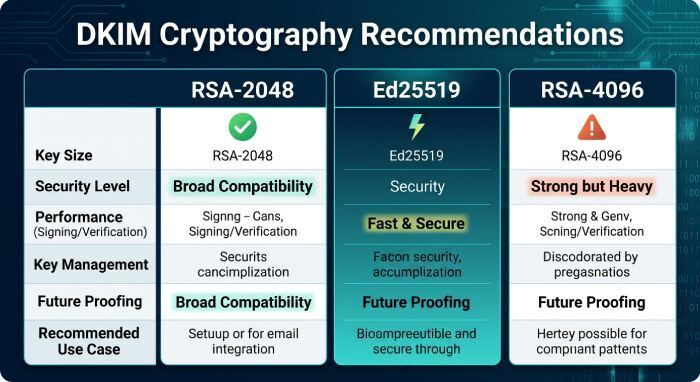
- RSA-2048 (sha256): Minimum standard for broad compatibility in 2026; widely supported by all major receivers and Network Solutions DNS.
- Ed25519-sha256: Short, fast keys with strong security; growing receiver support (not yet universal). Use in parallel with an RSA-2048 selector for maximum coverage.
- RSA-4096: Strong but heavy; risk of DNS record length issues and occasional receiver timeouts. Use only if you’ve validated your DNS/MTAs and key distribution pipeline.
| Scenario | Recommendation | Why | DMARCReport Value |
|---|---|---|---|
| General mail (marketing, transactional) | RSA-2048 | Ubiquitous support, safe security margin | Flags any ≤1024 keys; ensures sha256 use |
| Performance-sensitive, modern stack | Dual: Ed25519 + RSA-2048 | Speed + interoperability | Confirms both selectors pass across receivers |
| High-security enclave | RSA-2048 with frequent rotation (90 days) | Security via rotation; avoids 4096 pitfalls | Rotation calendar and drift alerts |
Performance note: Ed25519 signatures are typically 5–10x faster to sign and smaller on the wire than RSA-2048; verification is also efficient. For senders pushing >1M msgs/hour, Ed25519 can materially reduce CPU—publish both where possible.
DMARCReport tie-in: Our receiver-compatibility panel shows per-MSP acceptance of ed25519-sha256 for your traffic mix, and we verify that your DKIM-Signature uses rsa/sha256 or ed25519/sha256—never sha1.
Network Solutions: How to Publish, Change, and Rotate DKIM
Prerequisites
- Know your selector naming (e.g., s2026q3).
- Have your public key (TXT value starting with v=DKIM1; k=rsa or k=ed25519; p=…).
- Decide TTL (300–3600 seconds recommended).
DMARCReport helps you catalog selectors in use by each sending system (Network Solutions Professional Email, CRM, marketing ESPs), avoiding clashes.
Publishing DKIM in Network Solutions DNS
- Sign in to Network Solutions Account Manager.
- Go to My Products & Services > Domains > Manage.
- Open Edit DNS or Manage DNS Records.
- Choose Advanced DNS Records, then add a TXT record.
- Host/Name:
selector._domainkey.yourdomain.com(e.g.,s2026q3._domainkey.example.com). - TTL: 300–900 seconds for agility.
- Text: Your DKIM public key (v=DKIM1; k=rsa; p=Base64…).
- Save and wait for propagation.
Validation: Use a DKIM validator or DMARCReport’s DNS auditor to confirm the TXT record is visible and not truncated across multiple resolvers.
Enabling/Rotating DKIM for Network Solutions Email
- Network Solutions Professional Email: In the Email control panel, locate Authentication or Advanced Settings; enable DKIM for the domain. The portal may generate a selector and public key for DNS—publish in your DNS as above. If your plan lacks this option, open a support ticket to have DKIM enabled and keys issued.
- Rotation:
- Add a new selector in DNS (e.g., s2026q4) with the new public key.
- Reconfigure the sending platform to sign with the new selector.
- Monitor with DMARCReport until new-selector pass rates stabilize across receivers.
- Remove the old selector from DNS.
Emergency rotation playbook (suspected compromise): lower TTL (if higher), publish new selector immediately, switch signing, then remove the old key; details below.
DMARCReport linkage: We run “staged rotation checks” that verify both old/new selectors passing concurrently, alert on residual use of old selectors, and confirm full cutover before advising key removal.
DKIM Key Management Best Practices (Small Biz to Enterprise)
Key Generation and Storage
- Generate keys on hardened hosts; prefer OpenSSL (RSA-2048) or a modern library for Ed25519.
- Store private keys in restricted directories or HSM/KMS; never in source repos or shared drives.
- Separate keys by sending platforms (ESP, CRM, app) to compartmentalize risk.
DMARCReport: Our source inventory maps which IPs and vendors sign with which selectors, revealing over-shared keys.
Rotation Intervals and Governance
- Standard rotation: 90–180 days; 90 days for higher-risk brands or high-volume senders.
- Event-driven rotation: immediately after suspected compromise, staff turnover, or vendor offboarding.
- Keep two selectors live during rotation to avoid gaps.
DMARCReport: Rotation scheduler with reminders; alerts for selectors older than policy (e.g., >180 days).
Access Controls and Audit
- Least-privilege access to DNS and MTA configs.
- Change tickets for key generation and rotation.
- DNSSEC were available to protect DKIM records.
DMARCReport: Posture dashboard flags missing DNSSEC and long-TTL DKIM records.
Defense in Depth: DKIM + SPF + DMARC
Strict Alignment and Policy
- DMARC record:
v=DMARC1; p=reject; rua=mailto:reports@dmarcreport.example; pct=100; adkim=s; aspf=s; fo=1 - Start with p=quarantine pct=25, then move to reject 100% once authentication coverage is demonstrated.
- Enforce alignment: make sure the DKIM d= matches the From: domain (not just a shared subdomain by an ESP).
DMARCReport: We run policy simulations showing the exact impact of moving from p=none to quarantine/reject and from relaxed to strict alignment, so you can tighten with confidence.
SPF as a Backstop
- Maintain a clean, scoped SPF record; prune stale vendors.
- Avoid +all, use include: responsibly, and keep under 10 DNS-lookups.
DMARCReport: Highlights SPF mechanisms that cause lookups to exceed limits and identifies sources failing SPF or DKIM so you can remediate before enforcing DMARC.
Monitoring and Detection in Production
Signals to Watch
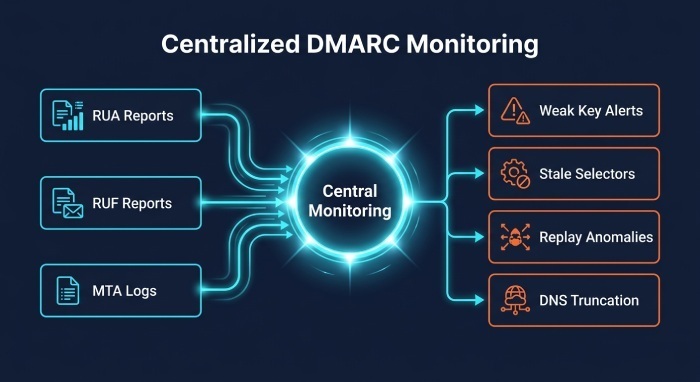
- DMARC Aggregate (RUA): volume by source, pass/fail by SPF/DKIM, selectors used.
- DMARC Forensic/Failure (RUF): samples of failed auth (where supported by receivers).
- MTA logs: DKIM signing failures, key not found, canonicalization errors.
- Validator scans: periodic checks of DNS visibility and key length.
DMARCReport: Centralizes RUA/RUF from all receivers, correlates with DNS and selector metadata, and issues:
- Weak-key alerts (≤1024 RSA).
- Stale-selector warnings (>180 days).
- Anomalous pass spikes (possible replay).
- Cross-receiver anomalies (one ISP failing due to DNS truncation).
Misconfigurations That Break DKIM (and How to Fix Them)
Common Errors
- Incorrect selector/hostname: Should be
selector._domainkey.example.com. - Publishing the private key by mistake: Ensure TXT contains only the public key (p=), not any BEGIN PRIVATE KEY material.
- Overlong single-string TXT: Split the p= value into quoted 255-char chunks; most DNS UIs (including Network Solutions) handle this automatically when you paste, but confirm after save.
- Trailing spaces/CRLFs or smart quotes: Paste as plain text; no extraneous characters.
- TTL too long (e.g., 86400): Slows rotation and incident response. Use 300–900 for DKIM.
- CNAME chains to third parties that exceed resolver limits: Keep CNAME (Canonical Name) record chains short and test resolution from multiple vantage points.
DMARCReport: Our DNS linting flags malformed records, suspicious characters, excessive TTLs, and CNAME resolution failures. We also surface receivers reporting temperror/permanent errors tied to DNS issues.
Deliverability and Interoperability: Selectors, Rotation, and Key Length
Subdomains, Multiple Selectors, and Traffic Splitting
- Use distinct selectors per platform (e.g., s-mktg, s-crm) or per quarter (s2026q3) to enable safe rotation and blast-radius control.
- For subdomain senders (news.example.com), publish subdomain-specific selectors to keep alignment clean.
DMARCReport: Per-selector deliverability panels show Gmail/Microsoft/Yahoo pass rates, so you can confirm that rotations or new subdomain keys haven’t harmed acceptance.
Key Length Impacts
- RSA-4096: Large p= values may hit DNS provider UI limits or cause truncation/timeout at some receivers; test carefully.
- Ed25519: Compact and fast, but some legacy gateways may not recognize ed25519-sha256 yet—hence dual-publish with RSA-2048.
DMARCReport: Compatibility matrix by receiver/region; alerts if a subset of receivers stops seeing valid keys after a key-length change.
Incident Response: Suspected DKIM Key Compromise on Network Solutions
Immediate actions (first 60 minutes):
- Lower TTL on the affected selector to 300s in Network Solutions DNS.
- Generate a new keypair; publish a new selector TXT (e.g., s-incident2026) immediately.
- Update all sending systems (Network Solutions Professional Email and any ESPs) to sign with the new selector.
- Remove the old compromised DKIM TXT once the new selector is passing at major receivers.
- Tighten DMARC to p=quarantine or reject (if not already) and set adkim=s.
Next 24–72 hours:
- Use DMARCReport to confirm the old selector’s use has dropped to zero; investigate any residual volume.
- Review access logs for DNS and Mail Transfer Agent (MTA)
- systems to identify the compromise vector.
- Rotate credentials and revoke keys at any third-party senders that had access.
- Notify security/brand teams; consider customer advisories if abuse occurred.
Long-term fixes:
- Enforce quarterly rotations; segment keys per platform; adopt DNSSEC; implement role-based access to DNS/email control panels.
- Consider dual Ed25519 + RSA-2048 publication for performance/security balance.
DMARCReport: Our incident console timestamps detection (e.g., first anomalous pass spike), guides your rotation steps, and verifies closure with cross-receiver evidence.
Tailored Deployment Patterns by Use Case
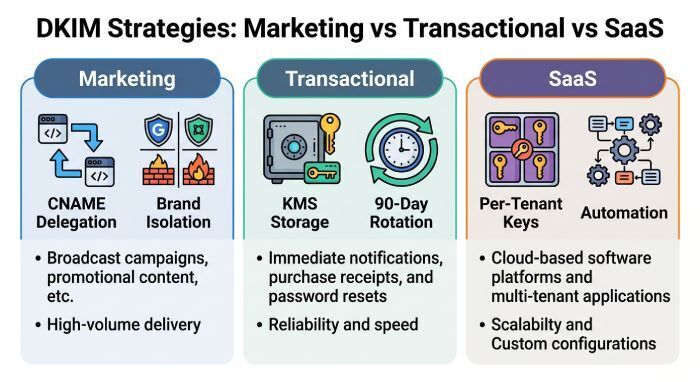
Marketing ESPs
- Delegate DKIM via CNAME or publish ESP-provided selectors; insist on RSA-2048 minimum.
- Use a unique selector per brand/subdomain to isolate replay/abuse.
- Verify alignment: From: matches d= domain, not the ESP’s shared domain.
DMARCReport: Per-source breakdown shows which email service provider (ESP) are authenticating/aligned and flags any using weak keys.
Transactional Email (App/CRM)
- Self-hosted MTAs: Generate and store keys in KMS/HSM; automate 90-day rotations.
- High-volume APIs: Consider dual Ed25519 + RSA-2048 to reduce signing CPU.
DMARCReport: Rotation runbooks and CI webhooks validate that new selectors are live before code deploys switch signing.
Multi-tenant SaaS
- Per-tenant selectors and keys to compartmentalize risk and simplify revocation.
- Automated DNS onboarding flows with preflight DKIM/DMARC checks.
DMARCReport: Tenant-level dashboards track each customer’s selector health, alignment, and DMARC policy, preventing platform-wide deliverability incidents.
FAQ
Is RSA-1024 still acceptable for DKIM?
It may still verify at many receivers, but it’s below modern security expectations and violates most enterprise policies; use RSA-2048 minimum. DMARCReport flags RSA-1024 as Medium-to-High risk and prioritizes it for rotation.
Do I need DNSSEC for DKIM?
While not mandatory, DNSSEC prevents on-path tampering with your DKIM public keys and is strongly recommended. DMARCReport’s posture report notes DNSSEC status and its potential impact.
Will Ed25519 break deliverability?
Most major receivers increasingly accept ed25519-sha256, but not all intermediaries do. Publish Ed25519 in parallel with RSA-2048 (different selectors) and monitor pass rates in DMARCReport before deprecating RSA.
How often should I rotate DKIM keys?
Every 90–180 days for most organizations; 90 days for high-risk brands or shared-tenant platforms. DMARCReport automates reminders and validates staged rotations.
What if my DKIM TXT looks too long?
For RSA-4096 especially, TXT values can exceed 255 characters; split into quoted chunks or, better, standardize on RSA-2048. DMARCReport’s DNS lint detects truncation before it hurts deliverability.
Conclusion: Strong Keys + Strong Operations, Verified by DMARCReport
Weak DKIM keys turn DMARC into a liability by making forged signatures feasible, enabling replay, and letting adversaries weaponize your brand; protecting Network Solutions email demands modern cryptography (RSA-2048 or dual Ed25519+RSA), strict DMARC alignment/policy, disciplined selector rotation via Network Solutions’ DNS/email controls, and continuous monitoring. DMARCReport is the operational backbone for that program: it inventories selectors and algorithms across all your senders, flags weak/stale keys and DNS pitfalls, simulates safer DMARC policies, guides zero-downtime rotations, and proves that your messages pass authentication everywhere they should—and nowhere they shouldn’t.
General Manager
General Manager of DuoCircle. Product strategy and commercial lead for DMARC Report's 2,000+ customer base.
LinkedIn Profile →Take control of your DMARC reports
Turn raw XML into actionable dashboards. Start free - no credit card required.