What Is Bot Activity? How To Detect Suspicious Email Behavior

Quick Answer
Bot activity refers to automated actions performed by software that may generate suspicious email behavior, such as unusual sending patterns, repeated login attempts, or sudden message spikes. Detecting these signs helps identify potential threats and strengthen email security.
Bot activity refers to actions performed by automated software rather than human users. While some bots serve legitimate purposes, others can trigger suspicious email clicks, manipulate engagement metrics, or attempt to steal sensitive information. Understanding what bot activity looks like and how to detect unusual email behavior can help businesses protect their email campaigns, improve security, and maintain accurate engagement data. In this guide, we’ll explore the common warning signs of email bot activity and practical ways to identify and prevent potential threats.
What Bot Activity Means in the Context of Email
Defining bot activity in email systems
Bot activity refers to actions performed by an automated software application rather than a human user. In email marketing, security, and Customer Support workflows, bot activity can include opening messages, clicking links, submitting forms, harvesting an email address, testing login credentials, or interacting with a chatbot. An internet bot is not inherently harmful; it is simply a software application designed to perform automated tasks, often at a scale humans cannot match.
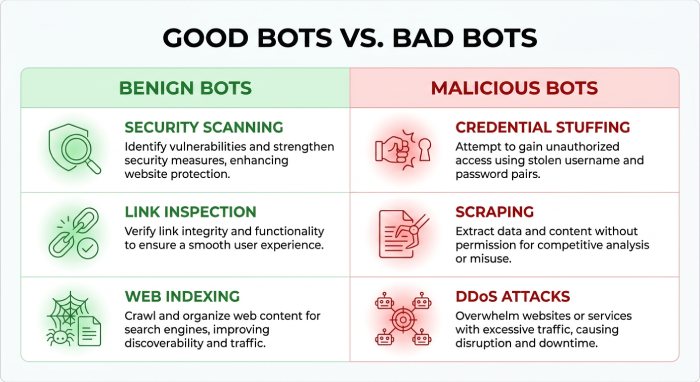
For example, good bots may help verify links, scan websites for malware, monitor uptime, or index content for Search Engine Results Pages. A web crawler such as Googlebot follows HTTP requests across webpages, respects signals like robots.txt when configured properly, and helps content appear in SERPs. Similarly, a customer service bot or chatbot can answer routine questions, use natural language processing, and improve user experience.
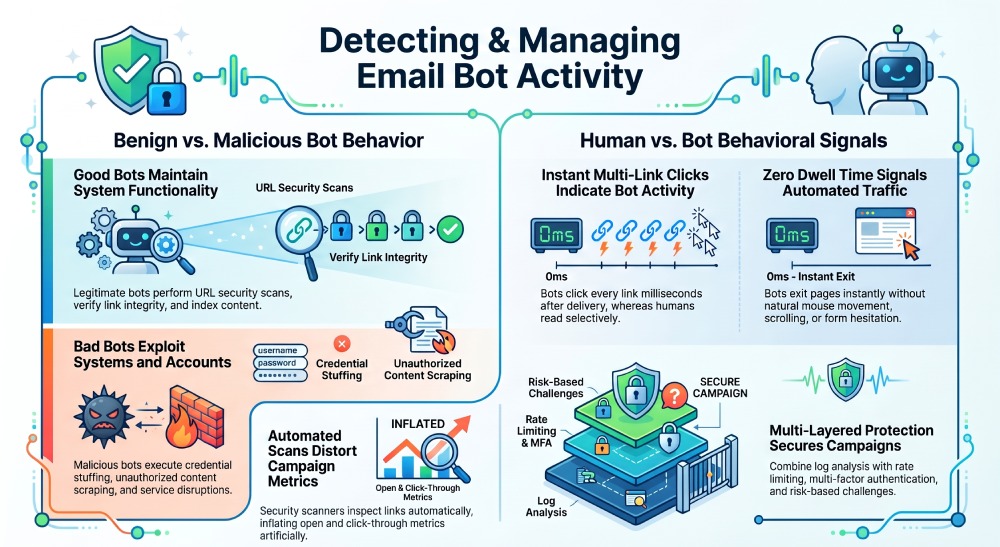
However, bad bots are designed to exploit systems. A malicious bot may generate spam clicks, attempt credential stuffing, perform email address harvesting, or support account takeover attempts. In this context, bot activity becomes a security and deliverability issue because automated tasks can distort engagement data, trigger fraud controls, and expose brands to security risks.
Good bots vs. bad bots in email behavior
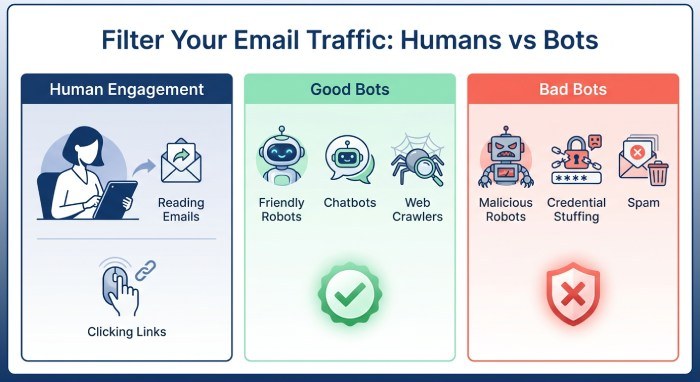
Good bots support useful repetitive tasks. Monitoring bots may check whether campaign links resolve properly. Transaction bots may confirm receipts, password resets, or order updates. Shopping bots can compare prices or track availability, while Chatbots may help users complete support workflows. These good bots are still automated, but their purpose is legitimate.
Bad bots, by contrast, perform repetitive tasks that damage trust. Spambots send bulk messages. Ticketing bots may abuse event queues. A malicious bot can click every link in an email to test for vulnerabilities, while a botnet may coordinate thousands of devices for malicious activity. These bad bots often hide behind rotating IP address ranges, cloud infrastructure, compromised browsers, or scripted HTTP behavior.
Common Types of Email Bot Activity and Why They Happen
Link scanning, scraping, and security checks
Some bot activity occurs because corporate gateways, antivirus tools, and security platforms inspect URLs before users click. These tools may behave like a web crawler by opening links, following redirects, and checking landing pages. This type of internet bot activity is often benign, but it can inflate opens and clicks.
Web scraping and content scraping can also target landing pages connected to campaigns. A web crawler may scan websites, copy webpages, or collect pricing and offer data. Legitimate Web crawlers help index content, while bad bots may ignore robots.txt and scrape content for competitive intelligence, phishing attack kits, or behavioral advertising profiles.
Cloudflare, AWS, and other infrastructure providers see this pattern frequently across web traffic and email-driven website traffic. Cloudflare Bot Management, for instance, is designed to separate good bots from bad bots by analyzing request patterns, device signals, and traffic anomalies.
Fraud, abuse, and account attacks
More dangerous email bot activity includes credential stuffing attacks, brute force attack patterns, and Brute force password cracking. In these cases, a malicious bot uses leaked credentials or guessed passwords to attempt account takeover. Credential stuffing is especially common after data breaches because bad bots can test millions of username-password pairs as automated tasks.
Other forms include click fraud, email address harvesting, and spam registration. A malicious bot may sign up for newsletters to poison lists, abuse coupon codes, or trigger fake engagement. Shopping bots may support inventory hoarding by reserving scarce products, while Ticketing bots can do the same for concerts or travel. Social bots on Social media platforms can amplify phishing links or manipulate reputation around campaigns.
In extreme cases, bot-driven traffic can support a DoS attack or DDoS attack against landing pages linked from high-volume emails. A botnet can flood servers with HTTP requests, creating downtime and damaging the user experience.
Key Warning Signs of Suspicious Email Behavior
Engagement patterns that do not look human
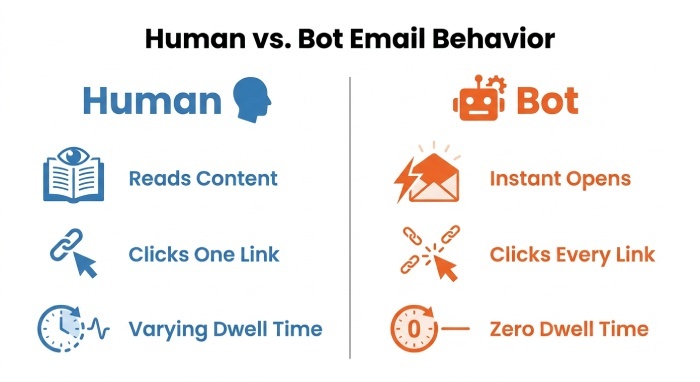
Suspicious email behavior often appears as engagement that is too fast, too uniform, or too broad. If hundreds of recipients open an email within seconds of delivery and click every link, the cause may be bot activity rather than genuine interest. A software application can perform repetitive tasks instantly, while humans behave with more variation.
Warning signs include:
- Clicks occurring milliseconds after delivery
- Every link in the email being clicked by the same recipient
- Opens and clicks from unusual geographies
- Repeated activity from the same IP address or user agent
- High click-through rates with no conversions
- Sudden spikes in unsubscribe or form submissions
- Multiple password reset attempts tied to one email address
These patterns suggest bad bots, a malicious bot, or automated scanning by a security tool. Behavioral analysis helps distinguish between harmless good bots and abusive bad bots.
Metric snapshot: human-like vs. bot-like behavior
A human may open an email, read it, click one relevant link, browse a landing page, and return later. A bot may open the message, trigger tracking pixels, click every link, send multiple HTTP requests, and exit within seconds. That difference is central to anomalies detection.
Technical signals in logs and campaign data
Email and web logs often reveal bot activity more clearly than campaign dashboards alone. Look for traffic anomalies such as repeated clicks from data center IP ranges, missing browser attributes, unusual user agents, or sessions with no mouse movement, scrolling, form hesitation, or dwell time.
A web crawler, chatbot, internet bot, or automated testing software application may identify itself honestly in the user agent. Googlebot, for example, is a known web crawler used by Google to index content for Search Engine Results Pages. But bad bots often impersonate browsers or good bots to bypass access control.
Security teams should also watch for patterns that connect email clicks to login abuse, credential stuffing, spam submissions, and account takeover. Bot activity in email rarely exists in isolation; it often connects to broader website traffic, API traffic, and authentication events.
How to Detect Bot Activity Using Email Metrics and Security Tools
Use email analytics, logs, and behavioral analysis together
Detecting bot activity requires more than open rates. Privacy features, link scanners, and automatic image loading can make opens unreliable. Instead, combine email metrics with web analytics, authentication logs, and behavioral analysis.
Important signals include:
- Time from send to open or click
- Number of links clicked per recipient
- IP address reputation and ASN
- Device and browser consistency
- Session duration after the click
- Conversion behavior after engagement
- Frequency of failed logins or password resets
Machine learning can help detect unusual patterns across large datasets by comparing typical engagement behavior with activity that appears automated. Deep learning may also be used in advanced bot management systems to detect evasive behavior, while artificial intelligence can classify sessions as likely human, good bots, or bad bots.
Apply bot management and bot protection technologies
Bot management tools help organizations detect, challenge, allow, or block automated traffic. Cloudflare Bot Management, AWS security services, and other Bot Management platforms evaluate HTTP signals, fingerprint devices, inspect request velocity, and apply risk scores. Bot protection can include rate limiting, CAPTCHA alternatives, JavaScript challenges, access control rules, and allowlists for known good bots.
Configure bot protection to distinguish legitimate automated traffic from suspicious activity. Rate limiting, access controls, and risk-based challenges can help reduce automated abuse on websites and forms linked from email campaigns. Review traffic patterns before blocking activity, as legitimate email security scanners may also generate automated requests.
Email security tools can automatically scan links in incoming messages to detect phishing attempts and malicious websites. These automated checks may trigger clicks that appear in campaign analytics even when recipients have not interacted with the email. Comparing click timestamps, link activity, and website sessions can help distinguish automated scanning from genuine user engagement.
Best Practices to Reduce Risk and Protect Email Campaigns
Improve list hygiene and authentication controls
DMARC reports help domain owners identify the sources sending email using their domain and review SPF and DKIM authentication results, including alignment with the domain’s DMARC policy. This information can help investigate unauthorized sending and potential email spoofing. However, DMARC reports do not directly identify automated email clicks or distinguish human engagement from bot activity. For a more complete picture, combine DMARC reporting with email campaign analytics, website logs, and authentication records.
Reducing risky bot activity starts with strong email operations. Use confirmed opt-in, remove invalid addresses, suppress suspicious signups, and monitor engagement quality rather than raw volume. Email address harvesting can put your brand on spam lists, so avoid exposing addresses directly on webpages and use forms with validation.
Strengthen account security with multifactor authentication, rate limits, login throttling, and anomaly-based access control. These controls reduce the impact of credential stuffing, brute force attack attempts, and account takeover campaigns. Monitor for repeated failed logins after large sends, especially when an email links to account pages.
Design campaigns with bot-aware measurement
Marketers should assume some bot activity is present in every campaign. Segment suspected bot clicks from human engagement, avoid overreacting to inflated metrics, and compare email clicks against on-site behavior. If a campaign has a high click rate but poor conversions, bad bots or security scanners may be responsible.
Protect landing pages with bot protection rules, validate form submissions, and watch for content scraping. If you use interactive email, embedded media, or features such as Picture in Picture on linked experiences, track whether users behave naturally after arrival. Separate monitoring bots and security scanners from real prospects when measuring performance.
Balance automation, usability, and security
Not all automation is dangerous. Good bots, a helpful chatbot, transaction bots, and monitoring bots can improve reliability and user experience. A web crawler can help index content, and Chatbots can reduce Customer Support workload. The goal is not to block every internet bot, but to distinguish good bots from bad bots.
A mature strategy combines bot management, machine learning, behavioral analysis, and clear governance. Allow trusted good bots, challenge suspicious automation, and block a malicious bot when it creates security risks. By understanding how bot activity appears in email metrics, teams can protect campaigns, preserve accurate reporting, and reduce exposure to spam, account takeover, click fraud, and other forms of malicious activity.
General Manager
General Manager of DuoCircle. Product strategy and commercial lead for DMARC Report's 2,000+ customer base.
LinkedIn Profile →Take control of your DMARC reports
Turn raw XML into actionable dashboards. Start free - no credit card required.