When Was Email Invented? How Email Became A Global Communication Tool

Quick Answer
Email was invented in the early 1970s, when Ray Tomlinson developed networked email and introduced the “@” symbol for addresses. Over time, email evolved from a simple computer messaging system into a fast, reliable, and essential global communication tool.

Email has evolved from simple messages exchanged between networked computers into a global communication system that carries business correspondence, financial transactions, account notifications, and sensitive information. As email became more widespread, new challenges such as spam, spoofing, phishing, and sender impersonation emerged, leading to the development of authentication technologies such as SPF, DKIM, and DMARC.
The Short Answer: When Email Was Invented and Who Created It
Email, in the modern networked sense, was invented in 1971 by Ray Tomlinson, an engineer working on ARPANET-related projects. His email invention combined two existing ideas: local computer-based messaging and file transfer across a network. By adapting SNDMSG, a local mail program, and CPYNET, a File Transfer Protocol-style file-copying tool, Tomlinson created a way to send mail messages between different computers.
The broader history of email is more complex. Before Tomlinson’s breakthrough, researchers at MIT and elsewhere had already developed electronic mail-like features on time-sharing systems. These early email systems allowed users on the same machine to leave messages for one another, often by appending text to shared files or a mailbox file. However, Tomlinson’s key contribution was network mail: electronic mail sent from one computer to another over ARPANET.
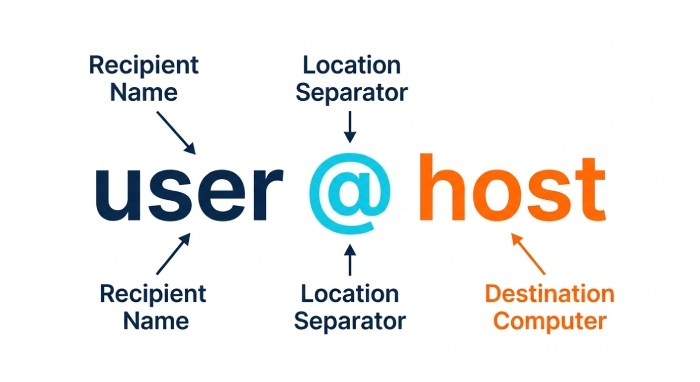
His most famous design choice was the @ symbol. Tomlinson used it in the address syntax to separate the user from the host machine, as in “user@computer.” That simple convention became one of the most recognizable elements in online communication and remains central to email systems today.
Early Messaging Before Email: Time-Sharing Systems and ARPANET
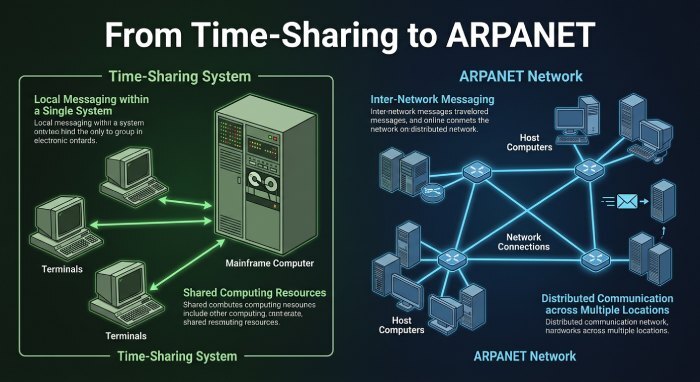
The history of email began before modern networked email existed. Earlier technologies such as the electrical telegraph, telex, and teleprinters established the idea of transmitting messages quickly over long distances. However, the development of computer-based messaging introduced a new possibility: storing messages electronically so recipients could access them later. In the 1960s, electronic messaging began to emerge within time-sharing computer systems. At MIT, the Compatible Time-Sharing System (CTSS) allowed multiple users to access a mainframe through terminals. CTSS included a form of computer mail that enabled users to leave messages for others on the same system. Although this was not networked email, it established important concepts such as electronic mailboxes, stored messages, and asynchronous communication.
Time-sharing was important because computers were expensive and commonly shared by multiple users. Instead of communicating through physical interoffice mail, users could leave a message electronically for another person using the same computer system. The recipient could then access the message later without needing to be online at the same time.
The next major step came with ARPANET, the early computer network developed under the U.S. Advanced Research Projects Agency. ARPANET connected computers at universities and research institutions, creating a way for information to move between separate systems. This network environment provided the foundation for networked electronic mail, eventually leading to the breakthrough work of Ray Tomlinson in 1971.
From Shared Files to Early Mail Applications
Before full email protocols existed, many mail applications relied on shared files. A user might append a message to another user’s mailbox file on the same system. Unix mail later followed a similar local-delivery model, storing messages in files that email clients or command-line tools could read.
These early email systems were primitive compared with modern webmail, but they established core concepts: the mailbox, stored mail messages, sender and recipient identities, and delayed reading. They also made computer-based messaging practical for teams using time-sharing on mainframes and minicomputers.
Ray Tomlinson’s Breakthrough: The @ Symbol and Networked Email
Ray Tomlinson’s 1971 work stands at the centre of the modern email invention story because it helped transform local electronic mail into networked communication. Working with ARPANET-connected computers, he modified SNDMSG so messages could be sent between different hosts, while CPYNET provided a way to transfer files between computers.
One of Tomlinson’s most lasting contributions was the use of the @ symbol in email addresses. He used the symbol to separate the recipient’s username from the computer or host where the account was located. The resulting “user@host” format provided a simple way to identify both the person and the destination of a message.
This addressing convention remained useful as email systems evolved from mainframes and minicomputers to personal computers, smartphones, and cloud-based services. The @ symbol eventually became one of the most recognisable features of digital communication.
Tomlinson did not initially regard his work as a world-changing event. However, networked email quickly proved useful to researchers and technical communities using ARPANET. It allowed people at different locations to exchange messages without requiring both parties to be online at the same time. Unlike instant messaging, email was designed around asynchronous communication, allowing messages to be stored and retrieved later.
Why ARPANET Email Spread Quickly
ARPANET email became popular because it addressed a practical need among researchers and organisations working across different locations. People could use email for project coordination, technical discussions, and sharing information without relying on physical mail or requiring simultaneous communication.
As email usage expanded, the need for common addressing, message formatting, routing, and delivery rules became increasingly important. These requirements contributed to the development of formal email standards and protocols, helping different email systems communicate more reliably with one another.
How Email Evolved Through Standards, Personal Computers, and the Internet
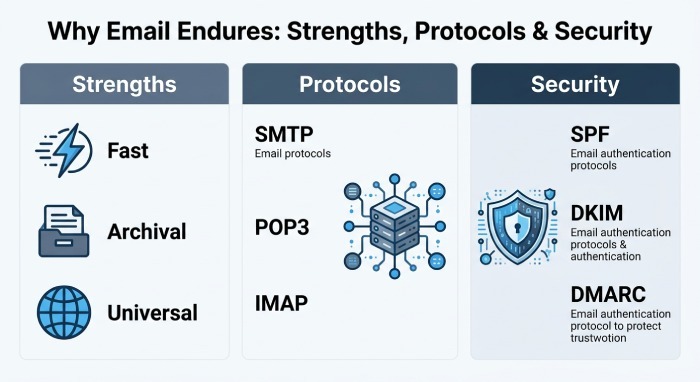
As networks expanded, email systems needed consistent rules. RFCs helped define message formats and delivery behavior. The most important later milestone was SMTP, the Simple Mail Transfer Protocol, which became the standard for sending mail across the internet. SMTP defined how a message transfer agent passes mail from one server to another, making large-scale mail transfer possible.
Retrieval also needed standards. POP3 allowed users to download messages from a server to an email client, while IMAP allowed mail to remain on the server and synchronize across devices. Together, SMTP, POP3, and IMAP became the core email protocols behind modern email systems. These email standards made electronic mail more portable, reliable, and vendor-neutral.
The path was not perfectly smooth. The Protocol Wars of the 1980s and early 1990s involved competing networking models and standards, including X.400, which governments promoted through frameworks such as GOSIP. X.400 was powerful but complex, while internet email based on SMTP proved simpler and more adaptable. The victory of internet email helped make online communication more open and scalable.
At the same time, proprietary electronic mail systems flourished inside businesses. IBM developed OFS (Office System) and IBM Profs for office automation. DEC offered ALL-IN-1. Hewlett-Packard built HPMAIL and HP DeskManager. CompuServe provided consumer and business messaging services, while Xerox Star demonstrated a graphical office environment that influenced the email client experience. Business Week and other business publications covered the rise of office automation as E-mail moved from research labs into corporate life.
The United States Postal Service even explored electronic delivery through E-COM, an attempt to combine electronic document transmission with physical mail delivery. These experiments show how seriously institutions took computer-based messaging as an extension of traditional interoffice mail and postal systems.
Why Email Became a Global Communication Tool and Its Lasting Impact
Email became global because it combined several strengths that other communication tools lacked. It was faster than postal mail, cheaper than many telecommunication services, more flexible than telex, and better documented than many proprietary electronic mail systems. It worked across organizations, operating systems, LAN environments, and eventually the public internet.
The rise of personal computers changed the user experience. Instead of logging into mainframes or minicomputers through terminals, people began using desktop email clients. Later, webmail made electronic mail available through any browser, and smartphones made email systems constantly accessible. A modern email client may hide the complexity, but behind the interface are still SMTP for sending, POP3 or IMAP for retrieval, a mailbox, mail messages, and message transfer agent infrastructure.
Email also survived the arrival of instant messaging. In fact, instant messaging and email evolved into complementary forms of online communication. Instant messaging is ideal for quick, synchronous exchanges, while electronic mail remains better for formal records, attachments, workflows, account creation, newsletters, contracts, and long-lived correspondence. The durability of email systems comes from this balance: they are personal, organizational, and archival at the same time.
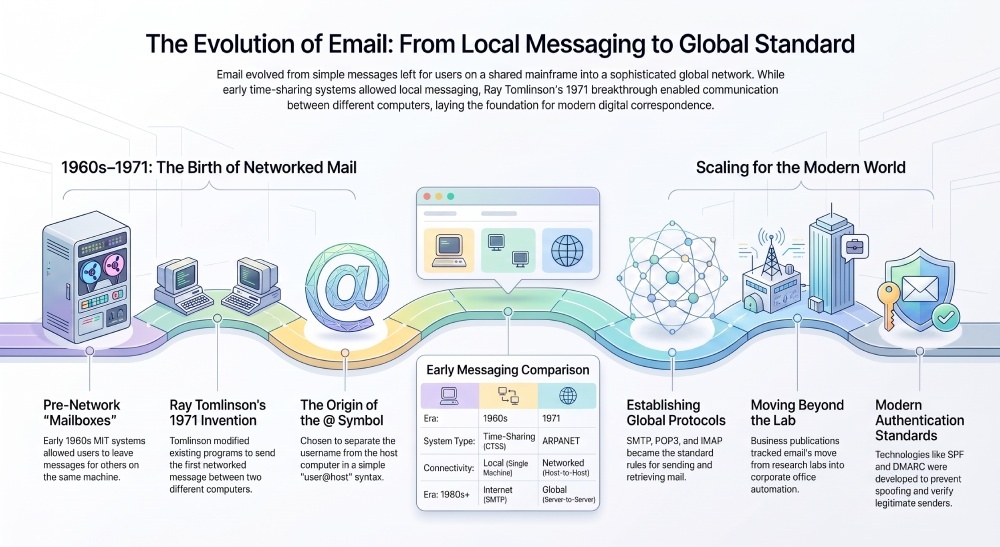 As email evolved, SPF, DKIM, and DMARC became essential email authentication standards that help verify legitimate senders, prevent spoofing, and protect domains from phishing and impersonation.
The history of email is therefore not only a technical timeline. It is a story of how computer-based messaging moved from time-sharing on mainframes, to ARPANET research communities, to minicomputers in offices, to global internet infrastructure. Ray Tomlinson’s email invention gave networked electronic mail its defining form, but decades of mail applications, email protocols, email standards, and user adoption turned it into one of the most important communication tools ever created.
General Manager
General Manager of DuoCircle. Product strategy and commercial lead for DMARC Report's 2,000+ customer base.
LinkedIn Profile →Take control of your DMARC reports
Turn raw XML into actionable dashboards. Start free - no credit card required.