The DMARC Divide: Why Big Brands Enforce While Most Domains Still Do Not

Quick Answer
DMARC enforcement remains low across most domains, while major brands show higher adoption. Learn how SPF, DKIM, and DMARC work together to improve email authentication, reduce spoofing risks, and help organizations move from monitoring to stronger enforcement.
Try Our Free DMARC Checker
Validate your DMARC policy, check alignment settings, and verify reporting configuration.
Check DMARC Record →Executive takeaway
Publishing DMARC does not mean requesting action against forged email. The supplied 2026 evidence reports 63.0% enforcement among Fortune Global 500 domains, versus 12.8% across a broad Tranco sample. Different populations limit that comparison, but a single traffic-ranked study also finds a substantial enforcement gap. Small-firm evidence shows that foundational authentication often outpaces enforcement. These findings establish an association with prominence, not its causes.
The operational priority is to identify legitimate senders, repair authentication alignment, and maintain enforcement with working reporting. DNS scans measure published policies, not guaranteed delivery outcomes or protection against every phishing technique.
The record is there. Is the protection?
Publishing DMARC does not necessarily ask receiving systems to act on authentication failures. A monitoring policy, p=none, requests neither quarantine nor rejection when messages fail DMARC. The central divide separates publishing a policy from requesting enforcement.
Two 2026 measurements illustrate that divide across very different populations. DMARCguard’s Tranco scan found enforcement on 12.8% of 5,499,028 domains. This provides a broad ranked-domain baseline, not a representative measure of business security practices.
Among domains representing the Fortune Global 500, enforcement reached 63.0%, according to SimpleDMARC’s study. These company domains differ substantially from a broad website-ranking population. The contrast is substantial, but it does not establish that company size causes stronger enforcement.
A within-study comparison provides clearer evidence of an association with visibility. 1Lookup’s September 2026 census reports 65.5% enforcement in its high-traffic mail-domain cohort, compared with 29.5% in its long-tail cohort. Shared measurement methods improve comparability, although traffic rank still cannot explain policy choices.
This paper asks two connected questions: where does enforcement concentrate, and what supports progress beyond monitoring? It synthesizes the supplied research summaries rather than conducting new measurements. The analysis distinguishes published configurations from operational outcomes and treats proposed explanations as hypotheses.
Monitoring can support enforcement preparation, but record presence alone cannot demonstrate progress. Its value depends on whether operators investigate legitimate senders, repair authentication, and act on the results. The practical goal is maintained enforcement—not merely a completed deployment checklist.
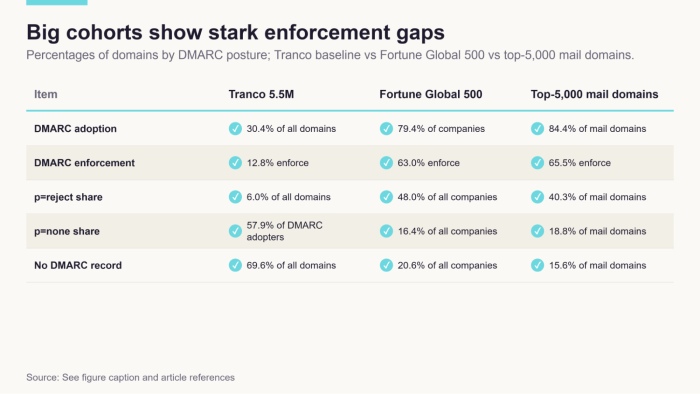
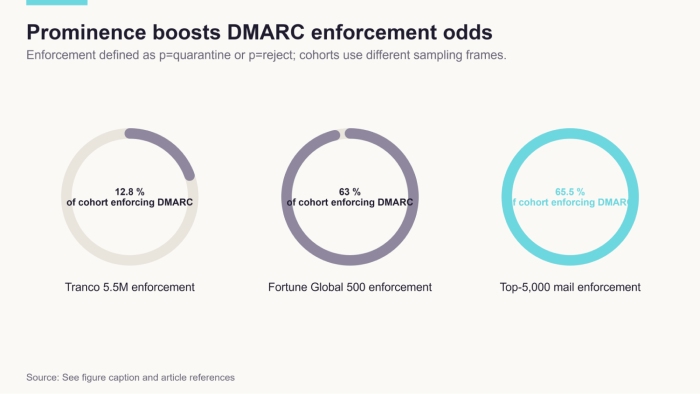
Enforcement rates for DMARC vary sharply between a 5.5M-domain Tranco baseline, Fortune Global 500 companies, and the top-5,000 mail domains, illustrating how prominence predicts stricter policies. Method: Values in this comparison table are taken directly from DMARCguard’s Tranco 5.5M study, SimpleDMARC’s Fortune Global 500 report, and 1Lookup’s email-authentication census. The table summarizes DMARC adoption, enforcement, p=reject shares, and monitoring-only p=none shares across three cohorts.
What SPF, DKIM, and DMARC actually do
SPF and DKIM authenticate different aspects of email; DMARC connects those checks to the visible sender domain. Without that connection, a message can authenticate for a domain unrelated to its displayed From address.
SPF, or Sender Policy Framework, publishes which servers may send for a domain. Receivers check the sending server against permissions stored in the Domain Name System, or DNS. SPF generally checks the technical envelope sender, not necessarily the From address displayed in an inbox.
SPF configuration requires precision. A domain can publish multiple TXT records, but must not publish multiple SPF records at the same name. The large-scale SPF configuration study identifies multiple records and invalid content as deployment problems. Record presence therefore does not establish a valid configuration.
DKIM, or DomainKeys Identified Mail, adds a digital signature to outgoing messages. Receivers verify that signature using a public key published by the signing domain. Successful verification authenticates that domain and checks the signed content—not automatically the visible sender’s identity.
DMARC means Domain-based Message Authentication, Reporting and Conformance. It requires alignment between the visible From domain and the domain authenticated through SPF or DKIM. Depending on configuration, alignment permits related subdomains or requires an exact domain match.
DMARC passes when at least one authentication method both passes and aligns. An aligned DKIM signature can therefore satisfy DMARC despite an SPF failure. Conversely, aligned SPF can satisfy DMARC when DKIM fails or is absent.
For example, consider a message displaying From: billing@example.com but authenticating only for an unrelated delivery-service domain. Those authentication passes do not establish alignment with example.com. A valid DKIM signature aligned with example.com, however, can satisfy DMARC.
The p= field declares the requested treatment of messages that fail DMARC. The supplied email authentication guidance distinguishes three policy levels:
p=none:monitoring. Requests no delivery change because of DMARC failure; reporting requires separate configuration.p=quarantine:suspicious treatment. Asks receivers to treat failing messages cautiously, commonly by placing them in spam.p=reject:rejection. Asks receivers to refuse failing messages.
These are receiver policy requests, not guaranteed delivery outcomes. Receiving systems retain their own filtering and handling rules. Monitoring does not guarantee inbox delivery, and rejection does not prevent every phishing technique.
Aggregate reporting provides feedback about observed senders and authentication results. The rua field specifies destinations for machine-readable summaries, generally in XML. Operators can use these reports to investigate unauthorized sources and legitimate services that fail alignment.
A reporting address does not prove that feedback arrives or receives attention. The study of DMARC reporting documents destination misconfigurations that prevent report delivery. Reporting supports investigation; it does not repair authentication or establish that all legitimate mail works.
The broad baseline: enforcement remains a minority practice
Enforcement remains a minority practice in the broad Tranco sample. DMARCguard’s study queried 5,499,028 domains from the full Tranco Top Sites List on 27 February 2026. It found DMARC records on 30.4% of domains, but enforcing policies on only 12.8%.
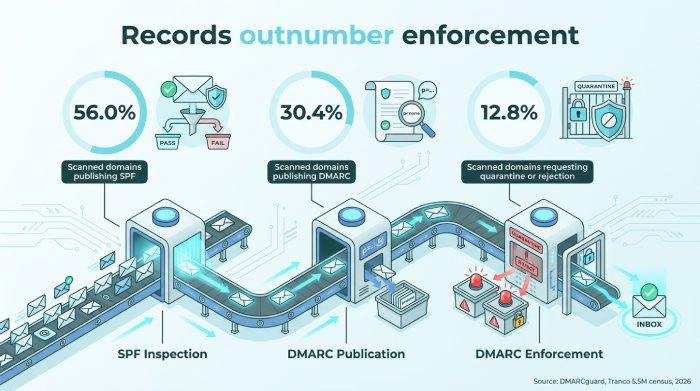
Source: DMARCguard, Tranco 5.5M census, 2026A
The policy breakdown separates adoption from requested action:
- 6.0% of all scanned domains published
p=reject. - 6.8% published
p=quarantine. - Together, these categories produced the 12.8% enforcement-policy rate.
Two complementary calculations clarify the remaining gap. Subtracting publication from 100% gives 69.6% without a DMARC record. Subtracting enforcement gives 87.2% without an enforcing policy. The supplied report’s “seven in ten” framing therefore describes missing records, not all non-enforcing domains.
Publication exceeded enforcement by 17.6 percentage points, calculated as 30.4% minus 12.8%. Among adopters, DMARCguard reports 42.0% enforcement and 57.9% monitoring. These rounded percentages show that most adopters still requested no DMARC-based quarantine or rejection.
The October 2026 Domain Security Census provides a broader but methodologically different comparison. It reports scanning 632,901,201 names, finding 361,301,790 existing domains, and grading 332,492,319. Its 25.1% adoption rate applies to graded domains, not every name initially scanned.
That census reports enforcement among 47.6% of DMARC adopters. Multiplying the reported adoption and adopter-enforcement percentages yields approximately 11.9% enforcement across graded domains. This calculation resembles February’s 12.8%, but cannot establish a stable global rate or a subsequent decline.
The populations and inclusion rules differ, and the October findings arrive through a press release. Large counts do not resolve questions about exclusions, grading, or reproducibility. The census is useful context, not a methodologically equivalent replication.
The supplied October 2026 snapshot of DmarcDkim.com’s dashboard covers another population: 1,467,511 domains. It classifies 67.7% as lacking effective protection, combining absent, invalid, and p=none records. It reports 11.9% full protection and 20.4% partial protection.
Those labels use different requirements from a simple quarantine-or-reject count. The dashboard defines full protection as p=reject with pct=100; partial protection includes quarantine or gradual rollout. It separately reports 29.2% with quarantine or reject at pct=100.
These results should not be merged into one global estimate. In particular, the dashboard’s 67.7% cannot describe DMARCguard’s population. The clearest baseline remains sample-specific: 12.8% of February’s Tranco domains published enforcing policies; 87.2% did not.
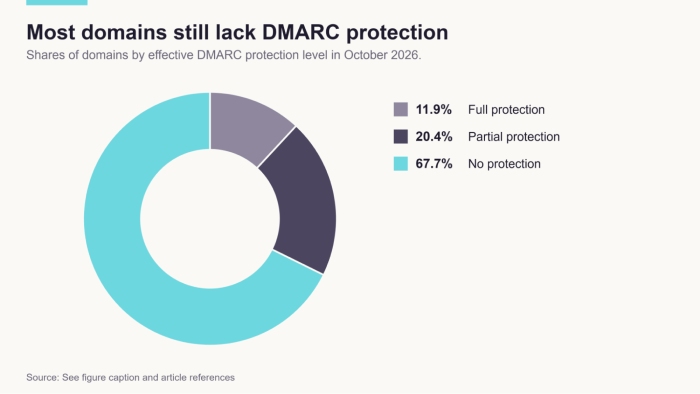
donut chart based on DmarcDkim.com’s global dataset shows that only about one-third of domains enjoy full or partial DMARC protection, while roughly two-thirds have none. Method: Segments reflect DmarcDkim.com’s classification of 1,467,511 domains worldwide into full protection (p=reject; pct=100), partial protection (quarantine or partial rollout), and no protection (p=none, invalid, or absent).
Before comparing surveys, check what they counted
A DMARC percentage needs an explicit denominator. All scanned domains, resolved domains, mail-receiving domains, adopters, and company domains answer different questions. Comparing them without qualification can create an apparent disagreement where none exists.
Five population definitions recur in the evidence:
- All scanned domains: Every domain included in a scan’s starting population. A ranked list still differs from all registered domains.
- Resolved domains: Domains retained after successful DNS resolution under the study’s criteria.
- MX-bearing domains: Domains with mail-exchange records identifying receiving infrastructure. This filter does not establish which domains send email.
- DMARC adopters: Only domains publishing DMARC. Enforcement within this group measures policy choices after adoption.
- Company-domain samples: Domains mapped to selected businesses. These need not cover each company’s complete domain portfolio.
DDMARC’s top-10,000 analysis illustrates the distinction. Among 8,907 resolved domains, 68.2% published DMARC, 31.6% requested rejection, and 18.3% requested quarantine. Adding the enforcement categories gives 49.9% of resolved domains.
Dividing 49.9 by 68.2 gives approximately 73.2% enforcement among adopters, calculated from rounded figures. Thus, about 73% of adopters enforcing and 49.9% of resolved domains enforcing describe the same sample. Neither percentage can replace the other without changing the question.
Domain prevalence also differs from message coverage. A domain count gives equal weight to low-volume and high-volume senders. Estimating the share of messages covered by enforcement requires message-volume data, which these DNS percentages do not provide.
Detection methods introduce another boundary: undetected does not necessarily mean absent. 1Lookup’s DKIM measurement checks common selectors—the DNS names identifying signing keys. Domains using other selectors can escape detection, making these results lower bounds. Finding a key also does not demonstrate that legitimate messages are correctly signed.
Definitions of “full protection” differ across studies:
- 1Lookup: SPF plus DMARC quarantine or rejection applied to 100% of mail.
- DmarcDkim.com:
p=rejectwithpct=100. - The small-firm study: SPF, enforced DMARC, and configured DKIM signing.
These definitions overlap but do not measure identical configurations. A higher score cannot establish better security without checking its required controls and denominator. Throughout this paper, comparisons remain descriptive rather than estimates of causal effects or prevented attacks.
Large brands lead, but size does not guarantee enforcement
Large-company enforcement is common, but far from universal. SimpleDMARC’s June 2026 study scanned domains representing all 500 Fortune Global 500 companies. It found 397 adopters, equivalent to 79.4% of the cohort.
Across all 500 companies, 63.0% published an enforcement policy and 48.0% specified rejection. The table preserves that whole-cohort denominator; company counts are calculated from the reported percentages.
| Published policy | Share of all 500 companies | Calculated company count |
|---|---|---|
Rejection: p=reject | 48.00% | 240 |
Quarantine: p=quarantine | 15.00% | 75 |
Monitoring: p=none | 16.40% | 82 |
| No DMARC record | 20.60% | 103 |
Quarantine and rejection account for 315 companies, leaving 185 without enforcement on their measured domains. Among the 397 adopters, approximately 79.3% enforce, calculated as 315 divided by 397. Large size therefore guarantees neither adoption nor progression beyond monitoring.
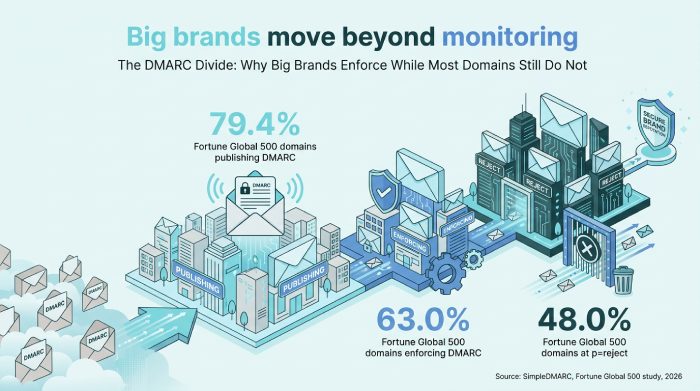
Source: SimpleDMARC, Fortune Global 500 study, 2026
The cohort’s identity matters: Fortune Global 500 is not the U.S. Fortune 500. Results for those lists cannot be pooled into a single large-company adoption range. Nor does one measured company domain establish security across subsidiaries and other domains.
Other prominent-domain samples report higher rates. ShowMyIP’s May 2026 study deliberately selected 288 well-known public domains. It reports 99.3% DMARC adoption and 97.6% MX availability, indicating widespread publication of receiving infrastructure records rather than verified mail delivery.
ShowMyIP reports 67.7% rejection, 18.1% quarantine, 13.5% monitoring, and 0.7% without DMARC. Adding rejection and quarantine gives 85.8% enforcement across its sample. Even near-universal publication therefore leaves a monitoring gap.
Domainposture’s June 2026 scan covers 994 highly visited domains. It reports 83.4% adoption, 69.1% enforcement, and 14.3% monitoring. These results fall between the company-based and deliberately prominent-domain benchmarks.
The differences need not indicate contradictory findings. Company lists, recognizable-domain selections, and traffic rankings capture different populations. Budgets, reputational exposure, and compliance obligations could contribute to stronger enforcement, but the supplied studies do not isolate their effects.
The supported conclusion is narrower than “big brands have solved DMARC.” Enforcement is the majority position in these selected cohorts, yet each retains non-enforcing domains. Even among the Fortune Global 500, more than one-third lack an enforcement policy.
Traffic rank reveals the clearest enforcement gap
Traffic rank separates enforcement more sharply than basic authentication deployment. 1Lookup’s September 2026 study offers the clearest within-study comparison. It queried 8,000 domains: the Tranco top 5,000 and 3,000 domains around ranks 500,001–503,000.
The email comparison retained domains with MX records. That left 3,517 mail-receiving domains in the high-traffic group and 2,102 in the long tail. The latter represents a specific ranking band, not the entire lower-traffic web.
Each percentage below uses all mail-receiving domains in its respective group. Small discrepancies between category sums and adoption totals reflect the reported rounded figures.
| Measure | Top-5,000 mail domains | Long-tail mail domains |
|---|---|---|
| Domains assessed | 3,517 | 2,102 |
| DMARC record published | 84.40% | 65.20% |
| DMARC at quarantine or reject | 65.50% | 29.50% |
Monitoring only: p=none | 18.80% | 35.60% |
| No DMARC record | 15.60% | 34.80% |
| SPF adoption | 92.50% | 89.50% |
The enforcement gap is 36.0 percentage points, calculated as 65.5% minus 29.5%. The adoption gap is 19.2 percentage points, calculated as 84.4% minus 65.2%. Long-tail domains therefore lag both in publication and in progression beyond monitoring.
The policy distribution makes that second gap clear. Enforcement substantially exceeds monitoring in the high-traffic cohort; monitoring exceeds enforcement in the long tail. Dividing enforcement by adoption gives approximately 77.6% of adopters enforcing versus 45.2%, respectively. These are calculations from rounded percentages, not separately reported measurements.
SPF supplies a useful counterpoint. Adoption differs by only 3.0 percentage points, calculated from the reported rates. Widespread foundational records coexist with sharply different DMARC policy choices. Record deployment alone therefore does not explain the enforcement divide.
The shared framework and MX filter strengthen this descriptive comparison. They reduce inconsistencies introduced by comparing unrelated surveys, but do not make the groups otherwise equivalent. Traffic rank measures visibility, not company size, staffing, or security budgets.
The figure discussion should consequently emphasize the association between visibility and enforcement in these two bands. No figure image, modeled odds ratio, or adjustment for organizational characteristics was supplied for inspection. Sender complexity, deployment timing, and operational ownership remain possible explanations—not demonstrated causes of the gap.
Radial progress rings compare DMARC enforcement shares across the Tranco 5.5M baseline, Fortune Global 500, and top-5,000 mail domains, highlighting how high-profile cohorts reach much higher enforcement. Method: Each ring’s percentage represents the share of domains in the cohort that enforce DMARC with quarantine or reject, using data from DMARCguard, SimpleDMARC, and 1Lookup. The visualization emphasizes relative enforcement levels, not absolute domain counts.
Small firms often have the ingredients, not the finished system
Small tax practices often publish authentication records without completing enforcement. Accounting Today’s October 2026 report describes 3,609 U.S. practices with two to eight preparers. It reports 97% SPF publication, 65% DMARC publication, and 34% DMARC enforcement.
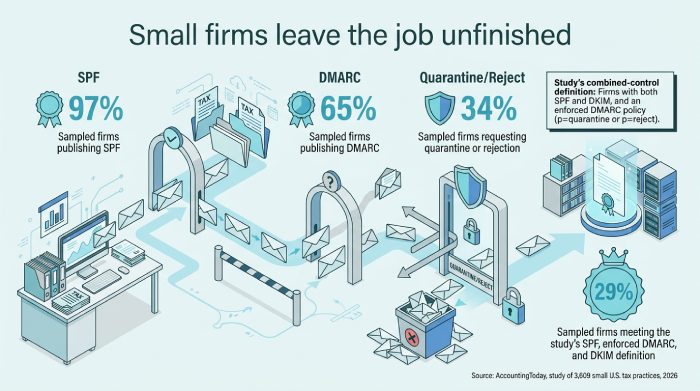
Source: AccountingToday, study of 3,609
The sample used the IRS public Preparer Tax Identification Number list and mapped one firm per web domain. This provides a defined professional sampling frame, not a representative cross-section of small American employers. A mapped domain also need not capture every domain or sending service a practice uses.
The 63-percentage-point gap between SPF publication and DMARC enforcement is calculated from 97% minus 34%. It measures the distance between deployment indicators, not attack exposure or losses. SPF publication alone cannot establish that messages align with the visible sender domain or that receivers receive an enforcement request.
The report also states that 45% of DMARC-enabled firms used p=none. That denominator differs from the full-sample enforcement rate. Moreover, the reported adoption, monitoring, and enforcement percentages do not fully reconcile arithmetically. The supplied summary does not explain the discrepancy, so they should remain separately reported rather than combined into inferred counts.
Only 29% met the study’s “fully protected” definition: SPF, enforced DMARC, and configured DKIM signing. This label describes a control combination, not protection against every email threat. Its five-percentage-point difference from enforcement also does not identify which component each firm lacked.
Enforcement varied within the sample: 32% among practices with two to three preparers, 42% with four to five, and 45% with six to eight. Even the largest group remained below half. These figures show an association with preparer count, not proof that adding staff improves security.
Resources, service providers, and technology management could explain the differences, but their effects were not isolated. The supplied evidence also gives no uncertainty estimates for these size bands. The defensible lesson is that foundational deployment often outpaced enforcement in this professional niche—not that small businesses generally neglect security.
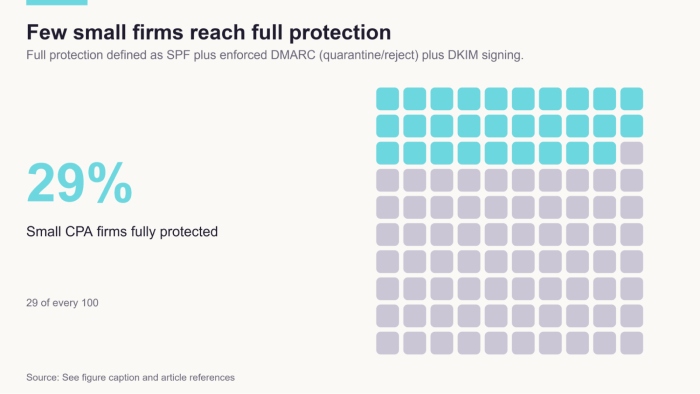
small U.S. tax practices, 2026A waffle chart illustrates that only 29% of small CPA firms in one study are fully protected with SPF, enforced DMARC, and DKIM signing, leaving most still exposed to spoofing. Method: The waffle uses AccountingToday’s reported 29% share of small CPA firms that have all three controls in place, treating 100 squares as the population and shading 29 as protected.
Sector benchmarks complicate the big-brand story
Organization-based benchmarks complicate a simple big-brand-versus-everyone-else account. The April 2026 Guardian360 benchmark covers 10,833 unique organization-associated domains in the Netherlands, Germany, Belgium, and France. DMARC Advisor B.V. conducted the scan within Guardian360’s ecosystem.
This sampling frame reaches beyond a most-visited-domain list, but does not establish national or Europe-wide prevalence. Its denominator remains selected domains, not companies or email messages. Across that sample, the reported policies were:
- 22.4% rejection.
- 22.1% quarantine.
- 29.7% monitoring.
- 25.8% without a DMARC record.
Adding rejection and quarantine gives 44.5% enforcement, calculated from rounded percentages. Monitoring and missing records total 55.5% without enforcement. These are the appropriate categories when distinguishing restrictive policy requests from non-enforcement.
Guardian360’s 77.6% below rejection figure answers a different question. Its “not fully protected” category includes quarantine as well as monitoring and missing records. Treating that entire category as unenforced would incorrectly discard the 22.1% requesting quarantine.
The contrast with Domainposture’s selected banks and fintech cohort is substantial. Within its June 2026 high-visibility sample, that cohort reached 98.5% enforcement, including 86.6% rejection. Those findings describe selected financial domains, not the financial sector generally.
The comparison cannot separate sector effects from visibility, geography, or selection. Regulatory obligations, fraud exposure, and security resources are plausible explanations, but these studies do not test their independent contributions. Guardian360’s overall result also cannot establish how its financial organizations compare with Domainposture’s cohort.
Reporting reveals a separate operational gap. Guardian360 reports that 30.5% of DMARC adopters lacked rua, the aggregate-report destination field. This percentage applies to adopters, not all 10,833 domains, and does not prove the absence of other monitoring.
The missing reporting channel also affected enforcing domains: 561 at rejection and 592 at quarantine. Together, these total 1,153 enforcing domains, calculated by addition. Missing reporting does not cancel enforcement, but removes this particular feedback channel.
The benchmark therefore supports two distinct questions: does a domain enforce, and can its operators observe the results? Restrictive policies and operational oversight should be measured separately. Neither policy publication nor a reporting address alone demonstrates a maintained system.
Adoption has grown faster than enforcement maturity
Publication and enforcement maturity describe different forms of progress. Spamcipher’s 2026 review reports enforcement between 43% and 49% of DMARC adopters from mid-2023 through 2026. That range suggests limited change in the aggregate policy mix, not necessarily stalled deployment.
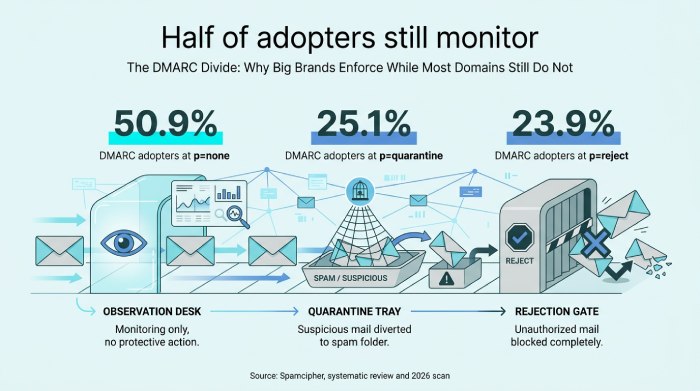
Source: Spamcipher, systematic review and 2026 scan
For 2026, the review reports 50.9% monitoring, 25.1% quarantine, and 23.9% rejection among adopters. Adding quarantine and rejection gives 49.0% enforcement, using the rounded figures. Approximately half of adopters therefore still requested no DMARC-based quarantine or rejection.
A stable share does not mean individual domains never advance. Existing adopters could tighten policy while newcomers enter at p=none, leaving the aggregate share nearly unchanged. This is a possible explanation, not an observed transition pattern in the supplied evidence.
An unchanged fraction can also represent more enforcing domains if the adopter population expands. Establishing whether monitoring is usually temporary requires tracking the same domains over time. Such analysis must distinguish newcomers, departures, and policy changes rather than relying on aggregate shares.
Spamcipher combines an active scan of a random Tranco top-million sample with an OpenINTEL DNS series covering 2022–2026. The active scan supplies a current snapshot; the longitudinal data provide the basis for examining change. These measurement roles should not be conflated.
For 2026, the active scan reports DMARC publication on 47.2% of resolvable top-million domains. The independent OpenINTEL snapshot reports 45.9%. Their proximity supports a broadly similar current picture without establishing identical coverage or methods.
An explicitly historical comparison illustrates the distance from early adoption. A 2017 Alexa top-million study reported 3.1% DMARC adoption and 0.4% rejection. These are historical reference points, not earlier observations from Spamcipher’s current population.
Alexa and Tranco select different domains, and study conditions differ. The contrast supports a broad account of increased publication, but not a precise growth rate or seamless trend line. Likewise, the supplied evidence does not directly quantify how much faster adoption grew than operational maturity.
The strongest conclusion separates three questions: how many domains adopt, which policies adopters publish, and how individual deployments change. Aggregate policy stability answers only the second. It cannot establish whether particular organizations are progressing or remaining indefinitely at monitoring.
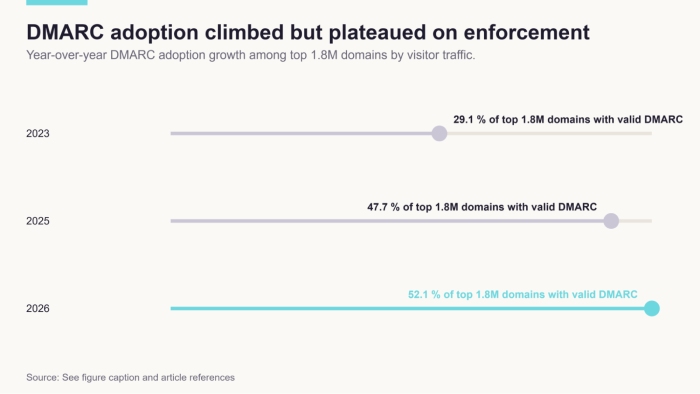
A line chart of EasyDMARC’s top-1.8M data shows strong growth in valid DMARC records from 2023 to 2026, while enforcement growth is slower and many domains remain at p=none. Method: Adoption percentages for 2023, 2025, and 2026 are taken from EasyDMARC’s DMARC adoption report, with points representing the share of the 1.8M-domain dataset that have valid DMARC records. Enforcement trends are discussed qualitatively in the text.
Tools can simplify enforcement, but cannot replace ownership
Tools can simplify enforcement, but cannot replace accountable ownership. Publishing a record is a configuration task. Maintaining enforcement requires understanding legitimate email flows, coordinating changes, and verifying repairs.
Commercial forecasts indicate substantial interest, not demonstrated security effectiveness. Mordor Intelligence’s market analysis estimates DMARC management services at $1.45 billion in 2026, projecting $2.61 billion in 2031. These are market-research estimates and forecasts, not observed enforcement outcomes; their underlying modeling cannot be assessed from the supplied summary.
Management platforms can reduce the effort required to interpret authentication reports. DMARC Report describes tooling that parses reports and highlights failing senders. That visibility supports investigation, but a dashboard cannot independently determine which services an organization intends to authorize.
The operational work has four connected parts:
- Discover senders: Match observed sources to an inventory of authorized services and business owners.
- Interpret failures: Distinguish unauthorized traffic from legitimate streams with authentication problems.
- Repair alignment: Coordinate changes to the sending service or domain configuration.
- Verify results: Check subsequent messages and reports rather than treating a closed support ticket as proof of repair.
These tasks separate reporting from remediation. A tool can accurately identify a failing stream while leaving its business purpose unresolved. An accountable owner must connect the technical finding to someone authorized to approve changes.
Report delivery also requires verification. The DMARC reporting study documents configuration failures that prevent feedback from reaching domain owners. Operationally, an empty dashboard should prompt questions about reporting coverage—not automatic confidence that every sender passes.
Ownership must continue after deployment. A practical operating model identifies who reviews failures, controls DNS, and manages provider relationships. It also defines who checks authentication when services are introduced or changed.
Resource constraints and tool usability remain plausible contributors to stalled enforcement, not established explanations for the observed divide. The supplied studies do not isolate their effects from infrastructure complexity or organizational priorities. Market growth cannot demonstrate which customers receive effective remediation support.
Better evidence would connect staffing and tooling to verified repairs and maintained enforcement over time. For current purchasing decisions, the test is more immediate: does the service help named owners turn findings into confirmed fixes?
When to move from monitoring to enforcement
Move toward enforcement when legitimate mail flows are understood and delivery consequences can be managed. Time spent at p=none does not establish readiness. The following framework is an editorial synthesis of the supplied operational guidance, not a validated score or universal timetable.
- Assign an accountable owner. Name someone responsible for coordinating DNS changes, sending-service configuration, report review, and troubleshooting. That person needs access to the departments and suppliers using the domain. If nobody can investigate a failing sender and authorize repairs, resolve ownership before tightening policy.
- Inventory legitimate sending services. List authorized systems and their business owners, including employee email, marketing, billing, and support services. Compare the inventory against observed traffic. Investigate unfamiliar sources rather than automatically authorizing them or assuming they are malicious. Treat the inventory as a working hypothesis, not proof that discovery is complete. Each legitimate stream should connect to an owner and an authentication configuration. That connection makes failures actionable.
- Verify reporting and review. Confirm that aggregate reports reach their destination and can be interpreted. The USENIX reporting study documents destination errors that prevent delivery. A DNS address alone is therefore insufficient evidence of working visibility. Make review produce decisions: record unexplained sources, investigation owners, and next actions. Unreviewed reports justify beginning investigation, not remaining permanently at monitoring. Reporting silence should also prompt a check of the reporting path.
- Repair legitimate authentication failures. Check whether approved streams pass through aligned SPF or aligned DKIM; DMARC does not require both. A provider can authenticate its own domain successfully without aligning with your visible From domain. Verify repairs through subsequent messages and reports. Inspect configuration quality where it contributes to failures. The SPF configuration study identifies multiple records and invalid content among deployment problems. Requiring SPF hard fail everywhere is not a substitute for checking DMARC alignment.
- Tighten policy while checking legitimate delivery. A staged approach moves from monitoring toward quarantine and then rejection. DMARC Report’s operational guidance connects this progression with sender discovery and remediation. The supplied evidence does not establish universal deadlines or pass-rate thresholds. Before each change, decide how delivery problems will be detected and investigated. Afterward, examine authentication reports alongside feedback from sending services and users. Advance when the evidence supports the next step, not simply because a monitoring period has expired. If legitimate mail encounters problems, identify and repair the affected stream. Avoid allowing an unresolved temporary issue to become indefinite domain-wide monitoring. A quiet support queue alone does not confirm that every legitimate flow works.
- Include future changes in readiness. Require new sending services and significant configuration changes to have an owner and an authentication check. Continue reviewing failures after rejection begins, with a clear escalation route. The practical standard is explainable senders, working visibility, repaired alignment, and accountable change management. These conditions support enforcement without treating deployment as the end of operational work.
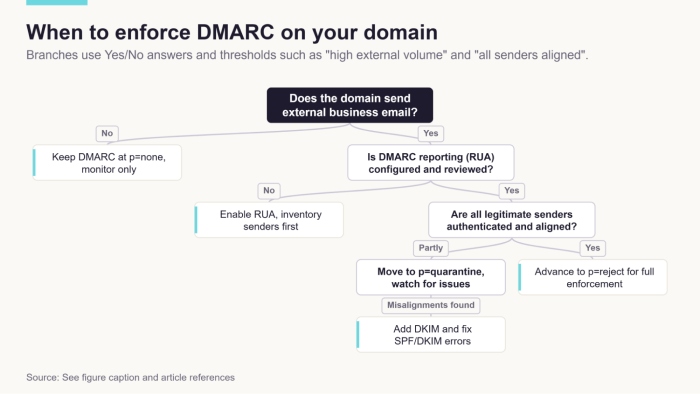
A practical decision tree helps readers decide when to move a domain from DMARC monitoring (p=none) to enforcement (quarantine or reject) based on mail volume, business criticality, and alignment readiness. Method: The tree encodes a simple staged decision process derived from industry guidance and the enforcement patterns seen in the studies: start with whether the domain sends meaningful external mail, then assess reporting visibility and sender alignment before choosing quarantine or reject.
Measure maintained enforcement, not records deployed
Prominence is associated with enforcement in these samples, but the evidence does not establish why. The 1Lookup traffic comparison offers stronger comparability than unrelated survey headlines. Its shared methods reduce measurement differences without isolating the effects of resources, sector, or organizational size.
The management implication is to measure maintained enforcement rather than records deployed or organizational prestige. Large brands still need evidence that legitimate senders authenticate correctly. Smaller organizations should assess their own mail flows rather than use cohort averages as readiness thresholds.
A useful dashboard separates four dimensions:
- Policy distribution: Track missing records, none, quarantine, and reject separately. State whether percentages describe all managed domains, sending domains, or adopters.
- Reporting coverage: Track configured destinations, actual report receipt, and review. Presence alone does not establish visibility.
- Legitimate sender alignment: Track approved services that pass DMARC with aligned authentication. Keep unresolved ownership or configuration questions visible.
- Unresolved failures: Record investigation owners, next actions, and remediation status. Distinguish legitimate mail problems from suspected unauthorized sending where evidence permits.
Reporting deserves separate attention because enforcement and visibility can diverge. The Guardian360 benchmark identifies enforcing domains without aggregate-report destinations. Such domains publish restrictive instructions but lack that particular feedback channel.
Requested policy, reported authentication, and observed delivery are also different measurements. DNS scans show what domains ask receivers to do, not every message’s outcome. Operational assessment should therefore combine policy status with authentication evidence and legitimate-delivery checks.
Broader security scores require the same discipline. Defaults.Exposed research combines SPF and enforced DMARC with DNSSEC, HTTPS, and HSTS, extending into DNS and web security. That bundle differs from a score combining SPF, DKIM, and enforced DMARC. Neither alone proves that legitimate messages authenticate or reach recipients.
Smaller teams should prioritize a manageable remediation process with explicit ownership. Larger portfolios need domain-level accountability so aggregate adoption rates do not hide unresolved exceptions. Both should give monitoring-only domains a documented next action and continue checks after enforcement begins.
The central test is concrete: who owns the next step beyond monitoring, and what evidence will confirm that legitimate mail still works? Answering those questions turns DMARC publication from a milestone into an operational control.
Limitations
- This paper synthesizes supplied source summaries; underlying source text and methods were not independently inspected. No new DNS measurements were conducted.
- Samples, scan dates, filters, and protection definitions differ. Cross-study comparisons are descriptive, and traffic rank does not establish organizational size or resources.
- DNS records describe published configurations, not message-level authentication, receiver behavior, or prevented attacks. Common-selector scans can miss DKIM deployments.
- The supplied evidence contains denominator errors, mismatched references, and some unreconciled percentages. Calculations are labeled, and unsupported interpretations are omitted.
- Vendor studies, live dashboards, press releases, and market forecasts have different evidential strengths. Their scale does not establish representativeness or methodological equivalence.
References
- The State of DMARC Adoption in 2026:938000 Domains …
- State of Email Security 2026 — DMARC Adoption Data
- DMARC BENCHMARK REPORT
- DMARC Adoption Statistics 2026: Fortune Global 500
- www.domainposture.com • blog • state-of-emailState of Email Authentication 2026: 994 domains
- The State of Email Authentication, September 2026
- PDF Email Authentication at Scale: A Systematic Review and 2026 …
- Email Authentication 2026: SPF, DKIM, DMARC | ShowMyIP
- Email Authentication Requirements in 2025
- October 2026 Domain Security Census Finds 18.6 Million Domains Reject Forged Email
- DMARC Adoption 2026: 30.4%, DKIM 22.7% of 5.5M - DMARCguard
- Only a third of small firms actively block email spoofing their domain
- DMARC Adoption Statistics 2026 - Live Global Data - DmarcDkim.com
- DMARC Management Services Market Size & Share Analysis
- Research — the state of domain security | Defaults.Exposed
- Measurement and Security Implications of DMARC Reporting
- Lazy Gatekeepers: A Large-Scale Study on SPF Configuration in the Wild
- SIGCHI Conference Proceedings Format
General Manager
General Manager of DuoCircle. Product strategy and commercial lead for DMARC Report's 2,000+ customer base.
LinkedIn Profile →Take control of your DMARC reports
Turn raw XML into actionable dashboards. Start free - no credit card required.