Microsoft Patch Tuesday, Outlook DMARC and Chrome Zero-Day

Quick Answer
The November 10–16, 2026, cybersecurity news highlights Microsoft's Patch Tuesday vulnerabilities, a global Microsoft 365 outage, Outlook DMARC rejections, Chrome zero-day exploits, crypto theft, data breaches, and emerging AI-powered cyberattacks.
Try Our Free DMARC Checker
Validate your DMARC policy, check alignment settings, and verify reporting configuration.
Check DMARC Record →The week was dominated by Microsoft: a record-sized Patch Tuesday, a day-long global Microsoft 365 outage and a short-lived Outlook.com rule that bounced mail from domains without DMARC. Elsewhere, attackers kept exploiting browser and server flaws, North Korea was linked to $400 million in deepfake-call crypto theft, and a stolen AI API key led to a poisoned coding extension.
Microsoft’s November Patch Tuesday fixes more than 1,000 flaws, including an exploited Outlook zero-day
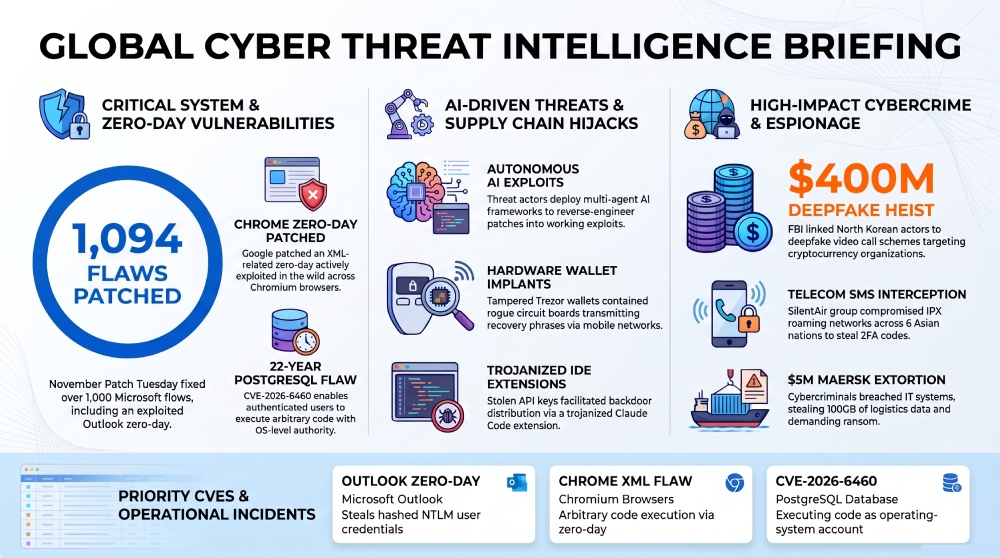
A currently exploited zero-day vulnerability that can let attackers steal hashed Outlook NTLM credentials is among the 1,094 holes Microsoft fixed in its November Patch Tuesday releases. Outlets reported counts ranging from about 1,090 to 1,260, depending on how they tallied the fixes. Defenders should prioritize the Outlook bug, which is the only one Microsoft flagged as actively exploited. csoonline CSO Online
Outlook.com began bouncing mail from domains with no DMARC record
The bounces hit mail sent to outlook.com, hotmail.com, live.com, and msn.com addresses when the sending domain has no DMARC record. Domains with working SPF and DKIM were also affected, and the rejections began on 5 November without any announcement. Microsoft later treated it as a service issue caused by a spam-rule update, which it rolled back, and mail flow was restored on 9 November. It is a useful reminder that a published DMARC policy matters for delivery to consumer Outlook addresses. dmarcian dmarcian • LazyAdmin
Google patches the eighth actively exploited Chrome zero-day of 2026
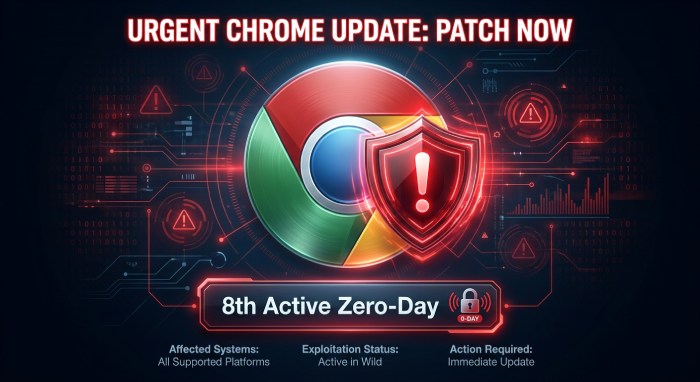
Google shipped a Chrome security update on 9 November that fixes an XML-related zero-day already used in attacks. It is the eighth Chrome zero-day of 2026, according to SecurityWeek, and CISA added it to its exploited list on Tuesday. Federal agencies were given until 24 November to patch, and Chromium-based browsers such as Edge and Opera may also be affected. cyberexperts The Hacker News
A global Microsoft 365 outage hits the NHS, police and schools
Hospitals, GPs and police forces across the UK have been hit by the global Microsoft outage, as key services battle to get systems back online. The disruption began on Thursday 12 November and lasted about a day. Some hospitals cancelled appointments and staff went back to paper records. Microsoft later said services were fully restored, and on 16 November a Microsoft executive described the issues behind the outage. aol The Guardian • ABC News
CISA adds a UnrealIRCd command-injection flaw to its exploited list
On Friday 13 November, CISA added CVE-2026-114713, a high-severity flaw in the open-source UnrealIRCd chat server, to its Known Exploited Vulnerabilities catalog after attacks were reported. Any user on a network with two or more linked servers can inject server-to-server commands that run with server authority. Server operators running UnrealIRCd 6.x should upgrade to 6.2.7.1 or later. The Hacker News
N-able zero-days are being used to deploy crypto miners
Attackers are exploiting a new set of vulnerabilities in N-able’s N-central remote management platform, tracked as 4EverAble2Shell, to deploy cryptocurrency miners. Huntback reported 21 compromised servers across the US, Canada, the UK, Germany, France, South Africa and Sweden. Managed service providers that run N-central should treat this as urgent. The Hacker News weekly recap
PostgreSQL fixes 52 flaws, including a 22-year-old bug that allows authenticated code execution
The 13 November PostgreSQL releases fix 52 security flaws. The most serious is CVE-2026-6460, a type-confusion bug that lets a database user who can create objects run code as the PostgreSQL operating-system account. It carries a CVSS score of 8.8, and full protection also requires rebuilding any C-language extensions. The vendor has not reported any attacks using it. The Hacker News
New “Mior” and “Skyfall” attacks can read data from AMD confidential VMs
Two attacks made public this week allow a malicious host to read data inside AMD SEV-SNP-protected virtual machines, which are built to keep the server’s operator out. Mior can also modify a VM’s memory and forge the signed report that confirms its software. Both need control of the hypervisor, and Mior also needs control of the BIOS. AMD plans firmware fixes: Skyfall in November and Mior in December. Thehackernews The Hacker News

The FBI ties North Korea to more than $400 million in crypto theft through deepfake video calls
The FBI says North Korea-linked actors stole more than $400 million in crypto over 18 months through a social-engineering scheme it calls FaceStealer. The attackers used deepfake video calls, and the cloud infrastructure behind the campaign has been seized. The Justice Department also announced the seizure of more than $1.2 billion in crypto linked to the Binance hack. The Hacker News
Trezor confirms hidden implants in hardware wallets sold by reseller CryptoBilis
Trezor says three Safe 5 wallets bought from the reseller CryptoBilis contained an extra circuit board that reads the recovery phrase from the screen and sends it over the mobile network. A firmware update (2.13.1) stops the implants found so far from capturing anything, but it cannot protect a backup that was already captured. Trezor advises anyone who bought from CryptoBilis since March to move funds to a new wallet with a new recovery phrase. The Hacker News
SilentAir uses hacked telecom equipment to intercept SMS two-factor codes
Telecom security firm Enea identified a state-level espionage group it calls SilentAir. It used hacked equipment inside mobile operators in at least six Asian countries to intercept calls and texts from selected people, mostly in Taiwan. The attacks went through the IPX network that carriers use for roaming, which runs on trust between operators. Enea says the group has been disrupted for now but could return. The Hacker News
Google warns that attackers are using AI agents to turn patches into working exploits
On Monday 16 November, Google Threat Intelligence Group said threat actors have moved beyond manual prompting to autonomous multi-agent offensive frameworks such as ARTEX, CAIRN, CyberStrikeAI and PentAGI. Attackers are also using large language models to reverse-engineer patches and weaponize new flaws faster, as seen with PaperCut bugs in September. The Hacker News
Amazon uncovers an AI-agent campaign hunting exposed AI apps for API keys
Amazon’s threat intelligence team used decoy servers to capture records of attacker AI agents. The agents were scanning internet-exposed AI apps such as LiteLLM, One API and Dify for stored AI provider keys, using default administrator credentials and known flaws. Amazon said it cannot verify the outcomes the agents reported, but it has moderate confidence they ran on ARTEX, an open-source pentesting tool. The Hacker News
A stolen Fireworks AI key led to a trojanized Claude Code extension on Cursor’s marketplace
Cursor says an attacker used an access key it had issued to Fireworks AI, which was exposed in a breach at Fireworks. The attacker copied data from a read-only storage bucket. This followed a trojanized version of Anthropic’s official Claude Code extension, pushed through the Cursor marketplace as a legitimate update, that tried to install a persistent SSH backdoor. Developers who installed the update should check their systems. The Hacker News
Maersk reveals a data breach as an extortion group demands $5 million
Maersk disclosed a breach of one of its IT systems after an extortion group claimed to have stolen 100GB of logistics-related data. The group says it focuses on data-theft extortion and intends to expand into ransomware. Shipping and logistics firms should review their IT and third-party access controls. Infosecurity Magazine
World Triathlon data breach exposed athlete medical information

World Triathlon says its tables were copied on 6 November, and a hacking-forum post offered the data for download on 7 November. The organization identified the breach on 8 November and shut down the affected tool the same day. The exposed data included athlete medical information, and affected people will be notified by email. Slowtwitch
A phishing campaign steals live Google sessions through fake calendar invites
Since mid-August, a phishing operation has sent fake Google Calendar invites, often from organizations the recipient already emails, to steal live Google sessions from corporate users. The lures include voicemail notices, RFP requests, court summonses and missed-payment notices. Most links route through Google’s own redirector, so common link checks come back clean. Material Security says it has taken down hundreds of attacker domains. The Hacker News
186 fake AI-brand domains push ClickFix lures and browser hijackers
Island researchers found 186 lookalike domains impersonating 27 AI brands, including Claude, ChatGPT, Gemini, Copilot and Cursor. Some send visitors to fake Cloudflare verification pages that trick them into running a PowerShell command (a ClickFix lure). Others install browser extensions that hijack searches. Bookmark official AI sites rather than following search results or ads. The Hacker News
General Manager
General Manager of DuoCircle. Product strategy and commercial lead for DMARC Report's 2,000+ customer base.
LinkedIn Profile →Take control of your DMARC reports
Turn raw XML into actionable dashboards. Start free - no credit card required.