MSPs and DMARC at Scale:Managing Email Authentication Across50, 500, or 5,000 Client Domains

Quick Answer
The Houlihan Lokey Managed Services Industry Overview (PDF, July 2025), one of the most authoritative institutional analyses of the MSP market, identifies a structural transformation underway: MSPs are no longer seen as outsourced IT vendors but as trusted technology partners essential tobusiness continuity.
Related: Free DMARC Checker
Try Our Free DMARC Checker
Validate your DMARC policy, check alignment settings, and verify reporting configuration.
Check DMARC Record →The $300 Billion Market’s Most Overlooked Revenue Stream
The Houlihan Lokey Managed Services Industry Overview (PDF, July 2025), one of the most authoritative institutional analyses of the MSP market, identifies a structural transformation underway: MSPs are no longer seen as outsourced IT vendors but as trusted technology partners essential tobusiness continuity. The report notes that rising cybersecurity threats and tightening regulatory requirements elevate managed security to a core business need, and that high-performing MSPs are separating themselves by building deep capabilities in high-value areas such as cybersecurity.
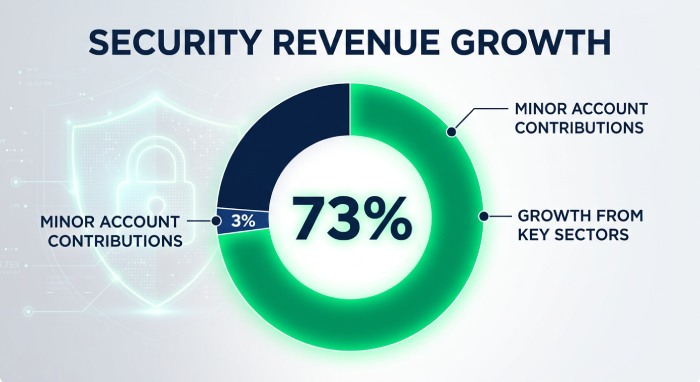
The Datto 2025 State of the MSP Report (PDF), surveying over 1,000 MSPs worldwide, confirms that cybersecurity concerns and awareness remain the top new-business driver. The Kaseya 2024 MSP Benchmark Survey (PDF) found that 78% of respondents consider cybersecurity a top IT challenge, and 73% reported an increase in security-related revenue.
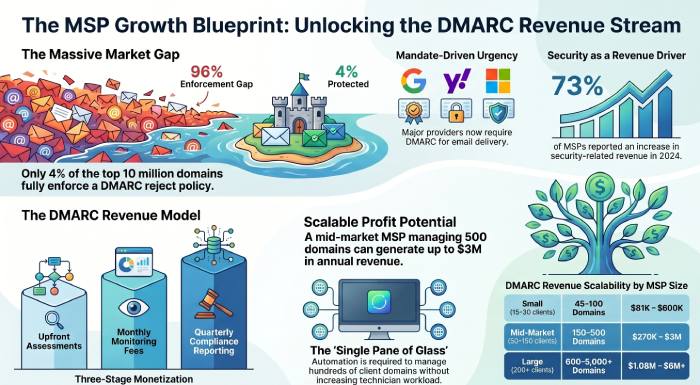
Yet there is a massive gap between the cybersecurity services MSPs offer and the one service nearly every client needs but almost none have: DMARC management. According to the EasyDMARC 2025 DMARC Adoption Report (PDF), DMARC adoption among the top 1.8 million domains grew from 29.1% to 47.7% between 2023 and 2025, but over half of adopters remain stuck at p=none, providing zero spoofing protection. The PowerDMARC Email Phishing and DMARC Statistics 2026 (PDF) shows that only about 4% of the world’s 10 million most-visited domains fully enforce a reject policy.
This report examines the MSP DMARC opportunity using exclusively PDF and document-based primary sources: institutional market analyses, government guidance, industry survey data, and technical best-practice documents.
The Market Opportunity: What the Data Says
The MSP Market Is Massive and Growing
The Houlihan Lokey PDF documents a market in sustained structural growth: hybrid work, rapid cloud adoption, and mounting IT complexity, combined with a shortage of skilled talent, force organizations to turn to expert, outsourced partners. The report notes a significant 50% growth rate in MSP M&A activity in 2024, driven by shifting customer expectations around cybersecurity. The client base has evolved from small businesses with minimal internal IT to middle-market organizations with dedicated teams seeking co-managed services.
The MSP Global State of the Industry Report 2024 (PDF) confirms that cybersecurity is often the top expected service from clients: “This intense need on the part of clients provides real opportunity in the form of business, but also a high-trust service with no room for mistakes.” Partnership and collaboration are identified as key means of business growth, with MSPs needing to expand service portfolios to meet increasingly diverse client demands.
Cybersecurity Is the Revenue Driver
The Kaseya 2024 MSP Benchmark Survey (PDF) provides concrete revenue data: 73% of respondents reported an increase in security-related revenue, while only 3% reported a decline. Almost half of MSPs (46%) said most of their clients turn to them for advice on cybersecurity plans. The CyberRisk Alliance Top 250 MSSPs 2024 Report (PDF) notes that the line between MSPs and MSSPs is blurring as MSPs offer cybersecurity services, with every single attack category increasing year-over-year in MSSP response data.
The Datto 2025 PDF survey shows that 91% of respondents said profitability was at least a medium priority for the next 12 months. Yet revenue growth depends on scalability, and smaller MSPs can still find opportunities in high-demand niches. DMARC management is precisely this type of niche: high demand, low client capability, predictable recurring revenue.
The DMARC Gap Is Enormous
The EasyDMARC 2025 PDF documents that enforcement-level DMARC policies rose from 233,249 domains in 2023 to 411,935 in 2026 among the top 1.8 million domains. But 525,996 remain at p=none. The PowerDMARC 2026 PDF notes that AI is now accelerating the phishing problem, enabling attackers to create convincing fake identities and automate attacks faster than traditional defenses can respond. DMARC, when properly implemented and enforced, remains one of the most effective controls for reducing phishing risk.
The opportunity equation: 73% of MSPs see growing security revenue (Kaseya PDF). 96% of domains lack DMARC enforcement (EasyDMARC/PowerDMARC PDFs). Cybersecurity is the top client demand (Datto/Houlihan Lokey PDFs). DMARC complexity drives outsourcing demand. This is the highest-demand, lowest-competition cybersecurity service in the MSP portfolio.
Why MSP Clients Need DMARC Now: The Government Says So
Multiple government PDF sources establish that email authentication is no longer optional, and that MSPs are at the center of the security equation.
CISA: MSPs Are High-Value Targets
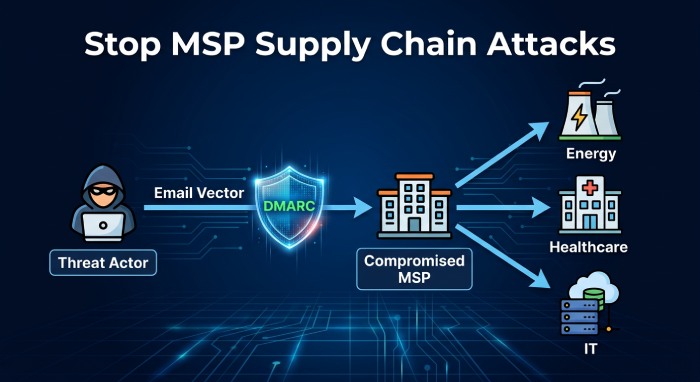
The NSA/CISA joint guidance on MSP cloud risks (PDF, March 2024) warns that malicious cyber actors are known to have an interest in targeting MSPs and using compromised MSPs to target customers. Incidents have involved both nation-state actors and criminal groups. The guidance emphasizes that MSPs, by their nature, must have access to their customers’ data and resources, often with privileged access, making a compromised MSP a gateway to dozens or hundreds of client environments.
The CISA Risk Considerations for MSP Customers (PDF) reinforces this: partnering with an MSP can introduce unanticipated risks by introducing third-party attack surfaces. The framework recommends that organizations proactively manage their cybersecurity risk and collaborate with their MSPs to jointly reduce that risk. For MSPs, this means building security services, including email authentication, into the core offering, not treating them as optional add-ons.
The CISA advisory on Chinese cyber activity targeting MSPs (PDF) documents how Chinese APT actors have used various tactics to infiltrate the networks of global MSPs for purposes of cyber espionage, targeting critical infrastructure sectors including IT, Energy, Healthcare, and Communications. Email is a primary vector for these attacks, and DMARC enforcement directly reduces the attack surface.
The WEF: Cybersecurity Complexity Is Outpacing Capability
The World Economic Forum Global Cybersecurity Outlook 2026 (PDF) and the 2025 edition (PDF) document the growing complexity gap that makes managed services essential. The WEF highlights that cyber inequity, the disparity between organizations with strong security posture and those without, is widening, with smaller organizations disproportionately affected. This is precisely the gap that MSP-delivered DMARC management fills: bringing enterprise-grade email authentication to organizations that cannot implement it alone.
The CyberSmart MSP Survey: Breaches Are Widespread
The CyberSmart MSP Survey 2025 (PDF), surveying MSPs across the UK, US, Australia, Germany, and the Netherlands, uncovered evidence that breaches of MSPs are widespread. The report cites a £3 million fine levied by the UK’s Information Commissioner’s Office on an MSP providing services to the NHS over security failings that led to a ransomware attack. 58% of MSPs surveyed felt their customers were more at risk than the previous year. This threat environment makes proactive email authentication not just a client service but a defensive necessity for the MSP itself.
The Operational Reality: Managing DMARC Across Hundreds of Domains
The Cisco Email Authentication Best Practices document (PDF), one of the most comprehensive technical guides on email authentication deployment, addresses the MSP challenge directly: “If your MSP does not follow [authentication best practices], or follows them incorrectly, that will lower their trustworthiness with large receiving systems and possibly delay or even block your messages.”
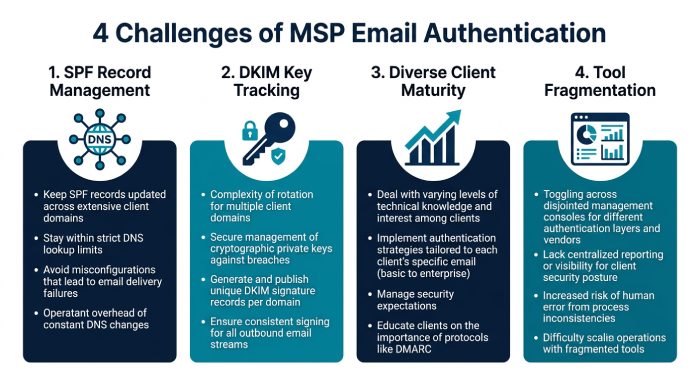
Challenge 1: SPF Record Management at Scale
The Cisco PDF emphasizes that SPF delegation is valid only for a single domain, making it critical to publish appropriate SPF records for every domain and subdomain. The Global Cyber Alliance SPF Setup Guide (PDF) reinforces that organizations likely own multiple domains, and that SPF records must be created for all of them, including those not used for sending. For an MSP managing 100+ client domains, each with different email service stacks, SPF management alone becomes a significant operational burden. The 10-DNS-lookup limit compounds this: each client’s unique combination of services consumes lookups differently, and any vendor change can push any client past the limit without warning.
Challenge 2: DKIM Key Management Across Vendors
The Cisco PDF provides detailed guidance on DKIM key management that highlights the MSP challenge: if you provide email services for a third-party domain, you will most probably need to get the key from them and import it. Each key is domain-specific, requiring unique selectors for each client’s sending services. The document recommends semantic selector naming including vendor and date (e.g., s=mkto-2025q1) and tracking ownership, a process that scales linearly with client count. The DMARCReport Email Authentication Essentials (PDF) provides additional practical guidance on multi-domain DKIM deployment.
Challenge 3: Diverse Client Maturity Levels
The Datto 2023 Global State of the MSP Report (PDF), surveying over 1,500 MSPs, found that MSPs serve a diverse range of business sizes, with the majority of clients having between 26 and 50 employees. The Kaseya PDF shows MSPs supporting anywhere from 10 to 500+ client sites. Each client is at a different stage of DMARC maturity: some with no record, some at p=none for years, some partially enforcing. Understanding how a DMARC policy works is key to moving each client toward enforcement. For the simplest clients, a DMARC generator produces a starter record in minutes. The MSP must run discovery, alignment, and enforcement workflows simultaneously across clients at every maturity level.
Challenge 4: Vendor Coordination and Tool Fragmentation
The Kaseya PDF identifies that the predominant workload challenge affecting MSPs is the inability to fully utilize their software solutions, with technicians frustrated by time spent switching between applications. 14% reported problems from poor integration among solutions. For DMARC management, which requires coordinating DNS changes across different registrars, communicating with each client’s unique email service vendors, and parsing reports from every mailbox provider, tool fragmentation is a critical obstacle.A multi-tenant DMARC platform that consolidates all operations into a single pane of glass is not a luxury, it is an operational requirement. The right DMARC monitoring platform unifies report parsing, alerting, and enforcement across every tenant.
The platform imperative: The Cisco PDF, Global Cyber Alliance guide, and MSP survey data collectively demonstrate that DMARC at scale requires automated SPF management, centralized DKIM key tracking, multi-tenant report parsing, and integrated DNS operations. Manual processes break at 20 domains. At 200 domains, they are impossible.
Building the DMARC Revenue Model: What PDF Survey Data Shows
The MSP survey PDFs provide the economic framework for DMARC as a managed service.
The Revenue Context
The Datto 2025 PDF shows that the primary revenue model for MSPs is monthly recurring services (37% of revenue), followed by consulting (22%), projects (21%), and break-fix (20%). DMARC fits perfectly into the recurring services model: an initial assessment project followed by ongoing monthly monitoring, enforcement management, and compliance reporting.
The Kaseya PDF confirms that revenue from security services is growing faster than any other category (73% reported increases). The CyberRisk Alliance MSSP PDF shows that smaller MSSPs and MSPs with security practices can be profitable even at modest scale, with the majority reporting profitability.
The DMARC-Specific Pricing Model
Based on the market data from the PDF sources and industry practice, DMARC generates revenue at three stages:
Stage 1, Assessment and Onboarding: A one-time project covering domain audit, SPF/DKIM baseline assessment, initial DMARC record publication, and sender discovery. Typical pricing: $500-$2,000 per client domain, depending on ecosystem complexity.
Stage 2, Ongoing Monitoring and Enforcement: Monthly managed service covering aggregate report analysis, unauthorized sender identification, vendor coordination for alignment fixes, phased enforcement progression, and alerting. Typical pricing: $150-$500 per domain per month, scaled by service tier.
Stage 3, Compliance Reporting and Expansion: Quarterly compliance reports showing enforcement progress, pass rates, threats blocked, and regulatory compliance posture (PCI DSS, cyber insurance). These reports justify the recurring fee and create expansion conversations around additional domains, BIMI implementation, and MTA-STS deployment.
The Scale Economics
| MSP Profile | Domains Managed | Estimated Annual DMARC Revenue |
|---|---|---|
| Small MSP (15-30 clients) | 45-100 domains | $81K-$600K |
| Mid-market (50-150 clients) | 150-500 domains | $270K-$3M |
| Large MSP/MSSP (200+ clients) | 600-5,000+ domains | $1.08M-$6M+ |
Note: Assumes average 3 domains per client and $150-$500/domain/month managed service fee. Assessment fees ($500-$2,000/domain) add additional upfront revenue not included in annual projections.
How to Sell DMARC to Your Clients: Four Conversations Backed by PDF Data
The Mandate Conversation
The PowerDMARC 2026 PDF documents every active mandate: Google/Yahoo (Feb 2024), Microsoft (May 2025), PCI DSS v4.0 (March 2025), and expanding government requirements. Show clients that their email will be rejected by the three largest email ecosystems without DMARC. The mandate creates the buying timeline, the MSP provides the implementation.
The Threat Conversation
The WEF Global Cybersecurity Outlook 2026 PDF and the CISA Chinese MSP Targeting PDF establish that MSPs and their clients are actively targeted by nation-state actors. The PowerDMARC PDF reports that in the first half of 2025 alone, more than 8,000 data breaches exposed roughly 345 million records. AI is making attacks more advanced and harder to detect. DMARC at enforcement is one of the most effective controls available.
The Insurance Conversation
The CyberSmart MSP Survey PDF documents that MSP breaches are widespread, with ICO fines reaching £3 million for security failings. Cyber insurers now ask about email authentication on applications. Without enforced DMARC, clients face higher premiums and potential coverage exclusions. The MSP that manages DMARC compliance also manages the client’s insurance readiness.
The Profitability Conversation (Internal)
The Houlihan Lokey PDF emphasizes that MSPs with deep capabilities in high-value areas command higher valuations and win new clients. The Datto PDF shows that profitability depends on scalable recurring services. DMARC management is uniquely well-suited: low per-domain delivery cost once automated, high perceived value to clients, and multi-year retention as the MSP becomes embedded in the client’s DNS and email infrastructure.
What an MSP-Grade DMARC Platform Must Do
Based on the operational requirements documented in the Cisco PDF, the Global Cyber Alliance SPF Guide (PDF), and the tool-fragmentation data from the Kaseya PDF, an MSP-grade DMARC platform must provide:
Multi-tenant architecture with complete data isolation. Each client’s domains, reports, and authentication data segregated with role-based access. MSP technicians see all clients; client users see only their own.
Automated sender discovery across all client domains. IP-to-service mapping that identifies sending platforms by name (Salesforce, Mailchimp, HubSpot) rather than raw IP addresses. Shadow IT detection that flags unauthorized senders.
Hosted SPF, DKIM, and DMARC management. The ability to manage all authentication records through the platform, including SPF flattening or macro support to handle the 10-lookup limit. This eliminates the need for direct DNS access for every change across hundreds of client domains.
Phased enforcement automation with alerting. Guided workflows moving clients from p=none through p=quarantine to p=reject, with impact simulation and automatic rollback capabilities. Real-time alerts when new unauthorized senders appear or authentication breaks.
White-label and co-branded reporting. Client-facing reports carrying the MSP’s branding. The quarterly compliance report is the primary client deliverable and the justification for recurring fees.
Partner pricing and commercial structure. Enterprise licensing is designed for single-organization deployments. Without MSP-specific partner pricing, per-domain costs make the service financially unviable at scale. The right platform offers 40-50% partner discounts with dedicated onboarding.
PSA and RMM integrations. For MSPs running ConnectWise, Autotask, or similar tools, DMARC monitoring and alerts must feed into existing operational workflows. The Kaseya PDF confirms that tool-switching and poor integration are the top workload challenges, DMARC cannot add to this burden.
The Bottom Line: The Window Is Open
The data from the most authoritative PDF sources in the managed services industry tells a consistent story:
The market is massive and growing. The Houlihan Lokey PDF documents sustained structural growth with cybersecurity as the primary differentiator. The Datto and Kaseya PDFs confirm that cybersecurity revenue is growing fastest of all MSP services.
The demand is urgent and mandate-driven. The PowerDMARC PDF and EasyDMARC PDF document a market where 96% of domains lack enforcement. Google, Microsoft, and Yahoo now reject non-compliant email. PCI DSS mandates DMARC. The urgency is real and accelerating.
The threat landscape demands it. The CISA and WEF PDFs confirm that MSPs are targeted by nation-state actors, that cyber inequity is widening, and that AI is making phishing harder to detect. DMARC at enforcement is one of the most effective controls available.
The operational model works. The Cisco PDF and Global Cyber Alliance PDF provide the technical foundation.The right multi-tenant platform automates the operational complexity. And the three-stage revenue model (assessment + monitoring + compliance) creates predictable, scalable recurring revenue.
The MSPs that build DMARC practices now, equipped with the right platform, the right pricing model, and the right client conversations, will capture a market that is growing, underserved, and mandate-driven. The window is open. The question is whether your MSP walks through it before your competitors do.
References and Sources (PDFs and Documents Only)
All sources referenced are PDFs or downloadable documents:
1. Houlihan Lokey: Managed Services Industry Overview, July 2025 (PDF)
https://cdn.hl.com/pdf/2025/managed-services-industry-overview-and-insights-hl-july-2025.pdf
2. Datto: State of the MSP Industry 2025 Look Ahead (PDF)
https://www.datto.com/wp-content/uploads/dlm_uploads/DAT-2024-State-of-the-MSP-Report-1.pdf
3. Datto: Global State of the MSP Report 2023 (PDF)
https://www.datto.com/wp-content/uploads/dlm_uploads/Datto-State_of_the_MSP_2023_Report.pdf
4. Kaseya: 2024 MSP Benchmark Survey Report (PDF)
5. CyberRisk Alliance: Top 250 MSSPs 2024 Edition (PDF)
https://files.cyberriskalliance.com/wp-content/uploads/2024/11/Top-250-MSSPs_Report_2024.pdf
6. MSP Global: State of the Industry Report 2024 (PDF)
7. CyberSmart: MSP Survey 2025 (PDF)
https://cybersmart.co.uk/wp-content/uploads/2025/06/CyberSmart-MSP-Survey-2025.pdf
8. NSA/CISA: Mitigate Risks from MSPs in Cloud (PDF, March 2024)
9. CISA: Risk Considerations for MSP Customers (PDF)
10. CISA: Chinese Cyber Activity Targeting MSPs (PDF)
11. CISA: Cybersecurity Strategic Plan FY2024-2026 (PDF)
https://www.cisa.gov/sites/default/files/2025-01/FY2024-2026\_Cybersecurity\_Strategic\_Plan508.pdf
12. CISA: CPG Adoption Report (PDF)
https://www.cisa.gov/sites/default/files/2025-01/CPG%20Adoption%20Report.pdf
13. World Economic Forum: Global Cybersecurity Outlook 2026 (PDF)
https://reports.weforum.org/docs/WEF_Global_Cybersecurity_Outlook_2026.pdf
14. World Economic Forum: Global Cybersecurity Outlook 2025 (PDF)
https://reports.weforum.org/docs/WEF_Global_Cybersecurity_Outlook_2025.pdf
15. Cisco: Email Authentication Best Practices, SPF, DKIM, DMARC (PDF)
https://www.cisco.com/c/dam/en/us/products/collateral/security/esa-spf-dkim-dmarc.pdf
16. Global Cyber Alliance: SPF Setup Guide (PDF)
https://globalcyberalliance.org/wp-content/uploads/2025/05/SPF-Setup-Guide.pdf
17. EasyDMARC: 2025 DMARC Adoption Report (PDF)
18. PowerDMARC: Email Phishing & DMARC Statistics 2026 (PDF)
19. DMARCReport: Email Authentication Essentials Guide (PDF)
General Manager
General Manager of DuoCircle. Product strategy and commercial lead for DMARC Report's 2,000+ customer base.
LinkedIn Profile →Take control of your DMARC reports
Turn raw XML into actionable dashboards. Start free - no credit card required.