Best DMARC Tools for MSPs and Managed Service Providers in 2026

Quick Answer
Quick answer: The best DMARC tools for MSPs in 2026 are DMARC Report (white-label multi-tenant with 50% partner pricing and dedicated onboarding), Red Sift OnDMARC (API-first architecture with Dynamic SPF and flat-rate MSP pricing), PowerDMARC (full-stack authentication with 1,000+ channel partners), Sendmarc (partner-first with certified ConnectWise PSA integration), EasyDMARC (guided onboarding with pay-per-domain model), and dmarcian (visual reporting with strong educational resources).
Related: Free DMARC Checker
Try Our Free DMARC Checker
Validate your DMARC policy, check alignment settings, and verify reporting configuration.
Check DMARC Record →Quick answer: The best DMARC tools for MSPs in 2026 are DMARC Report (white-label multi-tenant with 50% partner pricing and dedicated onboarding), Red Sift OnDMARC (API-first architecture with Dynamic SPF and flat-rate MSP pricing), PowerDMARC (full-stack authentication with 1,000+ channel partners), Sendmarc (partner-first with certified ConnectWise PSA integration), EasyDMARC (guided onboarding with pay-per-domain model), and dmarcian (visual reporting with strong educational resources). The right choice depends on your client volume, PSA/RMM integrations, white-label requirements, and whether you want to manage DMARC yourself or resell a done-with-you service.
Full disclosure: this guide is published by DMARC Report. We’ve aimed to be fair and specific about where each platform is strongest for MSP use cases. If any characterization needs correction, contact us and we’ll update it.
Why MSPs Should Offer DMARC as a Managed Service
DMARC (Domain-based Message Authentication, Reporting, and Conformance) is an email authentication protocol that prevents domain spoofing by building on SPF and DKIM to give domain owners control over how unauthenticated email is handled. If your team needs a refresher on the DMARC protocol, start with the fundamentals before pitching it as a service. For MSPs, DMARC represents one of the clearest revenue opportunities in cybersecurity today, high demand, low client capability, and sticky recurring revenue.
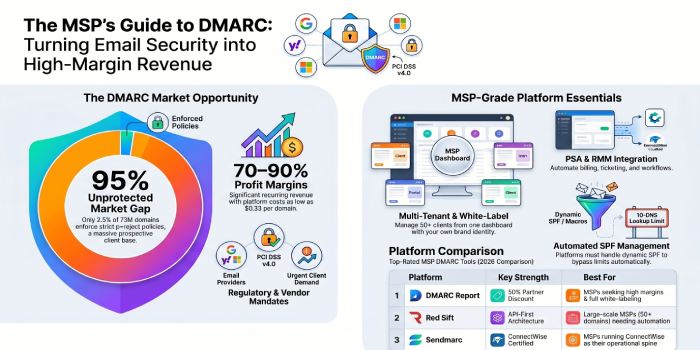
The numbers tell the story. According to Red Sift’s analysis of 73 million domains, only 14.9% have started their DMARC journey with even a basic p=none policy, and just 2.5% enforce the strictest p=reject policy. That leaves roughly 95% of domains unprotected against exact-domain spoofing. Meanwhile, a 2024 survey found that 40% of IT Directors cited DMARC implementation as too complex, and 54% said they would outsource it to an IT provider or specialist. Those are your prospective clients.
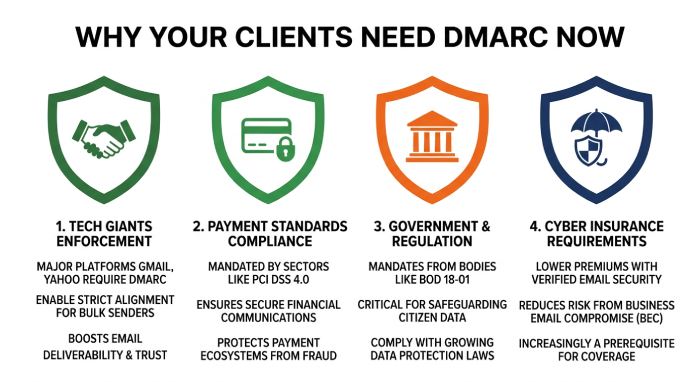
The regulatory environment is accelerating this demand. Google and Yahoo mandated DMARC for bulk senders in February 2024. Microsoft began rejecting non-compliant email in May 2025. PCI DSS v4.0 requires anti-phishing mechanisms as of March 2025. CISA BOD 18-01 mandates p=reject for federal domains. Cyber insurers increasingly require DMARC enforcement as an underwriting condition. Every one of these mandates pushes clients toward MSPs who can help them achieve DMARC compliance.
The market research supports this. According to EasyDMARC, the global DMARC software market was estimated at $254 million in 2022, with a projected CAGR of 37.5% reaching $1.7 billion by 2028. Cybersecurity is already the fastest-growing MSP service segment, expanding at 18% annually through 2026 according to industry analysis. DMARC fits squarely into this growth trajectory, it’s a service that every client with a domain needs, that most clients cannot implement themselves, and that generates predictable monthly recurring revenue.
The MSP Revenue Model for DMARC
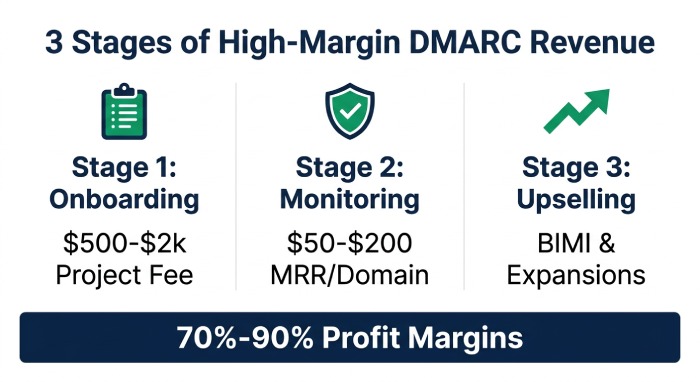
DMARC generates revenue at three stages, making it one of the highest-margin managed services an MSP can offer.
- Stage 1: Assessment and onboarding. Run a DMARC audit on the client’s domain, present the findings, and onboard them onto your monitoring platform. This is typically a one-time project fee ($500-$2,000 per domain depending on complexity) or included in the initial managed service contract.
- Stage 2: Monitoring and enforcement. The ongoing managed service: monitoring aggregate reports, identifying unauthorized senders, coordinating with the client’s third-party vendors to fix SPF/DKIM alignment, and progressively moving from p=none to p=quarantine to p=reject. This is monthly recurring revenue, typically $50-$200 per domain per month depending on your market.
- Stage 3: Upsell and expansion. Once DMARC is enforced, upsell to MTA-STS hosting, TLS-RPT monitoring, BIMI implementation, and ongoing compliance reporting. Additional domains (parked domains, subdomains, acquired domains) expand the contract over time.
The unit economics are attractive. Most MSP-focused DMARC platforms offer partner pricing between $0.33 and $5 per domain per month. If you charge clients $100-$200 per domain per month for managed DMARC, you’re operating at 70-90% margins on the platform cost alone. An MSP managing 100 client domains at $150/month generates $15,000/month in recurring revenue from DMARC alone, with platform costs of $500-$2,000/month.
What to Look for in an MSP DMARC Platform
Not every DMARC tool is built for MSPs. A platform that works well for a single organization managing its own domains may be completely inadequate for an MSP managing 50-500+ client domains. Here are the features that separate MSP-grade platforms from single-tenant tools.
Multi-tenant architecture. The most critical requirement. True multi-tenancy means complete data isolation between clients, separate login portals, and the ability to manage all clients from a single MSP dashboard while ensuring no client can see another’s data. Without this, you’re managing separate accounts per client, operationally unscalable.
White-label capabilities. Your clients should see your brand, not the platform vendor’s. Look for white-label options that include custom login URLs, branded reports, branded email alerts, and co-branded audit tools. The best programs let your clients never see the underlying vendor’s name.
PSA/RMM integration. If your MSP runs on ConnectWise, Autotask/Datto, or HaloPSA, your DMARC platform should integrate with your professional services automation. This means automated ticketing for DMARC alerts, synchronized billing, and unified client management. Without PSA integration, DMARC becomes a silo that requires separate workflows.
API access. Robust APIs let you automate client onboarding, pull report data into your own dashboards, integrate with SIEM platforms, and build custom workflows. API quality varies significantly between platforms, some offer full CRUD operations, others offer read-only endpoints.
Bulk domain onboarding. When you sign a new client with 15 domains, you need to onboard all of them in minutes, not hours. Look for CSV import, bulk DNS record generation, and automated discovery of subdomains and sending services.
Scalable pricing. MSP pricing should scale with your business, not penalize growth. The best models are flat-rate per domain with volume discounts at 50+ and 200+ domains. Avoid platforms that price by email volume for MSP use, your costs become unpredictable as clients grow.
Sender identification by vendor name. When a client’s DMARC report shows a failing IP, you need to know immediately if it’s Mailchimp, HubSpot, or an unauthorized sender. Platforms that classify sources by vendor name (not just IP) save hours of investigation per client.
Sales and marketing enablement. The best MSP programs provide pitch decks, objection handlers, co-branded audit tools, datasheets, and sales playbooks. These materials accelerate your DMARC sales cycle and help your team position DMARC to clients who don’t yet understand the need.
Solo Consultant vs. Mid-Size MSP vs. Large MSSP: Choosing the Right Tier
| Requirement | Solo / Small MSP (1-20 clients) | Mid-Size MSP (20-100 clients) | Large MSSP (100+ clients) |
|---|---|---|---|
| Domains managed | 10-50 | 50-300 | 300-5,000+ |
| Multi-tenant | Nice to have | Essential | Non-negotiable with RBAC |
| White-label | Branded reports | Full white-label portal | Custom URL + SSO + API |
| PSA integration | Optional | Important | Required (ConnectWise/Autotask) |
| Pricing model | Pay-as-you-go per domain | Volume discount tiers | Custom enterprise agreement |
| Support model | Self-service + docs | Dedicated partner manager | White-glove + co-delivery |
The Five-Stage DMARC Implementation Workflow for MSPs
Regardless of which platform you choose, the implementation workflow for MSP-delivered DMARC follows the same five stages. Understanding this workflow helps you evaluate which platforms support each stage most effectively.
Stage 1: Discovery. Publish a DMARC record in monitor-only mode (p=none) so every service sending email on the client’s behalf appears in aggregate reports. A DMARC report analyzer makes those aggregate reports readable so you can spot unauthorized senders quickly. No legitimate traffic is blocked. This phase typically takes 48-72 hours before reports start flowing.
Stage 2: Alignment. Configure each authorized sender to pass both SPF and DKIM. This means coordinating with the client’s email-sending services, CRM, marketing automation, invoicing, EHR portals, helpdesk, to ensure proper authentication. This is the most labor-intensive phase.
Stage 3: Automation. Use your multi-tenant platform to host DKIM keys, manage SPF includes, and set up alerts for configuration drift or new sending sources. This is where platform choice matters most, hosted SPF and DKIM reduce ongoing DNS management.
Stage 4: Enforcement. Move from p=none to p=quarantine (pct=25, then 50, then 100), then to p=reject. Each transition should be monitored for at least 7-14 days to catch any legitimate senders that were missed during alignment.
Stage 5: Ongoing monitoring. DMARC is not set-and-forget. Clients add new sending services, change vendors, acquire domains, and modify their email infrastructure. Your platform should alert you when any of these changes affect authentication, creating the sticky recurring revenue that makes DMARC valuable for MSPs.
Compliance Mandates Driving MSP DMARC Sales
These mandates are your sales ammunition. Every one of them creates urgency for clients who haven’t implemented DMARC.
- Google/Yahoo (Feb 2024): DMARC required for bulk senders (5,000+ messages/day). Non-compliant email gets filtered or rejected.
- Microsoft (May 2025): Began rejecting non-compliant email from high-volume senders to Outlook.com, Hotmail, and Live.
- PCI DSS v4.0 (March 2025): Anti-phishing mechanisms required for payment card data processors. DMARC is the standard control.
- CISA BOD 18-01: Mandates p=reject for U.S. federal agency domains. Sets the baseline for government contractors.
- Cyber insurance: Underwriters increasingly require DMARC enforcement as an underwriting condition or offer premium discounts for p=reject.
- NIS2 / DORA (EU): Cybersecurity directives that include email authentication as part of broader cyber hygiene requirements for covered organizations.
Top DMARC Tools for MSPs Compared
| Platform | G2 Rating | Best For | White-Label | PSA Integration | MSP Pricing | Not Ideal For |
|---|---|---|---|---|---|---|
| DMARC Report | 4.8/5 (470) | White-label + compliance docs | Full (URL, reports, portal) | API-based | 50% off list | MSPs wanting PSA-native ticketing (no ConnectWise cert) |
| Red Sift OnDMARC | 4.8/5 | API-first multi-tenant | Full | Event Hub / API | Flat-rate | Small MSPs, pricing sits higher than entry-level tools |
| PowerDMARC | 4.6/5 | Full-stack auth + 1,000+ partners | Full (URL, widgets, reports) | API + SIEM/SOAR | Pay-as-you-go | MSPs wanting DMARC-only, broad feature set adds complexity |
| Sendmarc | 4.5/5 | ConnectWise PSA certified | Co-branded portal | ConnectWise PSA certified | Custom partner | MSPs not on ConnectWise, PSA advantage doesn’t apply |
| EasyDMARC | 4.7/5 | Guided onboarding + sales enablement | Reports + materials | ConnectWise certified | Pay-per-domain | Large MSSPs needing deep multi-tenant separation |
| dmarcian | 4.3/5 | Visual reporting + education | Limited | Webhooks (Slack/Teams) | Partner pricing | MSPs needing white-label or advanced multi-tenant |
Pricing sourced from G2, Capterra, vendor websites, and ConnectWise Marketplace as of April 2026.
Individual Reviews
DMARC Report
DMARC Report is an enterprise-grade, white-label DMARC reporting and email authentication management platform with a dedicated MSP Partner Program built for service providers managing email security across multiple client organizations.
The MSP Partner Program is the centerpiece of DMARC Report’s MSP offering. Partners receive 50% off list pricing, a fully white-labeled platform (custom URL, branded login portal, branded reports and alerts), and a 25-seat white-labeled platform upon signing a single client. The program includes dedicated sales and technical professionals, white-glove onboarding, deal registration with conflict management, POC customization, and POT deployment support. Partners can resell the Done With You enforcement service at $1,950/domain cost (retail $3,900) and bill ongoing monitoring from the white-labeled platform at whatever rate works for their business.
The platform itself processes 50,000+ domains and provides automated aggregate and forensic report parsing, AI-powered sender analysis, source classification by vendor name, and multi-domain management including parked domains. The open REST API enables integration with existing PSA tools, SIEM platforms, and custom dashboards. Enterprise compliance documentation (SLA with 99.99% uptime, DPA, NDA, SOC-2 Type II, SSO/SAML, RBAC, audit logs) comes standard on higher tiers, valuable for MSPs serving regulated industries like healthcare and finance.
DMARC Report does not currently have a certified ConnectWise PSA integration, which is a disadvantage for MSPs running ConnectWise as their operational spine. Integration is possible via the REST API, but requires custom development rather than out-of-the-box ticketing and billing sync. Additionally, DMARC Report focuses on DMARC reporting, it does not include inbound email filtering or broader email security.
Top MSP Features
- 50% off list pricing for MSP partners
- Full white-label: custom URL, branded portal, reports, and alerts
- 25-seat white-labeled platform with first client signup
- Done With You enforcement: $1,950 partner cost, 90-day p=quarantine guarantee
- Dedicated sales + technical support, deal registration, POC/POT deployment
- Open REST API for PSA/SIEM integration
- Enterprise compliance docs: SLA, DPA, SOC-2 Type II, SSO/SAML
- AI-powered sender analysis and source classification by vendor name
MSP Pricing: 50% off list pricing. Volume discounts at 50+ and 200+ domains. Free trial available.
Best For: MSPs wanting full white-label DMARC with high margins, enterprise compliance documentation for regulated clients, and a done-with-you enforcement option they can resell.
How does it compare: DMARC Report is the most-reviewed DMARC platform on G2 with 470 verified reviews, which provides strong social proof for MSP sales pitches. According to G2, users rate it highest for implementability and ROI. The 50% partner pricing and white-label portal create strong unit economics for MSPs.
Red Sift OnDMARC
Red Sift OnDMARC is a purpose-built, API-first DMARC platform commonly cited by independent evaluators as the leading option for MSPs serious about email authentication as a managed service at scale.
The platform serves 1,200+ global customers and offers the most sophisticated multi-tenant architecture among DMARC vendors. Dynamic SPF technology solves the 10-lookup limit without manual flattening. The Investigate tool enables instant DNS verification without waiting for reports. Event Hub streams security and audit events via SIEM integrations, webhooks, Slack, and Teams. Beyond DMARC, Red Sift offers DNS Guardian (dangling DNS records, subdomain misconfigurations) and Brand Trust (lookalike domain detection), giving MSPs higher-margin security tiers to sell alongside core DMARC.
Red Sift’s pricing sits higher than entry-level DMARC monitoring tools. MSPs with smaller client bases or those evaluating the space for the first time may find the investment significant before the recurring revenue model justifies it.
Top MSP Features
- Purpose-built multi-tenant with complete data isolation
- Dynamic SPF (unlimited lookups) on higher tiers
- API-first architecture for full automation
- Event Hub for SIEM/webhook/Slack/Teams streaming
- Upsell path: DNS Guardian + Brand Trust
MSP Pricing: Flat-rate MSP pricing. 14-day free trial with full feature access.
Best For: MSPs managing 50+ client domains who want the strongest multi-tenant architecture, automation capabilities, and an expansion path into DNS and brand protection services.
How does it compare: According to independent evaluators, Red Sift OnDMARC offers the most robust multi-tenant architecture among DMARC vendors. The API-first design supports full automation of client onboarding, reporting, and policy management at scale.
PowerDMARC
PowerDMARC is a full-stack, SaaS-based email authentication platform with a Partner Program spanning 1,000+ channel partners across 100+ countries, offering DMARC, SPF, DKIM, BIMI, MTA-STS, and TLS-RPT from a single dashboard.
The MSP/MSSP Partner Program includes full white-labeling (custom URL, branded signup page, widgets, and reports), pay-as-you-go pricing with no contract commitment, and the platform can be translated into 11 global languages. API integration supports SIEM, SOAR, XDR, and cloud billing systems. PowerSPF (hosted SPF with macros) solves the 10-lookup limit. AI-powered threat intelligence provides real-time IP analysis and risk scoring. Partners receive dedicated marketing and sales support, datasheets, and enablement materials.
The breadth of features (DMARC + SPF + DKIM + BIMI + MTA-STS + TLS-RPT) is a double-edged sword for MSPs. The comprehensive feature set creates upsell opportunities, but according to G2 reviewers, it can also involve a learning curve for MSP teams without dedicated email security expertise.
Top MSP Features
- 1,000+ channel partners across 100+ countries
- Full white-label: custom URL, branded portal, widgets, reports
- Pay-as-you-go, no contract commitment
- PowerSPF with macro support
- AI-powered threat intelligence
- 11-language platform support
- SIEM/SOAR/XDR and cloud billing integration
MSP Pricing: According to G2, plans start from $8/month. Partner program uses pay-as-you-go model. 15-day free trial.
Best For: MSPs wanting to offer the full email authentication stack (DMARC + SPF + DKIM + BIMI) under one vendor, particularly those serving international clients across multiple languages.
How does it compare: PowerDMARC has the largest channel partner network in the DMARC space. According to Capterra reviews, users highlight the platform’s affordability and ease of setup.
Sendmarc
Sendmarc is a partner-first DMARC platform built specifically for MSPs and MSSPs, distinguished by its certified ConnectWise PSA integration developed through the ConnectWise Invent program.
The ConnectWise integration is Sendmarc’s standout differentiator. It enables synchronized account mapping, automated billing through ConnectWise agreements, predefined service desk templates that auto-generate DMARC tickets, and unified client management. For MSPs running ConnectWise as their operational spine, this eliminates the separate-workflow problem that plagues other DMARC platforms. Sendmarc also covers the full authentication stack (DMARC, SPF, DKIM, MTA-STS, TLS-RPT, BIMI) with automated policy enforcement, and provides co-branded portals, lead generation tools, and marketing enablement content.
Top MSP Features
- Certified ConnectWise PSA integration (Invent program)
- Automated billing via ConnectWise agreements
- Auto-generated service tickets from DMARC events
- Co-branded customer portals
- Lead generation and sales enablement toolkit
MSP Pricing: Custom partner pricing. Contact Sendmarc for volume-based MSP terms.
Best For: MSPs running ConnectWise PSA who want native ticketing, billing, and client management integration without custom API development.
How does it compare: Sendmarc’s ConnectWise certification gives it a clear operational advantage for ConnectWise-based MSPs. According to the ConnectWise Marketplace, the integration passed security review and receives tier 1 support. MSPs not on ConnectWise lose this core differentiator.
EasyDMARC
EasyDMARC is a user-friendly DMARC platform with a dedicated MSP Partner Program that combines guided onboarding, a pay-per-domain pricing model, and comprehensive sales enablement materials.
The MSP program offers a multi-tenant self-service platform with domain grouping, organization controls, and access management. White-label capabilities include branded reports and downloadable materials customized with your logo and colors. EasyDMARC also provides a ConnectWise-certified integration through the Invent program. The sales enablement is notable: EasyDMARC offers a free advanced sales process workbook, pitch materials, and marketing support. Real-time blocklist monitoring alerts MSPs when client IPs or domains appear on blocklists. The platform’s API allows pulling DMARC data into custom dashboards and running live DNS health checks.
Top MSP Features
- Pay-per-domain monthly pricing with no minimum
- ConnectWise-certified PSA integration
- Free sales process workbook and marketing enablement
- Domain grouping and organization controls
- Real-time blocklist monitoring
- API for custom dashboard integration
MSP Pricing: Pay-per-domain per month. Contact sales for MSP-specific pricing tiers.
Best For: MSPs new to offering DMARC who want the most guided onboarding experience, strong sales enablement materials, and a low-risk pay-as-you-go model.
How does it compare: EasyDMARC’s sales enablement materials (workbooks, pitch decks, objection handlers) are among the most comprehensive in the space. According to G2, users praise the platform’s ease of use. Larger MSSPs needing deep multi-tenant separation and compliance documentation may find the enterprise features less mature.
dmarcian
dmarcian is a DMARC monitoring platform founded by one of the original authors of the DMARC specification, with a strong MSP and reseller channel presence built on clear visual reporting and educational resources.
The platform emphasizes making DMARC data accessible. Domain Overview provides fast status checks across client domains. Geographic abuse source mapping adds context when investigating spoofing. The educational resources and documentation are among the strongest in the space, making dmarcian a good fit for MSPs whose teams are still building DMARC expertise. Partner pricing is available with special terms for service providers.
Top MSP Features
- Visual DMARC journey management
- Domain Overview for fast multi-domain status
- Geographic abuse source mapping
- Strong educational resources for MSP team training
- Notification via email, Slack, Teams, or Webhooks
MSP Pricing: Free plan (1,250 messages/month, 2 domains). Partner pricing available on request.
Best For: MSPs early in their DMARC journey who want the clearest visual reporting and the best educational resources to build team competency.
How does it compare: According to Expert Insights reviews, dmarcian’s reporting is clear and its support team is praised. However, white-label capabilities and multi-tenant sophistication are more limited than platforms purpose-built for MSP scale.
Decision Framework
| Question | If Yes → Consider |
|---|---|
| Need full white-label with high margins and compliance docs? | DMARC Report (MSP Partner Program) |
| Managing 50+ domains and need the strongest multi-tenant? | Red Sift OnDMARC |
| Want full-stack auth (DMARC+SPF+DKIM+BIMI) in one dashboard? | PowerDMARC |
| Running ConnectWise PSA and need native integration? | Sendmarc or EasyDMARC |
| New to DMARC and need guided onboarding + sales tools? | EasyDMARC |
| Building DMARC expertise with visual reporting? | dmarcian |
| Want done-with-you enforcement to resell at $3K-$5K? | DMARC Report (Done With You) |
Role-Based Buyer Guidance
For MSP owners and principals: Focus on unit economics. Compare your platform cost per domain against your target client billing rate. The platforms with the best MSP margins are DMARC Report (50% off list) and Red Sift OnDMARC (flat-rate). Factor in the cost of PSA integration, native integration (Sendmarc, EasyDMARC) saves development hours; API integration (DMARC Report, PowerDMARC) requires initial setup but offers more flexibility.
For MSP sales teams: Your sales tools matter. EasyDMARC provides the most comprehensive sales enablement materials. DMARC Report provides co-branded audit tools and pitch decks. PowerDMARC offers datasheets and marketing support. Lead with the client’s current DMARC posture, run a free DMARC check on their domain in the sales meeting.
For MSP technical teams: Evaluate API depth, bulk onboarding, and hosted DNS capabilities. Red Sift OnDMARC and PowerDMARC offer the strongest API-first architectures. DMARC Report’s REST API covers full CRUD. For SPF complexity, look at hosted SPF with macros (PowerDMARC PowerSPF, Red Sift Dynamic SPF) rather than manual flattening.
For MSSPs serving regulated industries: Compliance documentation is your differentiator. DMARC Report’s SLA, DPA, SOC-2 Type II, and SSO/SAML stack is the most comprehensive for regulated client procurement. Pair this with industry-specific positioning (healthcare HIPAA, finance PCI DSS, government CISA).
Implementation Considerations
Start with your own domain. Before selling DMARC to clients, implement it on your MSP’s domain. This gives your team hands-on experience with the platform, creates a case study you can reference in sales, and ensures your own email authentication is solid.
Productize the service. Create a standard DMARC service tier with defined scope, SLA, and pricing. Don’t sell DMARC as ad-hoc project work, it’s a managed service with ongoing monitoring that generates MRR. Bundle it with your existing security stack.
Use the audit as a sales tool. Every DMARC platform offers free domain checks. Run one on every prospect’s domain during the sales conversation. When they see p=none (or no DMARC record at all), the conversation shifts from “what is DMARC?” to “when can we start?”
Plan for SPF complexity. Many clients will already be near the 10 DNS lookup limit. Budget for SPF management (flattening or hosted macros) as part of your DMARC service, not as a separate line item.Set enforcement timelines in the SOW. Commit to a concrete timeline: 90 days to p=quarantine, 180 days to p=reject. This sets client expectations and creates a natural project cadence. DMARC Report’s Done With You program guarantees 90-day p=quarantine for MSPs who want to outsource the enforcement work.
General Manager
General Manager of DuoCircle. Product strategy and commercial lead for DMARC Report's 2,000+ customer base.
LinkedIn Profile →Take control of your DMARC reports
Turn raw XML into actionable dashboards. Start free - no credit card required.