Best DMARC Monitoring Tools for Multi-Domain Enterprises in 2026

Quick Answer
Quick answer: The best DMARC tools for multi-domain enterprises in 2026 are DMARC Report (enterprise compliance with SLAs, DPAs, SOC-2 Type II, unlimited domains on Ultimate), Red Sift OnDMARC (API-first with Dynamic SPF and DNS Guardian for subdomain security), PowerDMARC (full-stack authentication with bulk operations and AI threat intelligence), Valimail (automated enforcement with zero-DNS-maintenance for large portfolios), EasyDMARC (guided onboarding.
Related: Free DMARC Checker ·How to Create an SPF Record ·SPF Record Format
Try Our Free DMARC Checker
Validate your DMARC policy, check alignment settings, and verify reporting configuration.
Check DMARC Record →Quick answer: The best DMARC tools for multi-domain enterprises in 2026 are DMARC Report (enterprise compliance with SLAs, DPAs, SOC-2 Type II, unlimited domains on Ultimate), Red Sift OnDMARC (API-first with Dynamic SPF and DNS Guardian for subdomain security), PowerDMARC (full-stack authentication with bulk operations and AI threat intelligence), Valimail (automated enforcement with zero-DNS-maintenance for large portfolios), EasyDMARC (guided onboarding with domain grouping and organization controls), and dmarcian (visual reporting with automated domain discovery). The right choice depends on your domain count, procurement requirements, SPF complexity, and whether you need centralized visibility across business units or subsidiaries.
Full disclosure: this guide is published by DMARC Report. We’ve aimed to be fair about where each platform is strongest for multi-domain enterprise use cases. Contact us if any characterization needs correction.
Why Multi-Domain DMARC Is Different from Single-Domain
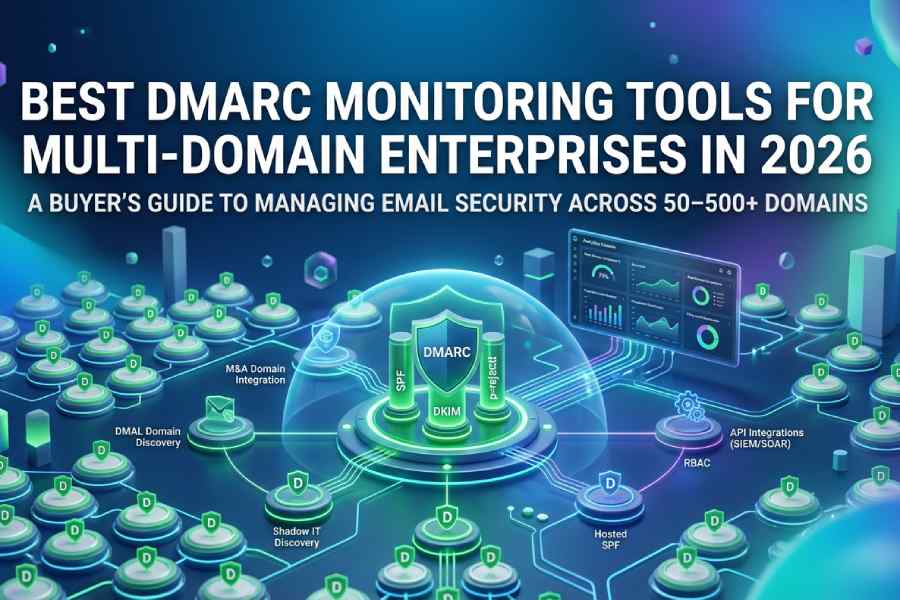
Managing DMARC for a single domain is straightforward: publish a record, monitor reports, align your sending services, and enforce. Managing DMARC across 50-500+ domains introduces a fundamentally different set of challenges that single-domain tools cannot address. At this scale, DMARC monitoring across the whole portfolio becomes its own operational discipline.
Enterprise domain portfolios grow through multiple channels: primary corporate domains, regional domains, product-specific domains, M&A acquired domains, parked defensive registrations, marketing campaign domains, and subdomains used by different business units. Each domain has its own set of authorized senders, its own SPF record approaching the 10-lookup limit, and its own DMARC policy that may be at a different stage of enforcement.
According to Red Sift’s analysis of 73 million domains, 84% lack adequate DMARC protection as of 2026. For enterprises, this gap often stems from implementation complexity rather than awareness, organizations understand DMARC’s importance but struggle with inventory management across dozens of sending sources, safe transition to enforcement without blocking legitimate email, and coordination across distributed IT and security teams.
The Five Challenges of Enterprise Multi-Domain DMARC
1. Domain Inventory and Shadow IT Discovery
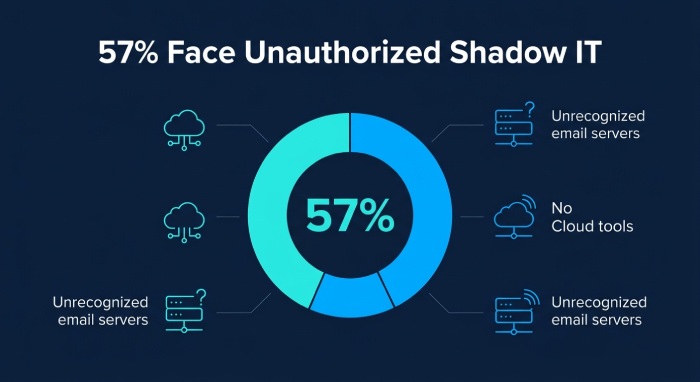
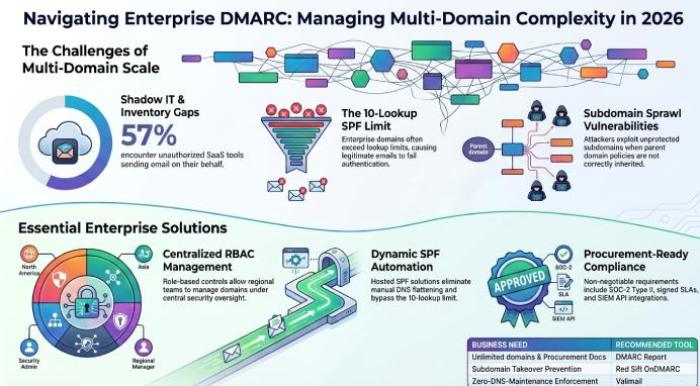
Most enterprises do not have a complete inventory of every domain and subdomain sending email on their behalf. Shadow IT, departments signing up for SaaS tools that send email from the corporate domain without IT’s knowledge, is the most common source of DMARC failures during enforcement. According to Wolters Kluwer’s 2026 survey, 57% of professionals have encountered unauthorized tools in their organizations. Without automated domain and subdomain discovery, enterprises enforce DMARC blind and risk blocking legitimate email.
2. SPF Complexity at Scale
The SPF protocol limits DNS lookups to 10 per record. A single enterprise domain may use Google Workspace, Salesforce, HubSpot, SendGrid, Zendesk, ServiceNow, and several custom applications, easily exceeding 10 lookups. Multiply this across 100+ domains and SPF management becomes a full-time operational burden. Enterprises need hosted SPF with macros or dynamic SPF flattening to stay within limits without losing authorized senders.
3. Subdomain Sprawl and Policy Inheritance
DMARC policies on a parent domain can be inherited by subdomains (via the sp= tag) or overridden with subdomain-specific DMARC records. In large enterprises, subdomains proliferate without governance: marketing.company.com, portal.company.com, legacy.company.com, staging.company.com. Attackers exploit unprotected subdomains for phishing (fake.company.com) because most enterprises enforce DMARC on the primary domain but leave subdomains exposed. Setting sp=reject on the parent domain protects all subdomains automatically, but requires prior validation of subdomain sending services.
4. M&A Domain Consolidation
Mergers and acquisitions introduce domains with unknown email ecosystems. Acquired companies may have no DMARC record, a p=none policy from years ago, or SPF records referencing decommissioned servers. Each acquired domain needs to be inventoried, its senders identified, and its DMARC policy brought into alignment with the parent organization’s security posture, without disrupting the acquired company’s ongoing email communications during the transition.
5. Cross-Team Coordination and Access Controls
Enterprise DMARC management spans IT security, email operations, marketing, compliance, and procurement. Different business units may own different domains. The DMARC platform must support role-based access controls (RBAC) so regional teams can manage their domains without seeing other teams’ data, while the central security team maintains a global view. Without RBAC, either the central team becomes a bottleneck or domain owners make changes without oversight.
Key Features for Enterprise Multi-Domain DMARC
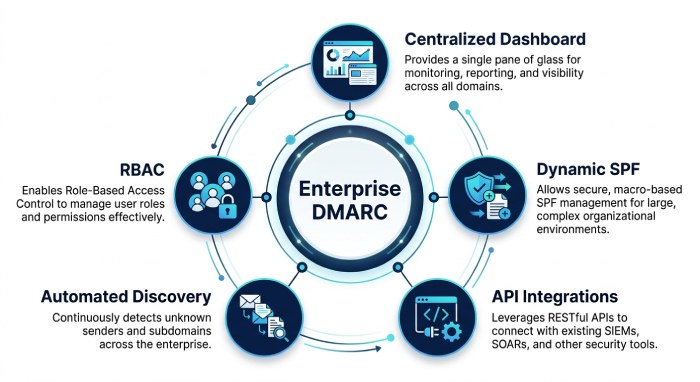
Centralized multi-domain dashboard. A single pane of glass showing DMARC status, policy level, authentication pass rates, and sender counts across all domains. The dashboard should support filtering by business unit, region, policy level, and enforcement status.
Automated domain and subdomain discovery. The platform should discover domains and subdomains you may not know about, registered domains without DMARC records, subdomains being used by unauthorized senders, and domains from M&A activity.
Bulk operations. When you onboard 50 domains, you need CSV import, bulk DNS record generation, and the ability to apply policy templates across domain groups. Domain-by-domain management is unscalable.
Hosted SPF / Dynamic SPF. SPF management at enterprise scale requires automated solutions that stay within the 10-lookup limit without manual flattening. Hosted SPF with macros or dynamic SPF technology eliminates this operational burden.
Role-based access controls (RBAC). Grant regional or business-unit administrators access to their specific domains only. Prevent accidental cross-contamination between brands while maintaining centralized oversight.
Enterprise compliance documentation. Signed SLAs, DPAs, NDAs, SOC-2 Type II, SSO/SAML, and audit logs. These are non-negotiable for enterprise procurement teams and vendor onboarding in regulated industries.
API-first architecture. Integration with SIEM (Splunk, Sentinel, QRadar), SOAR, GRC platforms, and internal dashboards. Enterprises need APIs for automated evidence collection, compliance reporting, and security operations workflows.
Parked domain protection. Defensively registered domains and parked domains still need DMARC records (with p=reject and null SPF) to prevent abuse. The platform should support parked domains as a distinct category with appropriate default policies.
DNS rollback capabilities. When a DMARC or SPF change causes unintended email disruption, the ability to quickly rollback DNS changes is critical for enterprises where email downtime has direct business impact.
Sizing Your Enterprise DMARC Deployment
| Requirement | Mid-Market (10-50 domains) | Enterprise (50-200 domains) | Global Enterprise (200-500+) |
|---|---|---|---|
| Dashboard | Centralized view with filtering | BU/region segmentation + RBAC | Multi-tenant with SSO/SAML |
| SPF management | Manual flattening or basic hosting | Hosted SPF with macros | Dynamic SPF with automation |
| Subdomain handling | sp=reject on parent | Automated subdomain discovery | Continuous subdomain monitoring |
| Compliance docs | DPA, SOC-2 | SLA, DPA, NDA, SSO/SAML | Custom SLA, dedicated engineer |
| API integration | REST API for reporting | SIEM/SOAR integration | Full CRUD + event streaming |
| Budget range | $75-$200/mo | $200-$3,900/mo | Custom enterprise agreement |
The Enterprise Compliance Landscape
- CISA BOD 18-01: Mandates p=reject for U.S. federal domains. Government contractors managing multiple domains must demonstrate DMARC enforcement across their portfolio.
- PCI DSS v4.0 (March 2025): Anti-phishing mechanisms required for all domains in the cardholder data environment and across the organization. Meeting email authentication compliance here is mandatory for card processors.
- Google/Yahoo (Feb 2024), Microsoft (May 2025): DMARC required for bulk senders. Enterprises sending from multiple domains need authentication on every one.
- NIS2 / DORA (EU): Cybersecurity directives requiring email authentication for covered financial and critical infrastructure entities.
- Cyber insurance: Underwriters increasingly audit DMARC enforcement across all organizational domains, not just the primary one.
Top DMARC Tools for Multi-Domain Enterprises Compared
| Platform | G2 Rating | Best For | Max Domains | Hosted SPF | Price | Not Ideal For |
|---|---|---|---|---|---|---|
| DMARC Report | 4.8/5 (470) | Compliance docs + unlimited domains | Unlimited (Ultimate) | Via AutoSPF | Free; $25/mo | Teams wanting automated SPF in-platform (requires AutoSPF pairing) |
| Red Sift OnDMARC | 4.8/5 | API-first + Dynamic SPF + DNS Guardian | Unlimited | Dynamic SPF | Custom | Budget-constrained mid-market, higher pricing tier |
| PowerDMARC | 4.6/5 | Full-stack + bulk ops + AI | Unlimited (Enterprise) | PowerSPF macros | From $8/mo | DMARC-only teams, feature breadth adds complexity |
| Valimail | 4.4/5 | Automated enforcement at scale | Unlimited | Automated SPF | ~$5K/yr+ | SMBs / budget-conscious orgs, enterprise pricing |
| EasyDMARC | 4.7/5 | Domain grouping + guided onboarding | Unlimited (Enterprise) | EasySPF | $35.99/mo | Enterprises needing signed SLAs and deep RBAC |
| dmarcian | 4.3/5 | Visual reporting + domain discovery | Enterprise plan | No | Custom | Orgs needing hosted SPF or MTA-STS in-platform |
Pricing sourced from G2, Capterra, vendor websites as of April 2026.
Individual Reviews
DMARC Report
DMARC Report is an enterprise-grade, compliance-ready DMARC reporting and email authentication management platform processing 50,000+ domains, with unlimited domain support on its Ultimate plan and the most comprehensive enterprise compliance documentation stack in the DMARC space.
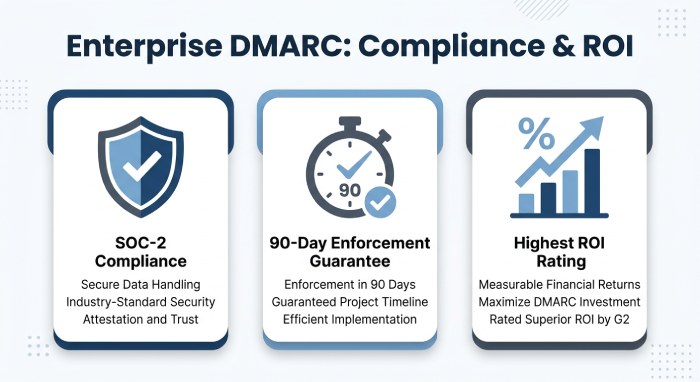
For multi-domain enterprises, DMARC Report’s core strengths are scale and compliance. The platform manages domains, subdomains, and parked domains from a single dashboard with source classification by vendor name. T_he Defender and Ultimate plans include signed SLAs (99.99% uptime), DPAs, NDAs, SOC-2 Type II, SSO/SAML, RBAC, audit logs, and DNS rollback, all standard_. The Ultimate plan ($3,900) adds unlimited domains, 3-year data history, a dedicated DMARC engineer, and a 90-day p=quarantine enforcement guarantee.
AI-powered analysis surfaces sender patterns and anomalies across the portfolio, reducing the manual effort of reviewing reports across hundreds of domains. The open REST API enables SIEM integration for centralized security monitoring. DMARC Report’s sister product, AutoSPF, provides dedicated SPF flattening with macros and a separate 99.99% SLA, relevant for enterprises needing SPF management beyond what basic DMARC platforms offer.
DMARC Report does not include automated domain discovery (you must add domains manually or via CSV) and does not include in-platform SPF hosting, SPF management requires the separate AutoSPF product. The platform focuses on DMARC reporting; it does not include inbound email filtering.
Top Enterprise Features
- Unlimited domains on Ultimate plan
- SOC-2 Type II, SLA, DPA, NDA, SSO/SAML, RBAC, audit logs, DNS rollback
- AI-powered sender analysis across portfolio
- Source classification by vendor name
- Parked domain support with appropriate default policies
- REST API for SIEM integration
- 3-year data history on Ultimate
- Dedicated DMARC engineer + 90-day enforcement guarantee (Ultimate)
Pricing: Free; $25/mo; $75/mo; $200/mo; $3,900 (Ultimate, unlimited domains). Annual saves ~17%.
Best For: Enterprises needing procurement-ready compliance documentation, unlimited domain management, and audit-trail evidence for regulated industries.
How does it compare: Most-reviewed DMARC platform on G2 (471 reviews). Highest rated for implementability and ROI. Compliance documentation stack is the most comprehensive as standard. SPF management requires the separate AutoSPF product.
Red Sift OnDMARC
Red Sift OnDMARC is a purpose-built, API-first DMARC platform with Dynamic SPF technology, continuous subdomain monitoring via DNS Guardian, and lookalike domain detection via Brand Trust, making it the most architecturally complete platform for enterprise multi-domain security.
Dynamic SPF eliminates the 10-lookup limit without manual flattening or separate products. DNS Guardian provides continuous monitoring for subdomain takeover vulnerabilities, dangling DNS records, and misconfigurations, addressing the subdomain sprawl problem that plagues large enterprises. Brand Trust adds AI-powered lookalike domain detection. The Investigate tool enables instant DNS verification without waiting for reports. Event Hub streams events to SIEM, webhooks, Slack, and Teams.
Red Sift’s pricing sits at the higher end. Enterprises serving 1,200+ customers including Capgemini, ZoomInfo, Wise, and TUI report faster time-to-enforcement than competing platforms.
Top Enterprise Features
- Dynamic SPF, unlimited lookups, no manual flattening
- DNS Guardian, continuous subdomain monitoring and takeover prevention
- Brand Trust, AI lookalike domain detection
- API-first with Event Hub for SIEM/webhook streaming
- Investigate tool for instant DNS verification
Pricing: Custom enterprise pricing. 14-day free trial with full features.
Best For: Global enterprises (200+ domains) wanting the strongest multi-domain architecture with Dynamic SPF, subdomain security, and brand protection in one platform.
How does it compare: According to independent evaluators, Red Sift offers the most robust multi-tenant architecture and the only integrated subdomain takeover prevention (DNS Guardian). Higher pricing may not fit mid-market budgets.
PowerDMARC
PowerDMARC is a full-stack email authentication platform bundling DMARC, SPF, DKIM, BIMI, MTA-STS, and TLS-RPT with AI-powered threat intelligence, serving 1,000+ organizations across 100+ countries with SOC-2 Type 2 and ISO 27001 dual certification.
PowerSPF solves the 10-lookup limit with hosted macros. The platform provides bulk domain operations, AI-driven risk scoring of sending sources, SIEM/SOAR/XDR integration, and geolocation reporting. PowerDMARC has published detailed multi-domain enterprise guidance and country-specific DMARC adoption reports across dozens of markets.
Top Enterprise Features
- PowerSPF with macro support for complex environments
- SOC-2 Type 2 + ISO 27001 dual certification
- AI-powered threat intelligence and risk scoring
- SIEM/SOAR/XDR integration
- Geolocation reporting for abuse source mapping
- 11-language platform support for global enterprises
Pricing: From $8/mo. Enterprise custom. 15-day free trial.
Best For: Global enterprises wanting all authentication protocols in one dashboard with dual security certification and multilingual support.
How does it compare: Dual SOC-2 + ISO 27001 is unique. Largest channel partner network (1,000+). Feature breadth may involve a learning curve per G2 reviews.
Valimail
Valimail is an enterprise email authentication platform focused on automated DMARC enforcement with zero-DNS-maintenance, serving large organizations including Fortune 500 companies that need to reach p=reject across hundreds of domains quickly.
Valimail’s automation-first approach automatically discovers legitimate senders and manages authentication records. For enterprises with complex M&A-driven domain portfolios, this automation reduces the manual sender-identification phase from months to weeks. Valimail’s Enforce Starter begins at $5,000/year.
Top Enterprise Features
- Automated sender discovery across large portfolios
- Zero-DNS-maintenance enforcement
- Automated SPF and DKIM management
Pricing: Enforce Starter from $5,000/yr. Premium and Enterprise are quote-based.
Best For: Large enterprises wanting to automate the path from p=none to p=reject across 100+ domains with minimal hands-on DNS work.
How does it compare: Strongest automation for enforcement. Enterprise pricing means smaller organizations often look elsewhere. Sales cycle is longer per G2 reviews.
EasyDMARC
EasyDMARC is a user-friendly DMARC platform with domain grouping, organization controls, and Managed DMARC services that allow enterprises to adjust policies directly from the platform through a single DNS record.
The platform’s domain grouping feature lets enterprises organize domains by business unit, region, or brand, a practical feature for multi-domain management. EasySPF provides dynamic SPF flattening. Managed DMARC eliminates manual DNS edits for policy changes. EasyDMARC has published a 2026 DMARC Adoption Report analyzing 1.8 million domains including Fortune 500 and Inc. 5000 companies.
Top Enterprise Features
- Domain grouping by business unit/region/brand
- Managed DMARC, policy changes without DNS edits
- EasySPF for dynamic flattening
- Industry benchmarking via adoption reports
Pricing: From $35.99/mo. Enterprise plan with unlimited domains is quote-based.
Best For: Mid-market enterprises (10-50 domains) wanting guided onboarding with domain grouping and Managed DMARC.
How does it compare: Domain grouping is a practical differentiator for multi-BU environments. Enterprise features like signed SLAs and deep RBAC may be less mature for Fortune 500 procurement.
dmarcian
dmarcian is a DMARC monitoring platform founded by a co-author of the DMARC specification, featuring automated Domain Discovery that detects registered domains that may not have DMARC records, an enterprise-only feature addressing the domain inventory challenge.
The Source Cataloguing engine tracks legitimate and suspicious senders across all managed domains. Geographic abuse source mapping provides context when investigating spoofing across regional domains. The Detail Viewer enables deep analysis of authentication gaps at the domain level.
Top Enterprise Features
- Domain Discovery, automated detection of unprotected domains
- Source Cataloguing across multi-domain portfolios
- Geographic abuse source mapping
- Regional data centers for data sovereignty
Pricing: Enterprise plan is quote-based. Free plan available (limited).
Best For: Enterprises with incomplete domain inventories that need automated discovery and clear visual reporting for cross-team communication.
How does it compare: Domain Discovery is a unique enterprise feature. However, hosted SPF and MTA-STS are not available in-platform. Enterprise compliance documentation (SLAs, DPAs) is more limited.
Decision Framework
| Question | If Yes → Consider |
|---|---|
| Need SLAs, DPAs, SOC-2, audit logs for procurement? | DMARC Report (Defender/Ultimate) |
| Managing 200+ domains with subdomain sprawl concerns? | Red Sift OnDMARC (DNS Guardian) |
| Want all auth protocols + dual SOC-2/ISO 27001? | PowerDMARC |
| Need automated enforcement across 100+ domains? | Valimail |
| Mid-market with domain grouping by business unit? | EasyDMARC |
| Incomplete domain inventory, need automated discovery? | dmarcian (Domain Discovery) |
| Need dedicated SPF management with separate SLA? | DMARC Report + AutoSPF |
| Need subdomain takeover + lookalike domain protection? | Red Sift OnDMARC (DNS Guardian + Brand Trust) |
Role-Based Buyer Guidance
For CISOs: Prioritize platforms with SIEM integration, audit logs, and vendor security certification. Evaluate the platform’s ability to provide a portfolio-wide compliance posture view. DMARC Report (SOC-2, audit logs, SIEM API) and Red Sift OnDMARC (Event Hub, DNS Guardian) address enterprise CISO requirements.
For IT Directors managing DNS: SPF complexity is your biggest operational challenge. Evaluate hosted SPF solutions carefully: PowerDMARC (PowerSPF macros), Red Sift OnDMARC (Dynamic SPF), and DMARC Report + AutoSPF. Count your current DNS lookups before selecting a platform.
For M&A and Corporate Development teams: Acquired domains need rapid assessment and onboarding. Evaluate platforms with bulk import, automated discovery (dmarcian Domain Discovery), and the ability to manage domains at different enforcement stages simultaneously.
For Procurement: Require signed SLAs, DPAs, SOC-2 Type II, and SSO/SAML from your DMARC vendor. DMARC Report provides the most comprehensive compliance documentation stack as standard. Verify that the vendor’s data processing practices align with your geographic and regulatory requirements.
Implementation Considerations
Start with a complete domain inventory. Before selecting a platform, audit your domain registrar accounts, DNS providers, and internal records. Many enterprises discover 20-40% more domains than they expected, acquired domains, forgotten campaign domains, and defensively registered variations. A quick DMARC lookup on each one shows which domains already publish a record and which are missing protection.
Categorize domains by type. Separate active sending domains (need full DMARC implementation), parked domains (need p=reject with null SPF), and subdomains (need sp= policy or individual DMARC records). Different categories have different implementation requirements.
Implement in waves. Don’t attempt to enforce DMARC on 200 domains simultaneously. Start with your highest-risk domains (primary corporate, customer-facing), then expand to secondary domains, then parked domains. Each wave follows the p=none → p=quarantine → p=reject progression independently.
Assign domain owners. Every domain must have an accountable owner who can authorize sending-service changes and approve enforcement progression. Without clear ownership, enforcement stalls when cross-team coordination is needed.
Plan for SPF before enforcement. Audit every domain’s SPF lookup count before moving to p=quarantine. Domains that exceed 10 lookups will generate authentication failures once you enforce DMARC, even for legitimate senders.
Budget for ongoing management. Multi-domain DMARC is not a one-time project. New sending services, vendor changes, domain acquisitions, and subdomain creation require continuous monitoring. Budget for the platform, the team, and the ongoing operational effort.
General Manager
General Manager of DuoCircle. Product strategy and commercial lead for DMARC Report's 2,000+ customer base.
LinkedIn Profile →Take control of your DMARC reports
Turn raw XML into actionable dashboards. Start free - no credit card required.