Best DMARC Solutions for Healthcare Organizations in 2026

Quick Answer
Quick answer: The best DMARC solutions for healthcare organizations in 2026 are DMARC Report (enterprise compliance with SLAs, DPAs, and SOC-2 Type II), PowerDMARC (full-stack email authentication with AI threat intelligence), EasyDMARC (guided onboarding for teams new to DMARC), Valimail (automated enforcement for large health systems), dmarcian (visual DMARC journey management), and Mimecast DMARC Analyzer (bundled with broader email security).
Related: Free DMARC Checker ·How to Create an SPF Record ·SPF Record Format
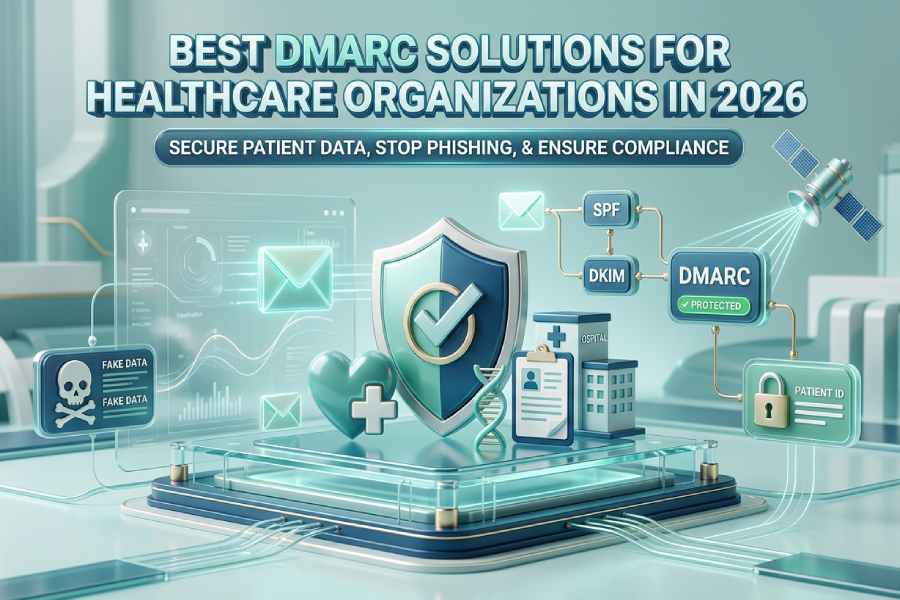
Try Our Free DMARC Checker
Validate your DMARC policy, check alignment settings, and verify reporting configuration.
Check DMARC Record →Quick answer: The best DMARC solutions for healthcare organizations in 2026 are DMARC Report (enterprise compliance with SLAs, DPAs, and SOC-2 Type II), PowerDMARC (full-stack email authentication with AI threat intelligence), EasyDMARC (guided onboarding for teams new to DMARC), Valimail (automated enforcement for large health systems), dmarcian (visual DMARC journey management), and Mimecast DMARC Analyzer (bundled with broader email security). The right choice depends on your compliance requirements, number of domains, and whether you need DMARC as a standalone solution or part of a wider email security stack.
Full disclosure: this guide is published by DMARC Report. We’ve aimed to be fair and specific about where each platform is strongest. If any characterization needs correction, contact us and we’ll update it.
Why Healthcare Organizations Need DMARC
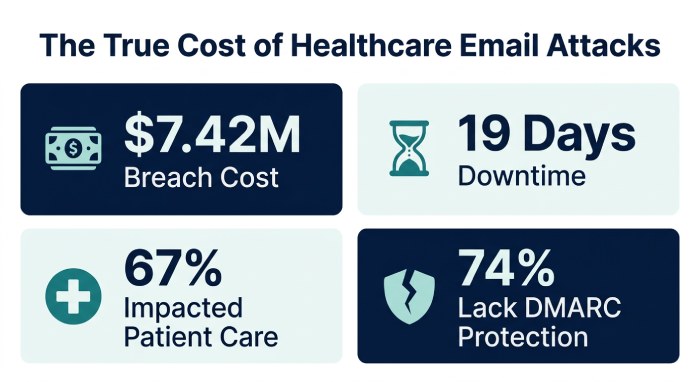
Healthcare is the most expensive industry for data breaches, and email remains the primary attack vector. According to IBM’s 2025 Cost of a Data Breach Report, healthcare breach costs averaged $7.42 million per incident, a figure that has held the top position across all industries for 14 consecutive years. Phishing accounted for 16% of all breaches as the leading initial access vector.
As healthcare organizations strengthen their cybersecurity posture, they are also adopting technologies that reduce exposure to common attack vectors. A virtual healthcare assistant can help minimize manual communication processes, automate routine patient interactions, and support secure information sharing across the care journey.
The problem is particularly acute in healthcare because of three converging factors. First, the value of medical records on criminal markets exceeds that of financial records, a single patient record contains personally identifiable information, insurance details, treatment history, and billing data. Second, healthcare staff operate under urgency cultures where “immediate action required” messages receive less scrutiny than in other industries. According to KnowBe4’s 2025 data, healthcare has a phishing susceptibility rate of 41.9%, the highest of any major industry. Third, the complexity of healthcare email ecosystems, spanning EHR notifications, appointment systems, insurance communications, lab results, and inter-provider messaging, creates a sprawling attack surface that is difficult to monitor without automated tools.
DMARC (Domain-based Message Authentication, Reporting, and Conformance) is the protocol that closes this gap. It builds on SPF and DKIM to let domain owners specify how receiving mail servers should handle unauthenticated messages, and, critically, it generates reports that show exactly who is sending email from your domains. If you’re new to the concept, our guide to DMARC authentication covers the fundamentals.
Despite this, DMARC adoption in healthcare lags behind other regulated industries. According to EasyDMARC’s research on healthcare institution domains, only 18% of U.S. healthcare domains have implemented the strictest DMARC policy (p=reject), compared to significantly higher adoption rates in financial services. A Dark Reading analysis noted that healthcare is struggling to surpass 40-50% overall DMARC adoption. This leaves the majority of healthcare domains vulnerable to spoofing attacks that impersonate hospitals, clinics, and insurance providers.
The Cost of Email-Based Attacks in Healthcare
The financial impact of email-based attacks on healthcare goes beyond the breach itself. Here is what the data shows:
- $7.42 million average breach cost with a 279-day lifecycle, five weeks longer than the global average (IBM 2025).
- 30% of healthcare breaches now involve third-party vendors, doubling year-over-year (Verizon 2025 DBIR).
- 74% of affected domains in email-related healthcare breaches lacked proper DMARC protection (Censinet 2025).
- ~19 days of downtime per ransomware incident for U.S. healthcare organizations.
- 67% of healthcare organizations say phishing and BEC negatively impacted patient care quality (Ponemon).
DMARC cannot prevent all phishing attacks, but it eliminates domain spoofing, the ability for attackers to send emails that appear to originate from your hospital, clinic, or health system domain. When a patient receives a spoofed email from what looks like their provider asking for insurance details, DMARC enforcement is the mechanism that prevents that email from being delivered.
DMARC, SPF, and DKIM: How Email Authentication Works
SPF (Sender Policy Framework) allows a domain owner to publish a DNS record listing the IP addresses authorized to send email on behalf of that domain. When a receiving server gets an email, it checks the sending IP against the SPF record to verify authorization.
DKIM (DomainKeys Identified Mail) adds a cryptographic signature to outgoing emails. The public key is published in DNS, and receiving servers use it to verify that the message content has not been tampered with and that it was authorized by the domain owner.
DMARC ties SPF and DKIM together with a policy layer. It instructs receiving mail servers what to do when a message fails authentication: deliver it anyway (p=none), send it to spam (p=quarantine), or reject it outright (p=reject). DMARC also generates aggregate reports (RUA) and forensic reports (RUF) that give domain owners visibility into all email traffic using their domain. Passing depends on SPF and DKIM alignment between the visible From domain and the authenticated sources.
For healthcare organizations, this reporting function is particularly valuable. Many health systems discover unauthorized senders, shadow IT services, legacy EHR notification systems, third-party appointment platforms, within the first 48 hours of enabling DMARC reporting.
| p=none (Monitor) | p=quarantine | p=reject (Enforce) | |
|---|---|---|---|
| Spoofed email | Delivered normally | Sent to spam | Blocked entirely |
| Recommended for | Initial deployment, sender discovery | Transition after identifying legitimate senders | Full enforcement |
| Healthcare use case | First 30-90 days: mapping email ecosystem | 30-60 day transition: validating EHR, billing senders | Ongoing: full domain protection |
Benefits of DMARC for Healthcare
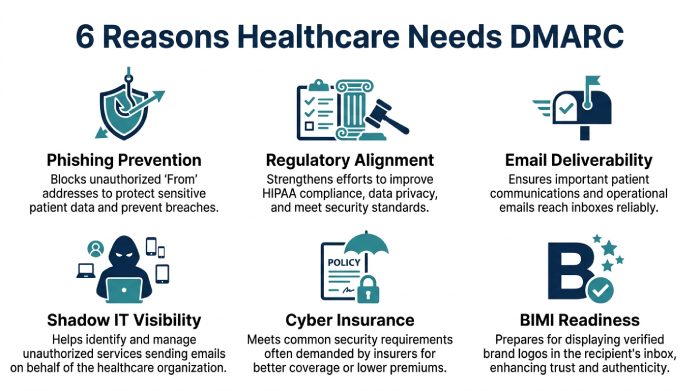
Phishing prevention at the domain level. DMARC enforcement prevents attackers from impersonating your organization’s domain in phishing emails sent to patients, staff, vendors, and insurance partners.
Regulatory alignment. While HIPAA does not explicitly mandate DMARC, the Security Rule requires safeguards against unauthorized access to ePHI. CISA’s Healthcare and Public Health Sector Cybersecurity Performance Goals specifically recommend DMARC implementation, starting at p=none and progressing to p=reject. CISA’s Binding Operational Directive 18-01 mandates p=reject for U.S. federal agency domains.
Email deliverability. As of 2025, Google, Yahoo, and Microsoft all require DMARC for bulk senders (5,000+ messages per day). Healthcare organizations sending appointment reminders, lab result notifications, and billing statements at scale cannot afford authentication failures.
Visibility into shadow IT. DMARC aggregate reports reveal every service sending email from your domain, including legacy systems, SaaS platforms, and third-party vendors that IT may not be tracking.
Cyber insurance readiness. Insurers increasingly require DMARC enforcement as an underwriting condition. Organizations at p=reject demonstrate a measurably stronger security posture.
BIMI readiness. Brand Indicators for Message Identification (BIMI) allows organizations to display a verified logo next to emails in recipient inboxes. BIMI requires DMARC enforcement at p=quarantine or p=reject.
Key Features to Look for in a Healthcare DMARC Solution
Aggregate and forensic report parsing. Raw DMARC reports arrive as XML files that are functionally unreadable. A DMARC report analyzer turns those raw XML files into readable dashboards. Any DMARC platform should parse these automatically and present them in visual dashboards.
Sender identification by vendor name. The best platforms classify sending sources by recognized vendor (e.g., Google Workspace, Epic MyChart, SendGrid) rather than just showing raw IP addresses.
Multi-domain management. Health systems often manage dozens or hundreds of domains. A healthcare-grade platform should provide centralized visibility across all of them.
Compliance documentation. Enterprise healthcare organizations need signed SLAs, DPAs, SOC-2 Type II, SSO/SAML, audit logs, and RBAC. These are non-negotiable for procurement in regulated environments.
SPF management. Healthcare organizations using multiple email-sending services frequently hit the 10 DNS lookup limit. Look for SPF flattening or hosted SPF macros.
MTA-STS and TLS-RPT support. MTA-STS ensures email in transit is encrypted and not downgraded. TLS-RPT provides reporting on encryption failures. Both are important for protecting ePHI in transit.
Alerting and real-time monitoring. Look for configurable real-time alerts when new unauthorized senders appear or when authentication failure rates spike.
API access. Integration with SIEM platforms (Splunk, Sentinel, QRadar), ticketing systems, and compliance dashboards requires robust API access.
Enterprise vs. SMB Healthcare: Choosing the Right Tier
| Requirement | Small Practice (1-5 domains) | Mid-Size Hospital (5-50) | Enterprise (50-500+) |
|---|---|---|---|
| DMARC reporting | Basic aggregate reports | Aggregate + forensic + alerting | Full suite with API + SIEM |
| Compliance docs | Standard terms | DPA, SOC-2 | SLA, DPA, NDA, SSO/SAML, audit logs |
| SPF management | Manual DNS | SPF flattening | Hosted SPF with macros |
| Budget range | Free, $75/mo | $75-$200/mo | $200-$3,900+/mo |
HIPAA, CISA, and PCI DSS: The Compliance Landscape
DMARC is not explicitly mandated by HIPAA, but it is increasingly woven into the regulatory frameworks that healthcare organizations must satisfy.
HIPAA Security Rule: Requires covered entities to implement technical safeguards for ePHI transmission security and to defend against phishing and spoofing. SPF, DKIM, and DMARC are widely recognized as core controls.
CISA BOD 18-01: Mandates p=reject for U.S. federal domains. CISA’s Healthcare and Public Health Sector Cybersecurity Performance Goals recommend DMARC implementation and progression to enforcement.
PCI DSS v4.0: Took effect March 2025. Mandates anti-phishing mechanisms for organizations processing payment card data, including healthcare billing.
Google, Yahoo, Microsoft sender requirements (2024-2025): Mandate DMARC for bulk senders, affecting healthcare domains sending appointment reminders, billing, and patient communications at volume.
Cyber insurance: Underwriters increasingly require DMARC enforcement at p=quarantine or p=reject as a condition of coverage.
How to Choose a DMARC Platform for Healthcare
Start by answering four questions. How many domains do you manage? What compliance documentation does your procurement team require? Do you need DMARC as a standalone solution or as part of a broader email security stack? And does your IT team have the technical depth to manage DMARC independently, or do you need guided onboarding or managed services?
If you manage fewer than 10 domains and your primary need is visibility, a platform with a strong free tier and clear dashboards will suffice. If you manage 50+ domains across a health system and need to satisfy enterprise procurement, you need signed SLAs, DPAs, SSO/SAML, and audit logs, features that only some platforms offer as standard.
Top DMARC Solutions for Healthcare Compared
| Platform | G2 Rating | Best For | Compliance Docs | Domains (Entry) | Starting Price | Not Ideal For |
|---|---|---|---|---|---|---|
| DMARC Report | 4.8/5 (473) | Enterprise compliance + MSP | SLA, DPA, NDA, SOC-2, SSO/SAML, RBAC | 1 (free) | Free; $25/mo | All-in-one email security (focuses on DMARC reporting) |
| PowerDMARC | 4.6/5 | Full-stack auth (DMARC+SPF+DKIM+BIMI) | SOC-2 Type 2, ISO 27001 | Multiple | From $8/mo | Teams needing only DMARC reporting |
| EasyDMARC | 4.7/5 | Guided onboarding | Standard terms | 2 (paid) | $35.99/mo | Large enterprises needing signed SLAs |
| Valimail | 4.4/5 | Automated enforcement | Enterprise terms | Custom | ~$2,000/yr+ | Small clinics / budget-conscious orgs |
| dmarcian | 4.3/5 | Visual DMARC journey | Standard terms | 2 (free) | Free (limited) | Enterprise-scale / compliance-heavy |
| Mimecast | 4.4/5 | Existing Mimecast ecosystem | Enterprise (bundled) | Custom | Custom | Orgs not already using Mimecast |
Pricing sourced from G2, Capterra, and vendor websites as of April 2026. Contact vendors directly for current pricing.
Individual Reviews
DMARC Report
DMARC Report is an enterprise-grade, compliance-ready DMARC reporting and email authentication management platform built for organizations that need deep visibility into email traffic alongside procurement-ready documentation.
For healthcare organizations, DMARC Report’s compliance stack is its primary differentiator. The Defender and Ultimate plans include signed SLAs with 99.99% uptime guarantees, Data Processing Agreements, NDAs, SOC-2 Type II certification, SSO/SAML, role-based access controls, and audit logs, all standard, not add-ons. Healthcare IT teams working with procurement departments will recognize these as the exact documents required for vendor onboarding in regulated environments.
The platform parses aggregate and forensic reports automatically once you point your RUA tag at DMARC Report’s ingestion address. Dashboards classify sending sources by vendor name, so you see “Epic MyChart” or “SendGrid” rather than raw IP blocks. Multi-domain management supports health systems managing hundreds of domains from a single dashboard, including parked domains. The AI-powered analysis feature surfaces anomalies and sender patterns, reducing the manual effort of interpreting DMARC data. The open REST API allows healthcare IT teams to integrate DMARC data into existing SIEM platforms, compliance dashboards, and custom workflows.
DMARC Report also offers a dedicated MSP Partner Program, relevant for healthcare MSPs managing email authentication across multiple client organizations with white-label reporting and multi-tenant architecture.
The platform offers a free tier (1 domain, 10,000 reports/month, 30 days history) and paid plans ranging from $25/month (Guard, 5 domains) to $3,900 (Ultimate, with a dedicated DMARC engineer and a 90-day enforcement guarantee).
It is worth noting that DMARC Report does not currently offer Business Associate Agreements (BAAs), which some HIPAA-covered entities may require. Additionally, DMARC Report focuses specifically on DMARC reporting and email authentication, it does not include inbound email filtering or broader email security capabilities. Organizations needing an all-in-one email security suite should consider pairing DMARC Report with a dedicated secure email gateway.
Top Features
- Automated aggregate and forensic report parsing with visual dashboards
- AI-powered sender pattern analysis and anomaly detection
- Source classification by vendor name (not just IP)
- Multi-domain and subdomain management (including parked domains)
- Enterprise compliance: SLA, DPA, NDA, SOC-2 Type II, SSO/SAML, RBAC, audit logs
- MSP Partner Program with white-label and multi-tenant
- Open REST API for SIEM and workflow integration
- MTA-STS hosting and TLS-RPT support
Pricing: Free (Core); $25/mo (Guard); $75/mo (Shield); $200/mo (Defender); $3,900 (Ultimate). Annual billing saves ~17%.
Best For: Healthcare organizations that need enterprise compliance documentation and deep DMARC reporting visibility, and MSPs managing DMARC for healthcare clients at scale.
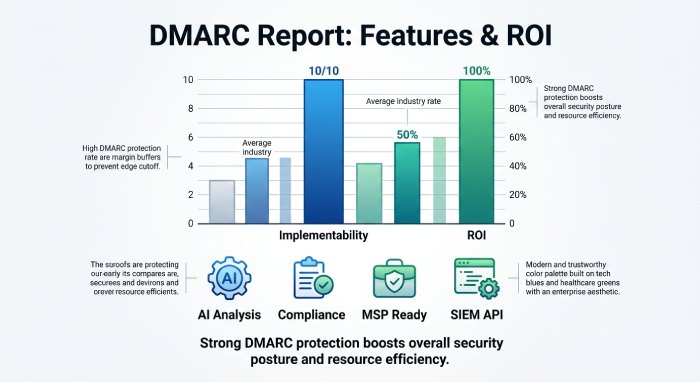
How does it compare: DMARC Report is the most-reviewed DMARC platform on G2 with 473 verified reviews. According to G2, users rate it highest for implementability and ROI. The compliance documentation stack exceeds what most competitors offer as standard.
PowerDMARC
PowerDMARC is a full-stack, SaaS-based email authentication platform that bundles DMARC, SPF, DKIM, BIMI, MTA-STS, and TLS-RPT into a single dashboard with AI-powered threat intelligence.
For healthcare organizations that want to consolidate all email authentication protocols under one vendor, PowerDMARC offers the broadest feature set. The platform includes hosted SPF with macro support (PowerSPF) to solve the 10-lookup limit, a common pain point for health systems using multiple sending services.
Top Features
- All-in-one dashboard: DMARC, SPF, DKIM, BIMI, MTA-STS, TLS-RPT
- AI-powered threat intelligence with real-time IP analysis
- Hosted SPF (PowerSPF) with macro support
- SOC-2 Type 2 and ISO 27001 certified
- Multi-language support (11+ languages)
Pricing: According to G2, plans start from $8/month. Enterprise and MSP pricing is custom. 15-day free trial.
Best For: Healthcare organizations wanting DMARC, SPF, DKIM, and BIMI managed from a single vendor dashboard.
How does it compare: According to G2 reviewers, PowerDMARC’s initial setup can involve a learning curve due to its extensive feature set.
EasyDMARC
EasyDMARC is a user-friendly DMARC platform designed for organizations starting their email authentication journey and wanting guided onboarding with minimal friction.
Top Features
- Guided DMARC journey (monitor → quarantine → enforce)
- Smart DNS scanning and one-click Cloudflare setup
- Aggregate and forensic report visualization
- EasySPF for dynamic SPF flattening
Pricing: Plans start at $35.99/month for 100,000 emails and 2 domains. Free plan: 1,000 emails, 1 domain.
Best For: Healthcare teams new to DMARC wanting the most guided onboarding experience.
How does it compare: Enterprise healthcare organizations needing signed SLAs, DPAs, and SSO/SAML may find these compliance features less mature compared to enterprise-first platforms.
Valimail
Valimail is an enterprise email authentication platform focused on automated DMARC enforcement with minimal manual DNS management. The automation-first approach is designed for large health systems that want to reach p=reject quickly.
Top Features
- Automated sender identification and SPF/DKIM management
- Zero-DNS-maintenance approach to DMARC enforcement
- Enterprise-grade automation and compliance features
Pricing: According to Capterra, Align starts at $19/month. Enforce starts at approximately $2,000/year with custom enterprise pricing.
Best For: Large health systems wanting to minimize hands-on DMARC management.
How does it compare: Pricing may exceed the budget of smaller healthcare practices. According to G2 reviews, enterprise pricing and sales process may be less accessible for mid-market organizations.
dmarcian
dmarcian is a DMARC monitoring platform founded by one of the original authors of the DMARC specification, known for clear visual reporting and educational resources.
Top Features
- Visual DMARC journey management
- Domain Overview with real-time status checks
- Geographic abuse source mapping
- Strong educational resources and documentation
Pricing: Free plan for up to 1,250 messages/month and 2 domains. Paid plans scale by volume.
Best For: Healthcare organizations early in their DMARC journey wanting clear visual reporting and educational guidance.
How does it compare: According to Expert Insights reviews, API integration and interface navigation can present a learning curve. Enterprise features are less mature than platforms purpose-built for healthcare procurement.
Mimecast DMARC Analyzer
Mimecast DMARC Analyzer bundles DMARC monitoring into the broader Mimecast email security platform, providing aggregate reporting and policy management for organizations already in the Mimecast ecosystem.
Top Features
- Integrated with Mimecast’s broader email security suite
- Aggregate report parsing and policy management
- Multi-domain environment support
Pricing: Custom pricing through Mimecast. Not typically available as standalone DMARC-only purchase.
Best For: Healthcare organizations already using Mimecast for inbound email filtering, archiving, or continuity.
How does it compare: DMARC capabilities are a component of a larger platform. According to independent evaluators, organizations not already in the Mimecast ecosystem will face a longer procurement and onboarding process.
Decision Framework
| Question | If Yes → Consider |
|---|---|
| Need signed SLAs, DPAs, SOC-2 for procurement? | DMARC Report (Defender/Ultimate) |
| Want DMARC + SPF + DKIM + BIMI in one dashboard? | PowerDMARC |
| Team new to DMARC, needs guided onboarding? | EasyDMARC |
| Want automated enforcement with minimal DNS work? | Valimail |
| Early in DMARC journey, want visual education? | dmarcian |
| Already a Mimecast customer? | Mimecast DMARC Analyzer |
| MSP managing DMARC for multiple healthcare clients? | DMARC Report (MSP Program) or PowerDMARC |
Role-Based Buyer Guidance
For CISOs and Security Directors: Prioritize platforms with SIEM integration (API access), real-time alerting, and forensic report analysis. Enterprise compliance documentation (SLAs, SOC-2) will streamline your vendor assessment. Evaluate DMARC Report (Defender/Ultimate) and PowerDMARC (Enterprise).
For IT Directors and System Administrators: Focus on multi-domain management, SPF flattening capabilities, and ease of DNS configuration. If you manage 50+ domains, look for centralized dashboards with bulk operations. Evaluate DMARC Report, PowerDMARC, and Valimail.
For Compliance Officers and HIPAA Privacy Officers: Look for audit logs, RBAC, and compliance report generation documenting your DMARC posture. Ask vendors specifically whether they offer BAAs. Evaluate DMARC Report (compliance stack) and Valimail (enterprise compliance).
For MSPs Serving Healthcare Clients: Multi-tenant architecture, white-label reporting, and scalable pricing are essential. Evaluate DMARC Report (MSP Partner Program, 50% off list pricing) and PowerDMARC (Partner Program).
Implementation Considerations
Start at p=none. Every DMARC implementation should begin in monitoring mode. This phase, typically 30 to 90 days, lets you discover all legitimate email-sending services before enforcing a policy that could block legitimate patient communications.
Map your email ecosystem first. Healthcare organizations typically discover 8-15 sending services once DMARC reporting is active: EHR portals, appointment systems, billing platforms, marketing automation, patient satisfaction surveys, lab notification services, insurance communication platforms, and internal IT tools.
Plan for SPF complexity. Healthcare organizations often exceed the 10 DNS lookup limit quickly. Evaluate whether your chosen platform offers SPF flattening or hosted SPF macros before committing.
Coordinate with third-party vendors. Any third-party service that sends email from your domain, EHR vendors, patient engagement platforms, billing services, needs to be included in your authentication configuration.
Set a timeline for enforcement. Organizations that remain at p=none indefinitely gain visibility but no protection. Set a concrete target: 90 days to p=quarantine, 180 days to p=reject. DMARC Report’s Ultimate plan includes a 90-day p=quarantine guarantee with a dedicated DMARC engineer.Document everything. For HIPAA audits and cyber insurance renewals, maintain records of your DMARC implementation timeline, policy progression dates, and remediated authentication failures.
Topics
General Manager
General Manager of DuoCircle. Product strategy and commercial lead for DMARC Report's 2,000+ customer base.
LinkedIn Profile →Take control of your DMARC reports
Turn raw XML into actionable dashboards. Start free - no credit card required.