Best Email Authentication Platforms for PCI DSS v4.0 Compliance in 2026

Quick Answer
Quick answer: PCI DSS v4.0 Requirement 5.4.1 mandates automated anti-phishing mechanisms for all organizations handling cardholder data, effective March 31, 2025. The PCI Security Standards Council specifically recommends DMARC, SPF, and DKIM as anti-spoofing controls. The best platforms for PCI DSS email authentication compliance are DMARC Report (enterprise compliance with SLAs, DPAs, SOC-2 Type II, and audit logs), PowerDMARC (full-stack.
Related: Free DMARC Checker ·How to Create an SPF Record ·SPF Record Format
Quick answer: PCI DSS v4.0 Requirement 5.4.1 mandates automated anti-phishing mechanisms for all organizations handling cardholder data, effective March 31, 2025. The PCI Security Standards Council specifically recommends DMARC, SPF, and DKIM as anti-spoofing controls. The best platforms for PCI DSS email authentication compliance are DMARC Report (enterprise compliance with SLAs, DPAs, SOC-2 Type II, and audit logs), PowerDMARC (full-stack authentication with SOC-2 and ISO 27001), Proofpoint (DMARC integrated with inbound email gateway), dmarcian (educational approach with PCI-specific guidance), EasyDMARC (guided onboarding with compliance reporting), and Valimail (automated enforcement for large payment processors).
Full disclosure: this guide is published by DMARC Report. We’ve aimed to be fair about where each platform is strongest for PCI DSS use cases. Contact us if any characterization needs correction.
What PCI DSS v4.0 Requires for Email Authentication
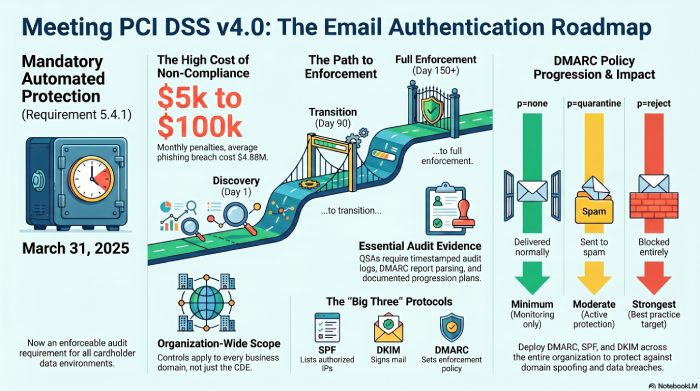
PCI DSS v4.0.1, released by the PCI Security Standards Council in June 2024, introduced Requirement 5.4.1: organizations must implement processes and automated mechanisms to detect and protect personnel against phishing attacks. This requirement became mandatory on March 31, 2025, it is no longer a best practice but an enforceable audit requirement.
Critically, Requirement 5.4.1 cannot be satisfied by security awareness training alone. The PCI SSC’s guidance explicitly states that organizations should consider a combination of approaches, including anti-spoofing controls such as DMARC, SPF, and DKIM. The guidance further recommends that anti-phishing controls be applied across an entity’s entire organization, not just within the cardholder data environment (CDE).
This means PCI DSS auditors (Qualified Security Assessors, or QSAs) will look for evidence that your organization has implemented automated email authentication controls. While PCI DSS does not mandate a specific DMARC policy level, organizations demonstrating p=quarantine or p=reject present a stronger compliance posture than those at p=none. Reaching full DMARC compliance means every legitimate sender passes SPF or DKIM alignment under an enforced policy.
Who Is Affected?
PCI DSS requirements apply to the cardholder data environment and any system components, people, or processes that could impact its security. This includes merchants, payment processors, acquirers, issuers, and service providers. If your organization accepts, processes, stores, or transmits cardholder data, you are subject to PCI DSS v4.0, and you need email authentication controls in place.
What QSAs Will Look For
- DMARC record published: A valid DMARC record for all domains used in business email, with a defined policy and reporting addresses (rua=/ruf=).
- SPF record configured: An SPF record listing all authorized sending servers, within the 10 DNS lookup limit.
- DKIM signing enabled: Outbound email signed with DKIM, with public keys published in DNS for each sending service.
- Monitoring and reporting: Active receipt and review of DMARC aggregate reports demonstrating ongoing visibility.
- Policy progression plan: Evidence of a roadmap from p=none to p=quarantine or p=reject.
- Organization-wide scope: Anti-phishing controls applied across the entire organization, not just CDE-connected systems.
Why DMARC Matters for Payment Security
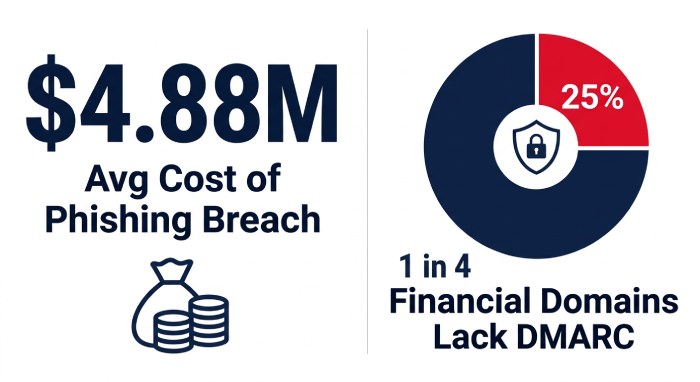
Phishing is the leading initial access vector for data breaches globally. According to IBM’s 2025 Cost of a Data Breach Report, phishing accounted for 16% of all breaches. Financial services face the highest attack frequency, 300 times more attacks than other industries, according to KnowBe4. The average cost of a phishing-initiated breach is $4.88 million.
For the payment card industry, phishing attacks typically target two objectives: stealing cardholder data through fake payment portals, or compromising employee credentials to access payment processing systems. DMARC prevents the first stage of both attack types by blocking domain spoofing.
The financial sector has responded more aggressively than most industries. According to dmarcian’s analysis of the top 100 global banks, there has been a 74% decrease in domains with no DMARC record between 2021 and 2025. Despite this progress, according to Red Sift’s global analysis, one in four financial services domains still lacks DMARC protection.
PCI DSS Non-Compliance: Penalties and Consequences
Non-compliance with PCI DSS can result in penalties ranging from $5,000 to $100,000 per month, depending on severity and duration. Beyond financial penalties, non-compliance can trigger increased audit scrutiny, restrictions on payment processing, and reputational damage. In the event of a breach tied to non-compliance, organizations face liability for fraud losses, card reissuance costs, and forensic investigation expenses.
DMARC implementation is one of the most straightforward PCI DSS v4.0 requirements to satisfy, it does not require hardware, does not involve changes to payment processing systems, and can be implemented in days. For most teams, reaching DMARC compliance takes days, not weeks.
How Email Authentication Works: SPF, DKIM, and DMARC
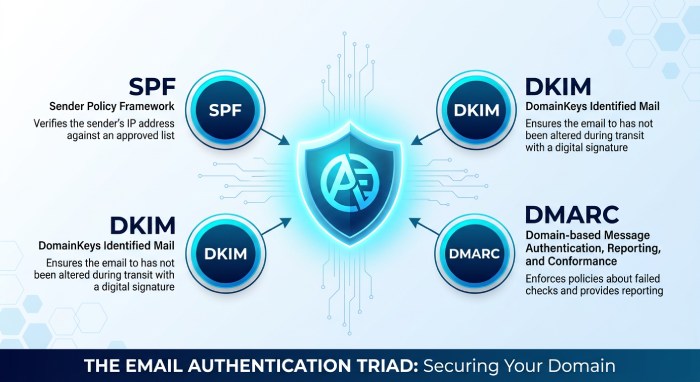
SPF publishes a DNS record listing IP addresses authorized to send email from your domain. For PCI DSS, your SPF record must include all legitimate sending services: payment confirmations, invoicing, marketing, customer support, and fraud alerts.
DKIM adds a cryptographic signature to outgoing emails. The public key is published in DNS. DKIM is particularly important for payment confirmation emails, where message integrity directly affects trust in transaction communications.
DMARC ties SPF and DKIM together with a policy layer and generates reporting that provides visibility into all email traffic using your domain.
| p=none | p=quarantine | p=reject | |
|---|---|---|---|
| Spoofed email | Delivered normally | Sent to spam | Blocked entirely |
| PCI DSS signal | Minimum, monitoring only | Moderate, active protection | Strongest, full enforcement |
| QSA posture | Acceptable with progression plan | Strong compliance | Best practice target |
| Timeline | Day 1-90: discovery | Day 90-150: transition | Day 150+: enforcement |
Key Features to Look for in a PCI DSS DMARC Platform
Aggregate and forensic report parsing. QSAs will ask for evidence that you monitor DMARC reports. Your platform must parse XML reports and present them in dashboards that compliance teams can reference during audits.
Audit logs and compliance documentation. PCI DSS requires documented evidence. Look for audit trails of policy changes, exportable compliance reports, and timestamped records of enforcement progression.
SPF management. Payment organizations frequently exceed the 10 DNS lookup limit. SPF flattening or hosted SPF macros are essential.
MTA-STS and TLS-RPT. PCI DSS mandates encryption of cardholder data in transit. MTA-STS ensures encrypted email transport; TLS-RPT reports on failures.
Multi-domain management. Payment organizations often operate multiple domains. All require DMARC.
Vendor security certification. SOC-2 Type II or ISO 27001 demonstrates the vendor meets auditable security standards.
Enterprise compliance documentation. Signed SLAs, DPAs, NDAs, SSO/SAML, and RBAC are expected in regulated payment environments.
SIEM integration. API access to Splunk, Sentinel, QRadar enables centralized compliance monitoring and automated evidence collection.
PCI DSS DMARC Compliance Checklist
- DMARC record published for all business email domains with rua= reporting
- SPF configured for all sending services, within 10 DNS lookup limit
- DKIM signing enabled for all outbound email services
- DMARC aggregate reports actively monitored
- Documented policy progression plan: p=none → p=quarantine → p=reject
- Anti-phishing controls applied organization-wide, not just CDE
- MTA-STS configured for transport encryption
- Audit logs retained for compliance evidence
- Vendor security certifications verified (SOC-2 / ISO 27001)
The Broader Compliance Landscape
- Google/Yahoo (Feb 2024), Microsoft (May 2025): DMARC required for bulk senders. Payment communications must be authenticated.
- CISA BOD 18-01: Mandates p=reject for U.S. federal domains, setting baseline for government payment contractors.
- DORA (EU): Requires financial entities to implement email authentication as part of cyber hygiene.
- Cyber insurance: Underwriters require DMARC enforcement as a coverage condition or premium discount.
- HIPAA: Healthcare payment processors face dual PCI DSS and HIPAA requirements.
Top Email Authentication Platforms for PCI DSS Compared
| Platform | G2 Rating | Best For | Security Certs | MTA-STS | Price | Not Ideal For |
|---|---|---|---|---|---|---|
| DMARC Report | 4.8/5 (470) | Enterprise PCI compliance docs | SOC-2 Type II | Yes + TLS-RPT | Free; $25/mo | All-in-one email security (DMARC focus only) |
| PowerDMARC | 4.6/5 | Full-stack + SIEM | SOC-2, ISO 27001 | Yes + TLS-RPT | From $8/mo | DMARC-only teams, broad features |
| Proofpoint | 4.3/5 | DMARC + inbound SEG | Enterprise | N/A | Enterprise | SMBs, enterprise pricing |
| dmarcian | 4.3/5 | PCI guidance + education | Standard | No | Free (limited) | Enterprise needing SLAs/SOC-2 |
| EasyDMARC | 4.7/5 | Guided onboarding | Standard | Via EasySPF | $35.99/mo | Large enterprises needing signed SLAs |
| Valimail | 4.4/5 | Automated enforcement | Enterprise | No | ~$2K/yr+ | SMBs / budget-conscious orgs |
Pricing sourced from G2, Capterra, vendor websites as of April 2026.
Individual Reviews
DMARC Report
DMARC Report is an enterprise-grade, compliance-ready DMARC reporting and email authentication management platform built for organizations that need procurement-ready documentation alongside deep email authentication visibility.
For PCI DSS compliance, DMARC Report’s primary differentiator is its enterprise compliance documentation stack. The Defender and Ultimate plans include signed SLAs with 99.99% uptime guarantees, Data Processing Agreements, NDAs, SOC-2 Type II certification, SSO/SAML, role-based access controls, and audit logs, all standard. Audit logs provide timestamped records of DMARC policy changes that serve as evidence during QSA assessments. The platform processes 50,000+ domains and provides automated aggregate and forensic report parsing, AI-powered sender analysis, source classification by vendor name, MTA-STS hosting, and TLS-RPT support. The open REST API enables SIEM integration for centralized PCI DSS compliance monitoring.
DMARC Report focuses on DMARC reporting and email authentication, it does not include inbound email filtering or SEG capabilities. The free tier (1 domain, 10,000 reports/month) allows organizations to start immediately without procurement approval. Paid DMARCReport plans add the SLAs, DPAs, and audit logs that regulated payment teams need for QSA review.
Top PCI DSS Features
- SOC-2 Type II certified vendor security
- Audit logs with timestamped policy change records
- Enterprise compliance: SLA, DPA, NDA, SSO/SAML, RBAC
- MTA-STS hosting + TLS-RPT for transport encryption
- AI-powered sender analysis and vendor-name classification
- REST API for SIEM integration
- Multi-domain management including parked domains
- Done With You enforcement: 90-day p=quarantine guarantee
Pricing: Free; $25/mo; $75/mo; $200/mo; $3,900 (Ultimate). Annual saves ~17%.
Best For: Payment organizations needing enterprise compliance docs and audit-ready DMARC evidence for QSA assessments.
How does it compare: Most-reviewed DMARC platform on G2 (471 reviews). Compliance documentation stack exceeds what most competitors offer as standard.
PowerDMARC
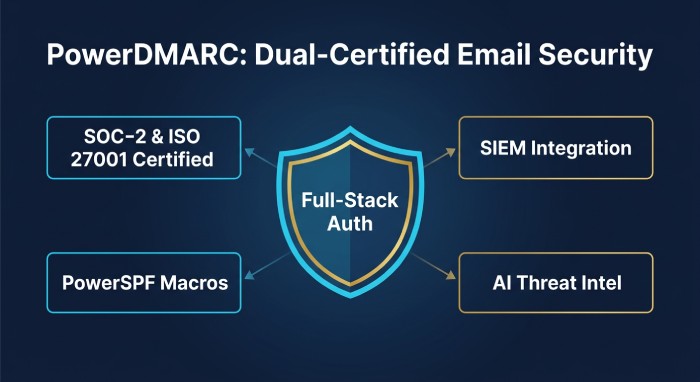
PowerDMARC is a full-stack email authentication platform combining DMARC, SPF, DKIM, BIMI, MTA-STS, and TLS-RPT, certified to both SOC-2 Type 2 and ISO 27001.
The dual certification provides strong vendor security assurance for PCI DSS contexts. SIEM integration (Splunk, Sentinel, QRadar) enables centralized compliance monitoring. PowerSPF solves the 10-lookup limit with hosted macros. PowerDMARC has published PCI DSS-specific compliance guidance.
Top PCI DSS Features
- SOC-2 Type 2 + ISO 27001 dual certification
- SIEM/SOAR/XDR integration via API
- PowerSPF with macro support
- AI-powered threat intelligence
Pricing: From $8/mo. Enterprise custom. 15-day trial.
Best For: Organizations wanting full auth stack with dual security certification.
How does it compare: Dual SOC-2 + ISO 27001 is unique in the DMARC space. Feature breadth may involve a learning curve per G2 reviews.
Proofpoint Email Fraud Defense
Proofpoint offers DMARC integrated with its market-leading secure email gateway, providing both outbound DMARC enforcement and inbound spoofed email blocking.
The integration between DMARC and inbound filtering addresses both sides of the phishing equation for PCI DSS. Proofpoint has published PCI DSS v4.0 compliance guidance positioning DMARC as a key Requirement 5.4.1 control.
Top PCI DSS Features
- DMARC integrated with enterprise SEG
- Inbound + outbound enforcement
- PCI DSS v4.0 compliance guidance published
Pricing: Enterprise. Contact Proofpoint.
Best For: Large payment processors already using Proofpoint for inbound email security.
How does it compare: Enterprise pricing unsuitable for SMB merchants. Per Proofpoint’s own guidance, positioned for mature email security programs.
dmarcian
dmarcian is a DMARC platform founded by a co-author of the DMARC specification, with dedicated PCI DSS v4.0.1 compliance guidance and educational resources.
dmarcian has published detailed Requirement 5.4.1 analysis for the payment card ecosystem. Clear visual reporting makes it easy to demonstrate DMARC status to QSAs.
Top PCI DSS Features
- PCI DSS-specific compliance guidance
- Founded by DMARC specification co-author
- Clear visual reporting for QSA demonstrations
Pricing: Free (1,250 msg/month, 2 domains). Paid plans scale by volume.
Best For: Organizations building PCI email auth compliance from scratch.
How does it compare: PCI-specific guidance is among the most detailed. Enterprise compliance docs and MTA-STS are more limited.
EasyDMARC
EasyDMARC offers guided onboarding, PCI DSS compliance content, and industry adoption benchmarking data from its DMARC Adoption Reports.
Top PCI DSS Features
- Guided enforcement journey
- PCI DSS compliance content
- Industry benchmarking reports
Pricing: From $35.99/mo. Free plan available.
Best For: Small/mid-sized merchants wanting guided onboarding.
How does it compare: Excels at accessibility. Enterprise SLAs/DPAs less mature.
Valimail
Valimail automates DMARC enforcement with minimal DNS management for large financial institutions and payment processors.
Top PCI DSS Features
- Automated sender discovery and management
- Zero-DNS-maintenance enforcement
Pricing: Align from $19/mo. Enforce from ~$2,000/yr. Enterprise custom.
Best For: Large payment processors wanting automated enforcement at scale.
How does it compare: Enterprise pricing may exceed SMB budgets. Sales process less accessible per G2.
Decision Framework
| Question | If Yes → Consider |
|---|---|
| Need SLAs, DPAs, SOC-2, audit logs for QSA review? | DMARC Report (Defender/Ultimate) |
| Want full auth stack + dual SOC-2/ISO 27001? | PowerDMARC |
| Already using Proofpoint for inbound email security? | Proofpoint Email Fraud Defense |
| Building PCI compliance from scratch, need guidance? | dmarcian |
| Small/mid merchant wanting guided onboarding? | EasyDMARC |
| Large processor wanting automated enforcement? | Valimail |
| Need MTA-STS for transport encryption? | DMARC Report or PowerDMARC |
Role-Based Buyer Guidance
For CISOs and Security Directors: Prioritize vendor security certifications (SOC-2, ISO 27001), SIEM integration, and audit log capabilities. Evaluate DMARC Report (SOC-2, audit logs, SIEM API) and PowerDMARC (dual certification, SIEM/SOAR).
For PCI DSS Compliance Officers and QSAs: Focus on evidence generation: exportable reports, timestamped audit logs, and documented monitoring processes. Evaluate DMARC Report (compliance docs + audit logs) and dmarcian (PCI-specific guidance).
For IT Directors: Evaluate SPF management, multi-domain support, and DNS configuration ease. Payment environments often have 10+ sending services. Evaluate PowerDMARC (PowerSPF) and DMARC Report (multi-domain).
For Small/Mid-Sized Merchants: Start with a free tier to assess your posture, then upgrade. EasyDMARC and DMARC Report both offer low-risk entry points.
Implementation Considerations
Start immediately. The PCI DSS v4.0 deadline was March 31, 2025. If you haven’t implemented DMARC, begin with p=none today to demonstrate progress to your QSA.
Document your enforcement roadmap. A documented plan, p=none by Day 1, p=quarantine by Day 90, p=reject by Day 180, demonstrates good faith compliance even before full enforcement.
Scope all domains. PCI DSS recommends anti-phishing controls organization-wide. Inventory every domain: corporate, marketing, payment confirmation, customer support, and parked domains.
Address SPF complexity early. Payment organizations use 10+ sending services. Audit your SPF record for lookup count before selecting a platform.
Consider MTA-STS. While beyond the specific anti-phishing requirement, MTA-STS strengthens your PCI DSS posture by ensuring email transport encryption. Retain evidence for audit. Save DMARC reports, policy change logs, and dashboard screenshots. Your QSA needs a timeline of progress, not just a snapshot.
Topics
General Manager
General Manager of DuoCircle. Product strategy and commercial lead for DMARC Report's 2,000+ customer base.
LinkedIn Profile →Take control of your DMARC reports
Turn raw XML into actionable dashboards. Start free - no credit card required.