What Is Dumpster Diving Cyber Security And Why Does It Matter?

Quick Answer
In cybersecurity, dumpster diving refers to harvesting discarded data to gain leverage for attacks. While the term evokes trash bags and alleyways, it spans both physical dumpster diving and digital dumpster diving. The objective is the same: extract sensitive information that can be weaponized by cybercriminals to enable data breaches, identity theft, and unauthorized access.
Related: Free DMARC Checker ·How to Create an SPF Record ·SPF Record Format
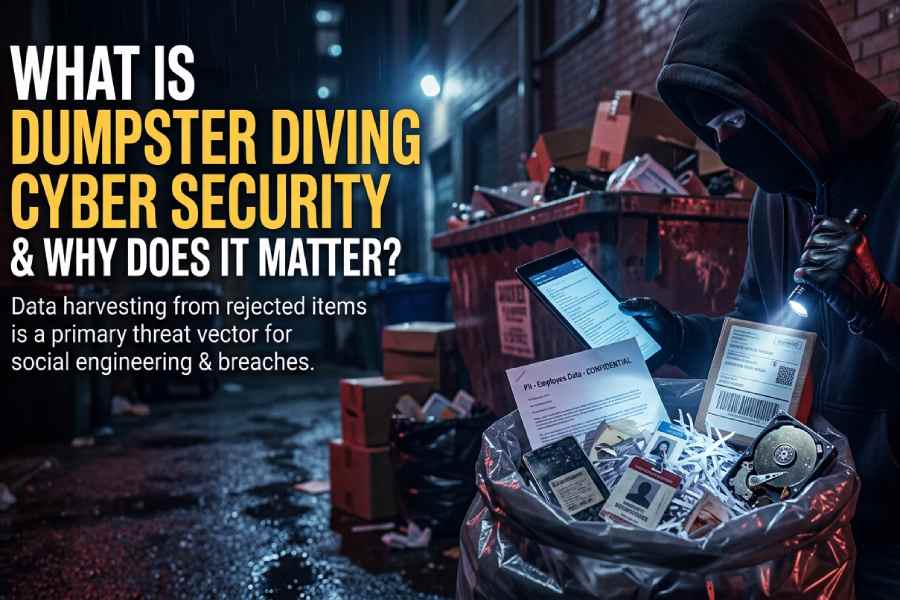
In cybersecurity, dumpster diving refers to harvesting discarded data to gain leverage for attacks. While the term evokes trash bags and alleyways, it spans both physical dumpster diving and digital dumpster diving. The objective is the same: extract sensitive information that can be weaponized by cybercriminals to enable data breaches, identity theft, and unauthorized access. Because organizations still generate paper trails, packaging artifacts, and device remnants, the risk of data breaches from dumpster diving persists even as enterprises modernize their security infrastructure.
Physical vs. Digital Dumpster Diving
Physical dumpster diving targets the analog remnants of business operations. Cybercriminals sift through discarded documents, printed reports, employee onboarding packets, HR files, or shipping labels to uncover personally identifiable information (PII), confidential information, or privileged details about security practices. Physical dumpster diving also includes rummaging e-waste for hard drives, backup drives, or employee badges that grant building access, opening doors to broader malicious activities and targeted attacks.
Digital dumpster diving applies the same mindset to abandoned data in digital ecosystems. Attackers exploit weak data deletion, recover deleted files from mismanaged endpoints, scour cloud storage accounts for exposed archives, and search code repositories or shared drives for test credentials. These data retrieval methods and information retrieval techniques often require basic hacking methods rather than advanced exploitation, yet they routinely lead to data breaches. A single spreadsheet of personally identifiable information in an open folder can fuel spear-phishing emails and broader cyber attacks.
Where Leaks Occur

- Office and home-office waste streams: discarded documents, packaging with return labels, printed passwords, and conference attendee lists.
- E-waste channels: decommissioned laptops and hard drives lacking secure file erasure; backup drives resold without proper data deletion.
- Shadow IT: unmanaged cloud storage or Cloud storage accounts with lax permissions; files believed to be deleted but still retrievable as deleted files.
- Social media trails: overshared details on Facebook or LinkedIn that, paired with found paperwork, enable convincingly tailored spear-phishing emails.
- Packaging metadata: barcodes and RMAs revealing device models, enabling cybercriminals to tailor attack techniques to known system vulnerabilities.
Why It Matters: Business Risk, Real-World Consequences, and Regulatory Exposure
Dumpster diving matters because it lowers the barrier to exploiting vulnerabilities. It allows cybercriminals to move from reconnaissance to unauthorized access with minimal cost, turning scraps into a blueprint of your organization. The business impact ranges from financial loss and remediation costs to reputation damage and erosion of customer trust when compromised data becomes public. According to sources like Investopedia and incident analyses by Cloudflare and CrowdStrike, low-tech pathways frequently precede high-impact data breaches, illustrating how simple lapses in safeguarding sensitive information compound security risks across the enterprise.
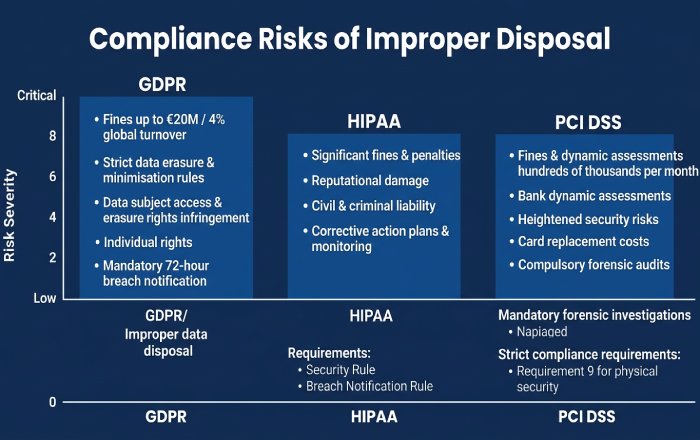
From a compliance perspective, regulators in the United States (HIPAA), the European Union (GDPR), the United Kingdom (UK GDPR), as well as Australia, New Zealand, and Singapore enforce stringent data protection standards. Poor disposal can constitute a risk of data breach and result in legal consequences, fines, and mandatory notifications. Frameworks like PCI DSS and ISO 27001 expect robust organizational safeguards, documented data disposal policies, and demonstrable preventive measures. Failure to operationalize these expectations, across both physical dumpster diving and digital dumpster diving exposures, can transform a minor oversight into a high-visibility enforcement action.
Common Targets and Attack Pathways: Paper, Packaging, and Discarded Devices Feeding Social Engineering
Paper Artifacts, Packaging Metadata, and Device Residue
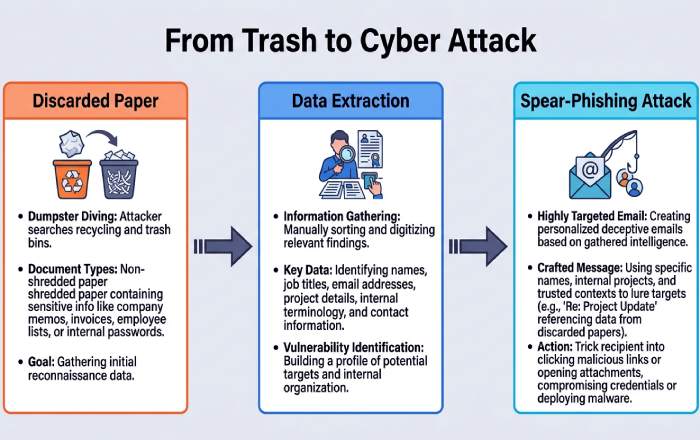
Attackers start with what’s easy. Paper trails yield personally identifiable information, finance reports, or vendor invoices that outline procurement cycles. Discarded documents can contain architectural diagrams, Wi-Fi passwords, or email formats that help craft spear-phishing emails. To defend against forged sender addresses, learn about DKIM and how cryptographic signing verifies legitimate mail. Packaging reveals model numbers and serials for routers, firewalls, and endpoints, helpful breadcrumbs for exploiting vulnerabilities and selecting attack techniques.
Discarded devices often hold recoverable data. Without secure file erasure aligned to NIST SP 800-88, hard drives and backup drives may store customer lists, API keys, or access tokens. Inadequate encryption technologies or misconfigured security software exacerbate system vulnerabilities, letting cybercriminals pull credentials and pivot into cloud storage or internal resources. Even a single recovered badge or shipping manifest can support targeted attacks staged through social engineering, onsite tailgating, or blended hacking methods.
How Social Engineering Flows from Trash to Inbox
- Found org charts, resumes, or travel itineraries guide impersonation on Social media, particularly Facebook and LinkedIn.
- Recovered email signatures and ticket formats enable spoofed help-desk messages and spear-phishing emails.
- Disclosed device models inform exploit kits and lend credibility to “urgent patch” scams, which then deliver payloads resulting in compromised data.
Prevention Essentials: Disposal Policies, Shredding, Media Sanitization, Clean-Desk Culture, and Vendor Controls
Data Disposal Policies and Clean-Desk Culture
The cornerstone of risk reduction is formal, enforced data disposal policies that cover both physical dumpster diving and digital dumpster diving. Policies should mandate:
- Clean-desk expectations to prevent leave-behinds of sensitive information.
- Role-based retention schedules and documented data deletion requirements.
- Secure file erasure for endpoints and removable media.
- Procedures for packaging and mailroom privacy (redacting labels and removing metadata).
These organizational safeguards should be integrated with data loss prevention (DLP) controls and DLP solutions to detect exfiltration and flag sensitive information before it is printed or exported. When data disposal policies are reinforced by employee education and tested routinely, they become durable preventive measures that strengthen overall security posture.
Shredding and Media Sanitization (NIST SP 800-88), Secure Bins, and E‑Waste Vendors
Shredding documents using cross-cut or micro-cut devices, paired with locked, tamper-evident secure bins, prevents easy reconstruction. For media, follow NIST SP 800-88 guidance for clearing, purging, and destroying storage, covering SSDs, hard drives, and backup drives. Where reuse is intended, apply encryption technologies and verified erasure, then document the chain-of-custody. For destruction, use certified e-waste partners and audit them: require certificates of destruction, process transparency, and spot checks.
Align disposal workflows with data loss prevention and monitoring software to prevent print, copy, and export of personally identifiable information without authorization. Mature data disposal policies should connect these technical and procedural controls, ensuring that safeguarding sensitive information is enforced from desktop to dumpster.
Technology Controls that Reinforce Human Discipline
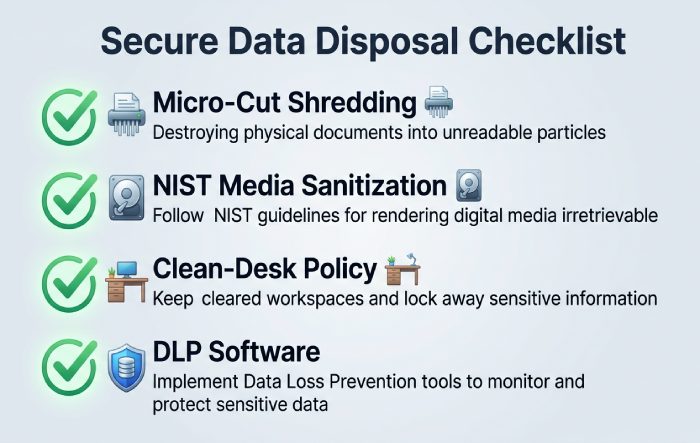
- Security software and DLP solutions that classify and block printing or uploading of PII to unmanaged Cloud storage accounts.
- Endpoint agents for secure file erasure, automated data deletion, and verification logs.
- Print-security measures, including badge-release printing with Employee badges to reduce orphaned printouts.
- Email security methods, including SPF, DKIM, and DMARC, are utilized to safeguard against phishing, spoofing, and attempts to impersonate domains that are driven by stolen organizational information. A DMARC lookup confirms these records are published so attackers can’t easily spoof your domain.
Detection and Response: Trash Audits, Incident Handling, Training, and Standards Alignment
Effective programs don’t stop at prevention; they verify. Conduct periodic trash audits to validate that shredding documents and media sanitization are happening as designed. Use monitoring software to detect anomalous printing, mass exports, or uploads to personal cloud storage that may indicate impending data breaches. Establish incident handling playbooks for dumpster diving discoveries: preserve evidence, assess the scope of compromised data, notify legal/regulatory teams, and execute containment to prevent further unauthorized access. Pair these playbooks with email authentication tools so that stolen letterhead or signatures can’t be turned into convincing spoofed messages.
Embed employee training that blends security practices with real scenarios. A cybersecurity consultant or an operations leader can lead tabletop exercises simulating physical dumpster diving and digital dumpster diving incidents, from a found box of resumes to a recovered laptop. Tie lessons to information security fundamentals: how data retrieval methods work, why even “deleted files” are recoverable, and how small lapses cascade into cyber attacks. Reinforce accountability and reporting channels so staff escalate sightings quickly.
Finally, align your program with HIPAA, GDPR, PCI DSS, and ISO 27001. Map controls to clauses on data protection, asset disposal, and incident response, and document your rationale. Reference external threat intelligence from Cloudflare and CrowdStrike when updating playbooks, and consult neutral definitions from Investopedia to standardize terminology like identity theft and data breaches.
For organizations building talent pipelines, consider structured upskilling. The Institute of Data offers practical pathways, including a cyber security program, Data Science & Artificial Intelligence Program, UX/UI Design Program, and Software Engineering Program, guided by an industry Advisory Board. Professional recognition through a Cyber Security Certification, Data Science Certification, Software Engineering Certification, or UX/UI Design Certification can help teams maintain modern security practices.
Many professionals in the Technology industry pair study toward a Practical AI Professional Certificate with Career Consultation to move into roles such as Cybersecurity consultant or Operations leader, enabling them to mature disposal processes, strengthen data loss prevention, and elevate security infrastructure in the United States, Australia, New Zealand, Singapore, and the United Kingdom.
Topics
General Manager
General Manager of DuoCircle. Product strategy and commercial lead for DMARC Report's 2,000+ customer base.
LinkedIn Profile →Take control of your DMARC reports
Turn raw XML into actionable dashboards. Start free - no credit card required.