DNS Amplification Attack: Common Examples, Detection Methods & Mitigation Strategies

Quick Answer
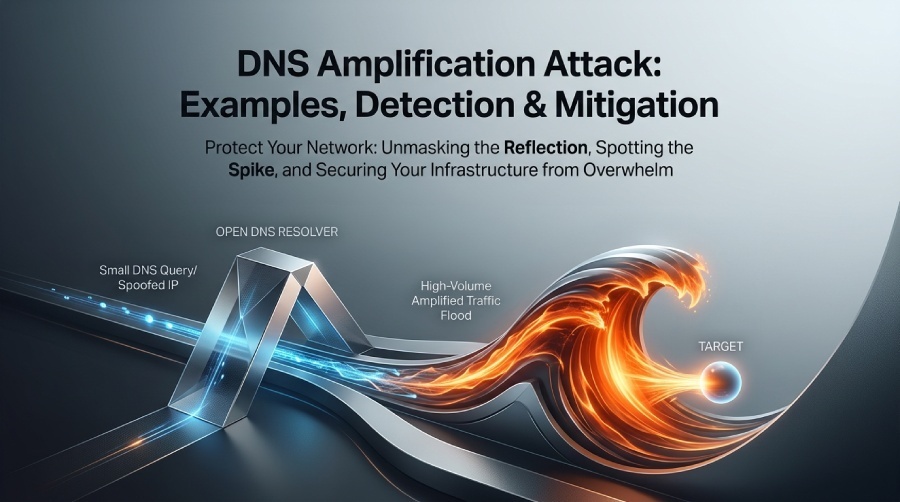
A DNS amplification attack is a DDoS technique that abuses open DNS resolvers to overwhelm a target with amplified traffic. Detect it through unusual DNS traffic and mitigate it by securing resolvers, filtering traffic, and using DDoS protection.
DNS is the foundation of modern email authentication. Protocols such as SPF, DKIM, and DMARC rely on DNS records to verify legitimate email senders and protect domains from spoofing. The DMARC record, for instance, lives as a DNS TXT entry that receivers query on every message. Because of this dependency, attacks against DNS infrastructure—including DNS amplification attacks—can indirectly affect email authentication, email delivery, and domain security. Understanding how DNS amplification attacks work helps organizations strengthen both their network resilience and email security posture.
What Is a DNS Amplification Attack and How Does It Work?
A DNS amplification attack is a type of DDoS attack that abuses the domain name system to overwhelm a target with excessive traffic. It is both a reflection attack and a volumetric attack: the attacker sends small DNS requests to third-party DNS infrastructure, and those systems send much larger replies to the victim. The result is a high-volume distributed denial-of-service event that can exhaust bandwidth, degrade applications, and disrupt critical network infrastructure.
The “amplification” occurs because DNS can produce a large response from a relatively small query. When the request size is much smaller than the response size, the amplification factor becomes attractive to attackers. In many cases, the attacker uses a spoofed ip address, making DNS resolvers believe the query came from the victim. The resolver then sends the response to the victim’s ip address, creating a one-way traffic flood.
The Role of DNS, UDP, and Spoofed Traffic
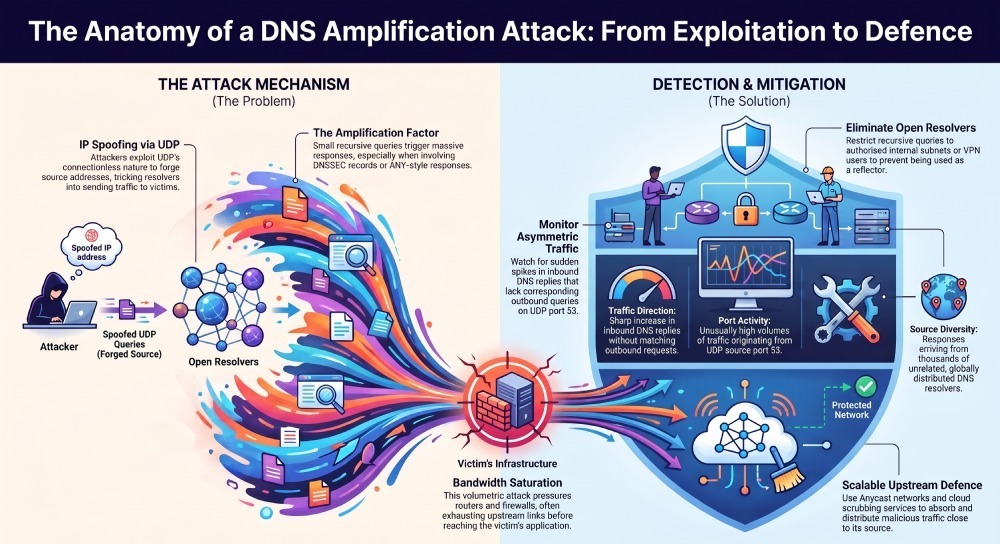
DNS commonly uses UDP, which is fast and connectionless. Because User Datagram Protocol(UDP) does not require a handshake, attackers can forge the source address of UDP packets more easily than with connection-oriented protocols. This makes IP spoofing central to the attack. The attacker sets a spoofed IP address as the source of DNS queries, causing a DNS resolver to reflect responses toward the victim.
A DNS amplification attack often relies on open DNS resolvers—DNS servers that answer queries from anyone on the Internet. These open DNS resolvers may include poorly configured public resolvers, exposed enterprise DNS systems, or a misconfigured recursive DNS server. When a DNS recursor accepts recursive queries from untrusted sources, it can become part of a reflection-based attack.
Why Amplification Makes the Attack So Disruptive
The amplification factor is the ratio between the query sent by the attacker and the response sent to the victim. A small recursive query can trigger a much larger answer, especially where DNSSEC records, ANY-style responses, or misconfigured records are involved. This data amplification is why the technique earned the Amplification moniker.
A DNS amplification attack is dangerous because it consumes external bandwidth before malicious packets even reach the victim’s applications. As a volumetric attack, it pressures routers, load balancers, firewalls, and upstream links. The result can be network congestion, bandwidth consumption, service disruption, and full infrastructure overload. In severe cases, the target’s network resources are unavailable even if servers themselves remain healthy.
Common DNS Amplification Attack Examples and Real-World Scenarios
Open DNS Resolvers Used as Reflectors
The most common scenario involves open DNS resolvers acting as unwilling reflectors. An Attacker controlling a Botnet sends DNS queries with a spoofed IP address belonging to the Victim. The Open DNS resolver responds to the victim, not the attacker. With thousands of reflectors involved, the resulting DDoS attack becomes a massive distributed denial-of-service campaign.
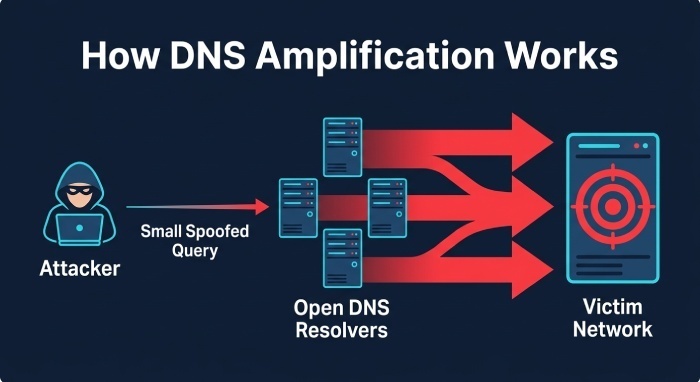
In this scenario, the domain name system is not “hacked” in the traditional sense. Instead, the attacker abuses normal DNS behavior and poor server configuration. A single open resolver may not seem dangerous, but many open DNS resolvers across global internet infrastructure can produce a significant volumetric attack.
High-Amplification DNS Query Abuse
Attackers look for DNS records that produce a large response. For example, misconfigured zones, oversized TXT records, or legacy support for broad query types may increase the amplification factor. A poorly controlled DNS zone transfer or Zone transfer exposure can also reveal information that helps a cybercriminal identify high-value DNS targets, though zone transfers themselves should be restricted to authorized systems.
In real-world incidents, attack traffic may come from thousands of unrelated DNS servers, making attribution difficult. Security vendors such as Cloudflare and Imperva frequently discuss DNS-based Reflection attacks as part of the broader DDoS attack landscape. Services like Cloudflare DDoS Protection, Gatebot, and other DDoS mitigation system platforms use global traffic analysis to identify and absorb malicious traffic before it reaches customer origins.
Example: ISP-Level Reflection Pressure
An Internet Service Provider or regional carrier may see a surge of DNS responses aimed at one subscriber. Even if the target has a strong local firewall, the upstream circuit may saturate first. In this case, ISPs, Upstream infrastructure providers, and other Internet infrastructure providers may need to assist with filtering, rerouting, or temporary Blackhole controls.
Key Indicators and Detection Methods for DNS Amplification Attacks
Traffic Patterns That Signal an Attack
A DNS amplification attack typically produces a sudden spike in inbound DNS response traffic, often from many DNS resolvers the victim never queried. Security teams may observe high volumes of UDP source port 53 traffic, abnormal packet-per-second rates, and unexpected traffic from globally distributed trusted sources that are actually being abused as reflectors.
Common indicators include:
- A sharp increase in inbound DNS replies without matching outbound DNS queries
- Many DNS responses from unrelated DNS resolver systems
- Saturated uplinks and abnormal bandwidth consumption
- Packet captures showing a spoofed IP address pattern in upstream telemetry
- A volumetric attack profile that overwhelms bandwidth rather than application logic
Because this is a distributed denial-of-service event, the traffic may appear to come from legitimate DNS infrastructure. That makes a reflection attack harder to block with simple source-based rules.
Monitoring DNS and Network Infrastructure
Detection requires visibility across DNS, edge routers, flow logs, and network infrastructure telemetry. Cybersecurity teams should review NetFlow, sFlow, firewall logs, DNS server metrics, and DDoS monitoring dashboards. A spike in DNS response traffic combined with no corresponding outbound query volume is a strong signal of a DNS amplification attack.
A mature DDoS mitigation strategy also tracks the amplification factor and the distribution of reflectors. If most malicious traffic is DNS response traffic from many autonomous systems, the organization is likely facing a reflection attack rather than a conventional flood.
Useful Detection Sources
- Edge router flow records showing UDP/53 spikes
- Firewall counters and dropped-packet logs
- DNS telemetry from authoritative and recursive services
- Alerts from Cloudflare, Imperva, or an upstream provider
- Threat intelligence from the Open resolver project and similar datasets
Mitigation Strategies: Hardening DNS Infrastructure and Network Defenses
Eliminate Open Resolver Exposure
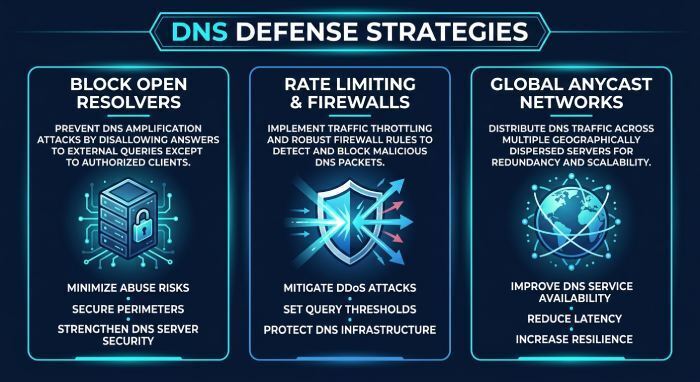
The most important defensive step is to prevent internal systems from becoming open DNS resolvers. A recursive DNS server should only answer recursive queries from authorized clients, such as internal subnets, Virtual Private Network (VPN) users, or designated resolver networks. This reduces abuse of the domain name system and prevents your organization from contributing to a distributed denial-of-service campaign against someone else.
Recommended server configuration controls include disabling open recursion, limiting responses to approved networks, restricting DNS zone transfer access, and keeping DNS software updated. These preventative measures reduce the chance that your DNS infrastructure becomes an attack vector in a reflection-based attack.
Use Filtering, Rate Limiting, and Upstream Controls
Organizations should combine local controls with provider-level mitigation strategies. Since a volumetric attack can saturate links before traffic reaches the data center, collaboration with an upstream provider is essential. Network operators can apply ingress filtering to reduce ip spoofing, while enterprises can request scrubbing, diversion, or blackhole routing during severe attacks.
Effective controls include:
- Rate limiting DNS responses where appropriate
- Access control lists for resolver access
- Edge firewall rules for abnormal UDP/53 patterns
- BCP 38-style ingress filtering by ISPs
- Traffic scrubbing through a cloud DDoS mitigation provider
- Use of an anycast network to distribute attack load
Providers such as Cloudflare operate large Anycast networks across global Data Centers, allowing malicious traffic to be absorbed close to its source. An anycast network helps reduce the impact of a DDoS attack by distributing the flood across many locations instead of one origin.
Best Practices for Prevention, Monitoring, and Incident Response
Build a DNS and DDoS Readiness Program
Defending against a DNS amplification attack requires preparation before the attack starts. Maintain an inventory of every DNS server, DNS resolver, and DNS recursor in your environment. Confirm that no system functions as an unintended Open DNS resolver. Regularly test access controls and validate that resolver policies accept queries only from approved networks.
Your incident response plan should define escalation paths for Cybersecurity teams, network engineers, executive stakeholders, ISPs, and Upstream infrastructure providers. Because a DDoS attack can cause rapid service disruption, pre-approved contacts and runbooks save valuable time.
Coordinate During Active Attacks
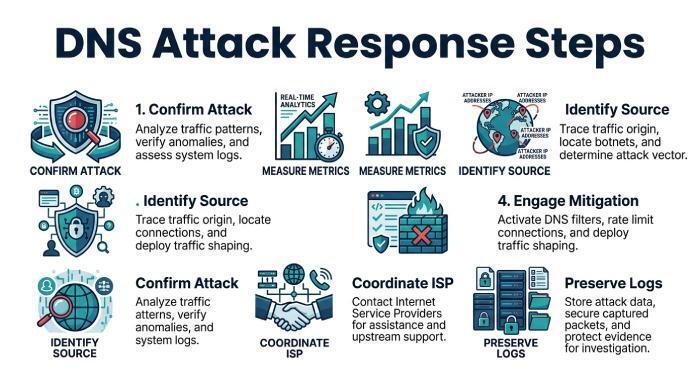
During an active distributed denial-of-service event, teams should classify the traffic, preserve evidence, and engage mitigation partners quickly. If the attack is a DNS-based reflection attack, block or rate-limit obvious malicious patterns locally while asking the internet service provider or mitigation vendor to filter traffic upstream. In extreme cases, blackhole routing may be used to protect broader network infrastructure, although it can temporarily make the targeted service unreachable.
Key response actions include:
- Confirm whether the incident is a DNS amplification attack
- Measure the amplification factor, packet rate, and total bandwidth
- Identify reflector patterns and source networks
- Engage Cloudflare, Imperva, or another DDoS mitigation system
- Coordinate with ISPs and upstream providers
- Preserve logs for post-incident analysis
A resilient DNS defense combines hardened configuration, spoofing prevention, monitoring, and scalable mitigation. When the domain name system is secured properly and open DNS resolvers are eliminated, the organization reduces both its exposure as a victim and its risk of being abused as part of someone else’s volumetric attack.
DNS amplification attacks highlight the importance of resilient DNS infrastructure. Since DMARC, SPF, and DKIM all rely on DNS, protecting DNS services is essential for maintaining secure email authentication, preventing spoofing, and ensuring uninterrupted email delivery. Our free DMARC tools help you confirm those email authentication records are valid. Organizations that combine strong DNS security with properly configured email authentication protocols are better equipped to defend against both network-level and email-based threats. If you have not already done so, create DMARC record coverage for every domain to close the spoofing gap alongside your DNS hardening.
General Manager
General Manager of DuoCircle. Product strategy and commercial lead for DMARC Report's 2,000+ customer base.
LinkedIn Profile →Take control of your DMARC reports
Turn raw XML into actionable dashboards. Start free - no credit card required.