How can I implement a DMARC policy for domains using Gmail or Google Workspace?

How can I implement a DMARC policy for domains using Gmail or Google Workspace?

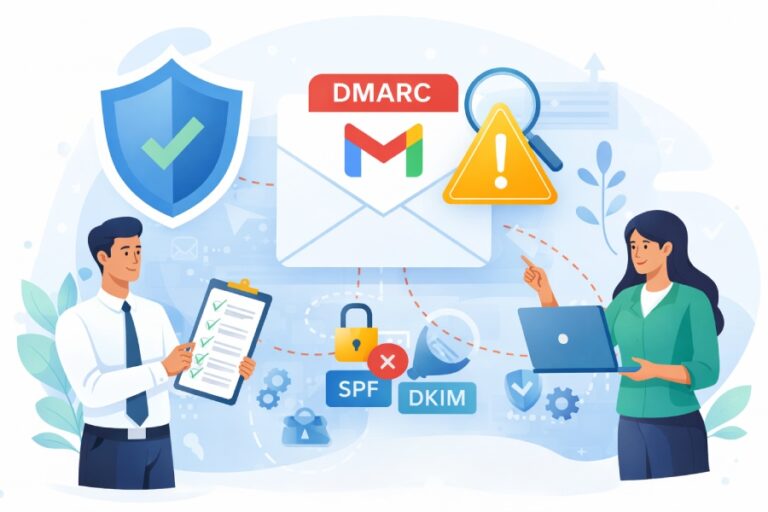
You implement a DMARC policy for a domain using Gmail/Google Workspace by configuring SPF and DKIM alignment for all senders, publishing a DMARC TXT record at _dmarc.yourdomain with monitoring (p=none, rua/ruf), analyzing reports, and then progressively enforcing p=quarantine and p=reject—using pct and sp for subdomains—while monitoring results in Google Admin/Postmaster Tools and DMARCReport. Implementing DMARC…

5 situations in which your DMARC policy should be ‘p=quarantine’

5 situations in which your DMARC policy should be ‘p=quarantine’

DMARC in monitoring mode provides visibility, but it is not sufficient. After all, visibility alone does not stop abuse. Once you know that there are unauthorized senders sending emails on behalf of your domain, continuing to monitor them without taking any preventive steps serves little purpose.  At this stage, it is important that you start…

How can a DMARC Analyzer help reduce phishing emails sent from my domain?

How can a DMARC Analyzer help reduce phishing emails sent from my domain?

A DMARC Analyzer like DMARCReport reduces phishing from your domain by enforcing SPF/DKIM alignment through DMARC policy, mapping and eliminating unauthorized senders with aggregate/forensic reporting, and guiding you—via dashboards, alerts, and automated policy recommendations—from monitor to quarantine/reject without disrupting legitimate mail. DMARC (Domain-based Message Authentication, Reporting & Conformance) is the control plane for email identity:…

FreshMail DKIM & SPF Setup — A Complete Guide

FreshMail DKIM & SPF Setup — A Complete Guide

If you send email marketing campaigns using FreshMail, you already know how powerful and flexible the platform is. However, to ensure your emails actually reach the inbox and don’t get blocked, flagged as spam, or rejected outright, you need to authenticate your domain properly. That’s where SPF and DKIM come in — two critical email…

What is a DMARC record and why does it matter for my email security?

What is a DMARC record and why does it matter for my email security?

A DMARC record is a DNS TXT policy that tells receiving mail servers how to handle emails that claim to be from your domain by verifying SPF/DKIM alignment, and it matters because it prevents spoofing, improves deliverability, and gives you visibility through reports to enforce authentication safely. DMARC (Domain-based Message Authentication, Reporting & Conformance) builds…

Cyberattack Shuts School, Cyber Scam Thwarted, JLR Faces Losses

Cyberattack Shuts School, Cyber Scam Thwarted, JLR Faces Losses

This is the first edition of the month, and we have curated the top four cyber incidents that you must be well-versed in. Cyber mishaps this week revolved around a data breach at Higham Lane School, a potential cyber scam that was prevented by a hacker, and Brightspeed’s customer data breach incident.  Meanwhile, the unfortunate…

What Are The Best Practices For Making DMARC Work With Cloud Email Providers?

What Are The Best Practices For Making DMARC Work With Cloud Email Providers?

The best practices for making DMARC work with cloud email providers are to authenticate every sender with aligned DKIM, keep SPF lean via subdomain delegation and managed includes, roll out DMARC in phased enforcement (p=none → quarantine → reject) with continuous rua/ruf monitoring, and mitigate edge cases (forwarding, mailing lists) with ARC and custom return-paths—while…

How to Fix “External Verification Failure” — A Complete Guide by DMARCReport

How to Fix “External Verification Failure” — A Complete Guide by DMARCReport

Email authentication is no longer a luxury — it’s a critical part of protecting your domain from abuse, spoofing, phishing, and deliverability issues. At DMARCReport, we help thousands of organizations understand and resolve technical email security problems every day. One of the most common issues domain owners encounter when managing DMARC records is an error…

What are the basic components required to create a DMARC record?

What are the basic components required to create a DMARC record?

To create a DMARC record, you publish a DNS TXT record at _dmarc.yourdomain.com containing at least v=DMARC1 (this must be first) and p=(none|quarantine|reject), and you typically add optional tags like rua, ruf, pct, adkim, aspf, sp, fo, and ri to control reporting, alignment, rollout, and subdomain behavior. DMARC (Domain-based Message Authentication, Reporting, and Conformance) tells…

What Are The Best Practices For Gradually Enforcing DMARC On G Suite?

What Are The Best Practices For Gradually Enforcing DMARC On G Suite?

The best practices for gradually enforcing DMARC on G Suite (Google Workspace) are to inventory and align all sending sources with SPF/DKIM, deploy DMARC at p=none with full RUA/RUF reporting, monitor and remediate using DMARCReport, then phase to quarantine and reject with pct/subdomain controls while rotating DKIM keys, addressing forwarding via ARC/SRS, and validating readiness…