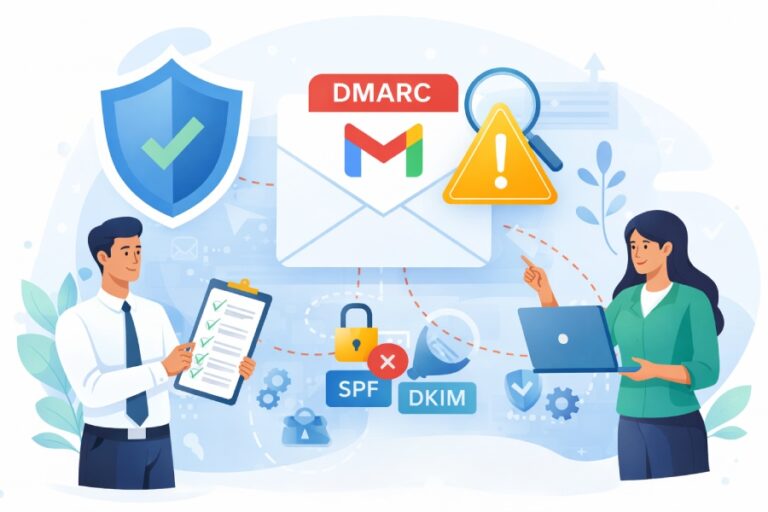
Why Is RUA Important For Monitoring Email Authentication Issues?

Why Is RUA Important For Monitoring Email Authentication Issues?

RUA (DMARC aggregate) reporting is important because it gives domain owners daily, privacy-safe, cross‑receiver visibility into SPF/DKIM authentication and alignment outcomes at scale, so they can detect, prioritize, and remediate email authentication issues and abuse before they impact deliverability, brand, or customers. Email authentication only works if you can see where it fails. DMARC’s aggregate…

Why does Gmail reject or mark my messages as spam when my DMARC policy is strict?

Why does Gmail reject or mark my messages as spam when my DMARC policy is strict?

Gmail rejects or marks your messages as spam when your DMARC policy is strict because the messages fail DMARC alignment (SPF or DKIM pass but don’t align with the visible From domain), alignment is broken by forwarding/lists/intermediaries, or misconfigurations exist, and Gmail combines these results with reputation and engagement signals to quarantine or reject according…

How to maintain a good email sender reputation in 2026

How to maintain a good email sender reputation in 2026

Email platforms today are much stricter about security and trust, and have become far less forgiving than ever. This means even a minor slip-up could cost your brand visibility, credibility, and trust among the email service providers and recipients. Now imagine this happening repeatedly. If your outgoing emails often fail authentication checks, trigger spam complaints,…

New ClickFix Scam, Dental Practice Banned, UK MPs Targeted

New ClickFix Scam, Dental Practice Banned, UK MPs Targeted

Cybercriminals are getting smarter, quieter, and far more convincing. From a new browser-based ClickFix variant that slips past traditional security tools, to healthcare organizations facing legal action after phishing breaches, and even UK MPs being targeted through trusted messaging apps, recent incidents show how fast attack methods are evolving. These threats no longer rely on…

DDoS vs DoS Attacks: A Complete Guide from DMARCReport

DDoS vs DoS Attacks: A Complete Guide from DMARCReport

In today’s hyper-connected world, where digital services power everything from your business to your personal communications, the threat landscape continues to evolve at an unprecedented pace. Among the most prevalent and damaging types of cyberattacks are Denial-of-Service (DoS) and Distributed Denial-of-Service (DDoS) attacks. These attacks don’t aim to steal data or quietly infiltrate systems—instead, they…

How can I check whether my domain’s DMARC policy is correctly configured for Gmail?

How can I check whether my domain’s DMARC policy is correctly configured for Gmail?

To check whether your domain’s DMARC policy is correctly configured for Gmail, validate your DMARC DNS TXT record syntax and tags, confirm SPF and DKIM alignment with your header-from domain, send test messages to Gmail and inspect Authentication-Results and Google Postmaster Tools, verify delivery and parsing of DMARC aggregate (rua) reports (noting Gmail does not…

Business Email Compromise vs Phishing Attacks — A Deep Dive by DMARCReport

Business Email Compromise vs Phishing Attacks — A Deep Dive by DMARCReport

In today’s hyper-connected digital world, email remains the backbone of business communication — and unfortunately, also one of the most exploited attack vectors used by cybercriminals. Sophisticated threat actors continually refine their techniques to deceive trusted recipients, impersonate legitimate senders, and manipulate end users into disclosing sensitive information or transferring funds. At DMARCReport, we believe…

Does a DMARC check verify SPF and DKIM alignment for my domain?

Does a DMARC check verify SPF and DKIM alignment for my domain?

Yes—DMARC explicitly evaluates SPF and DKIM authentication results and verifies their alignment with the message’s Header From domain, passing if at least one of SPF or DKIM both authenticates and aligns per your DMARC policy. DMARC (Domain-based Message Authentication, Reporting, and Conformance) exists to connect message authentication to domain identity as shown to recipients: the…

How can DMARC improve email deliverability and reduce phishing risks?

How can DMARC improve email deliverability and reduce phishing risks?

DMARC improves deliverability and reduces phishing by enforcing domain-aligned authentication (SPF/DKIM) that mailbox providers trust to place legitimate emails in the inbox while blocking or quarantining spoofed messages at scale. DMARC—Domain-based Message Authentication, Reporting, and Conformance—adds a policy and reporting layer on top of SPF and DKIM so receivers can verify that a message claiming…

How Can I Verify If My DMARC Record Is Using SPF Or DKIM Alignment?

How Can I Verify If My DMARC Record Is Using SPF Or DKIM Alignment?

To verify whether your DMARC policy uses SPF or DKIM alignment and whether messages align, query your domain’s _dmarc TXT record to read the adkim (for DKIM) and aspf (for SPF) flags (set to r for relaxed or s for strict), then inspect a delivered message’s Authentication-Results, Header From, Return-Path, and DKIM-Signature (d=) fields to…