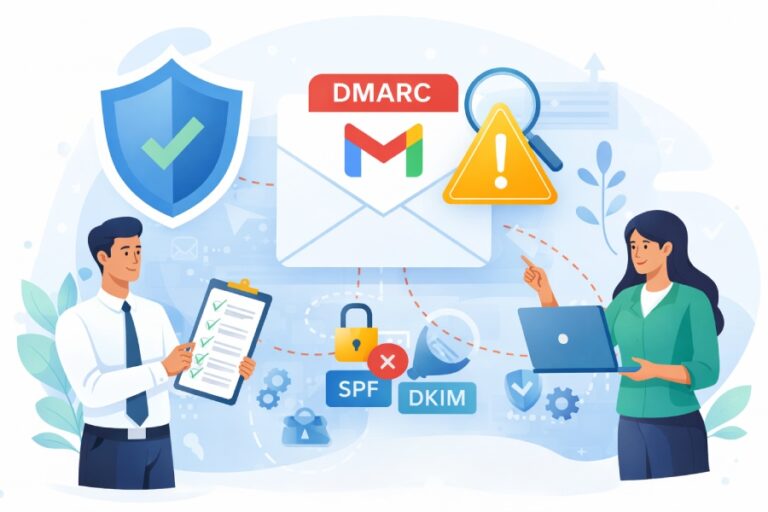
How Can I Use DMARC Lookup Findings To Start Fixing Authentication Issues?

How Can I Use DMARC Lookup Findings To Start Fixing Authentication Issues?

You can use DMARC lookup findings to fix authentication issues by turning aggregate and forensic reports into a prioritized map of failing senders, IPs, and domains; applying targeted SPF and DKIM alignment fixes; choosing relaxed vs strict alignment; rolling out DMARC policy from none to reject with measured thresholds; addressing forwarding, mailing lists, and third‑party…

Email List Validation: The Essential Guide for Modern Email Marketers

Email List Validation: The Essential Guide for Modern Email Marketers

Email marketing remains one of the most powerful digital communication channels available today — and that’s not going to change anytime soon. Despite new platforms and tools emerging constantly, email continues to deliver unmatched ROI, engagement, and direct audience access. But the key to success in email marketing isn’t the size of your list —…

What is the recommended DNS record syntax for a DMARC record used with Office 365?

What is the recommended DNS record syntax for a DMARC record used with Office 365?

Publish a TXT record at _dmarc.yourdomain.com with the value “v=DMARC1; p=none; rua=mailto:rua@dmarcreport.com; ruf=mailto:ruf@dmarcreport.com; fo=1; pct=100; adkim=r; aspf=r; sp=none” to begin DMARC monitoring for Office 365 safely and effectively. DMARC (Domain-based Message Authentication, Reporting and Conformance) builds on SPF and DKIM to tell receivers how to handle messages that fail authentication. In an Office 365 tenant,…

Monitor, Analyze, And Protect: A Free DMARC Analyzer Solution

Monitor, Analyze, And Protect: A Free DMARC Analyzer Solution

You can monitor, analyze, and protect your domain for free by implementing SPF, DKIM, and an initial p=none DMARC record with RUA/RUF pointing to DMARCReport, then using DMARCReport’s free analyzer to visualize alignment, tune policies toward quarantine/reject, handle third‑party senders, and integrate alerts and privacy controls at scale. Modern email authentication hinges on three open…

Email-Borne Insurance Scams: A Complete Guide to Understanding, Preventing & Securing Your Domain

Email-Borne Insurance Scams: A Complete Guide to Understanding, Preventing & Securing Your Domain

In today’s highly digital world, email remains one of the most essential communication channels for businesses — especially in the insurance industry. Unfortunately, as the industry embraces digital transformation, it also becomes an increasingly attractive target for cybercriminals leveraging email to defraud companies and unsuspecting policyholders alike. Email-borne insurance scams aren’t just an annoyance. When…

How to set up SPF and DKIM for Autotask

How to set up SPF and DKIM for Autotask

Companies rely on Autotask for sending emails about ticket updates, workflow alerts, invoices, system notifications, and more. Many of these emails are time and response-sensitive, which is why it’s important that domain owners integrate SPF, DKIM, and DMARC for their Autotask accounts. When these emails are not authenticated, receiving mailbox providers may treat them as…

How can I set up DMARC for my Google Workspace domain without breaking delivery?

How can I set up DMARC for my Google Workspace domain without breaking delivery?

To set up DMARC for your Google Workspace domain without breaking delivery, publish SPF (v=spf1 include:_spf.google.com ~all), generate and enable 2048‑bit DKIM in the Google Admin console, start with DMARC at p=none with rua/ruf to DMARCReport for monitoring, fix and align all third‑party senders via DKIM or aligned SPF, then progressively move to quarantine and…

France Post Targeted, Romanian Waters Attacked, WhatsApp GhostPairing Threat

France Post Targeted, Romanian Waters Attacked, WhatsApp GhostPairing Threat

This is the fourth edition of the month, and we have curated the top three cyber incidents that you must know about. We will begin the bulletin with the alleged threat attack on a French post office. Next, we will discuss the recent cyberattack on Romanian waters and try to understand the extent of damage…

DMARC: A Comprehensive Guide to Protect Your Domain — by DMARCReport

DMARC: A Comprehensive Guide to Protect Your Domain — by DMARCReport

Email security is among the most critical aspects of modern digital communications. Every year, organizations lose money, time, and reputation due to email fraud, phishing attacks, and domain spoofing. Studies show that even small breaches can cost businesses tens of thousands of dollars, while larger enterprises can lose millions per incident. With email-based threats rising…

How can I get started reading DMARC reports to understand delivery problems?

How can I get started reading DMARC reports to understand delivery problems?

Start by publishing a DMARC TXT record with aggregate (RUA) and optional forensic (RUF) destinations, ingesting those reports into a parser like DMARCReport, and then reading the aggregate XML fields—policy, alignment, SPF/DKIM results, source IP, and message counts—to correlate failures with your SPF/DKIM/DNS configuration and remediate misconfigurations before gradually tightening policy. DMARC is an authentication…

Understanding DMARC RFC: A Comprehensive Guide by DMARCReport

Understanding DMARC RFC: A Comprehensive Guide by DMARCReport

In today’s digital world, email remains one of the most powerful communication channels, but it is also one of the most abused. Every day, millions of malicious emails are sent to deceive recipients — from phishing to brand spoofing to targeted business email compromise (BEC). As these attacks evolve, so too must our defenses. At…

How long after publishing a DMARC DNS record should I expect to see effects on delivery?

How long after publishing a DMARC DNS record should I expect to see effects on delivery?

You should expect initial DMARC-driven delivery effects as soon as DNS caches refresh your new TXT record—typically within 5–60 minutes, broad enforcement by major mailbox providers within 1–24 hours, and full stabilization (including report-based visibility) within 24–72 hours. DMARC is evaluated in real time on each message, but its input—the DMARC TXT record at _dmarc.yourdomain—travels…

What Are The Best Tools For Validating And Analyzing A DMARC Record Example?

What Are The Best Tools For Validating And Analyzing A DMARC Record Example?

The best tools for validating and analyzing a DMARC record example are a combination of web validators (DMARCReport Validator, MXToolbox, dmarcian, DMARC Analyzer), command-line utilities (dig/host/nslookup, OpenDMARC), open-source parsers (parsedmarc), and APIs (DMARCReport API, SecurityTrails, WhoisXML) supplemented by deliverability testbeds (Gmail/Outlook header analysis, Mail-Tester, GlockApps) to cover both syntax accuracy and real-world enforcement outcomes. Why…

DMARC Deployment & Monitoring: A Practical Guide by DMARCReport

DMARC Deployment & Monitoring: A Practical Guide by DMARCReport

In today’s digital ecosystem, email remains one of the most vital communication channels for organizations worldwide. Yet, without strong safeguards in place, email domains can be abused by attackers to send phishing, spoofing, and other fraudulent messages that harm your brand, customers, and internal users. To protect your domain and ensure only authorized email senders…

How Can A DMARC Report Analyzer Help Reduce Phishing And Spoofing Incidents?

How Can A DMARC Report Analyzer Help Reduce Phishing And Spoofing Incidents?

A DMARC report analyzer reduces phishing and spoofing by transforming raw RUA/RUF data into prioritized insights, automated enforcement, and rapid incident response that block unauthorized senders while preserving legitimate email flows. Email authentication works only when you can see who’s sending on your behalf, how their messages authenticate, and where policy changes will help—or hurt—deliverability;…

Why is DMARC important for protecting emails sent from G Suite?

Why is DMARC important for protecting emails sent from G Suite?

DMARC is important for protecting emails sent from G Suite (Google Workspace) because it verifies your domain’s messages via SPF/DKIM alignment and tells receiving servers to quarantine or reject spoofed mail, which dramatically reduces phishing while improving deliverability and visibility through standardized reporting. G Suite’s native security (SPF and DKIM) prevents many spoofing attempts, but…