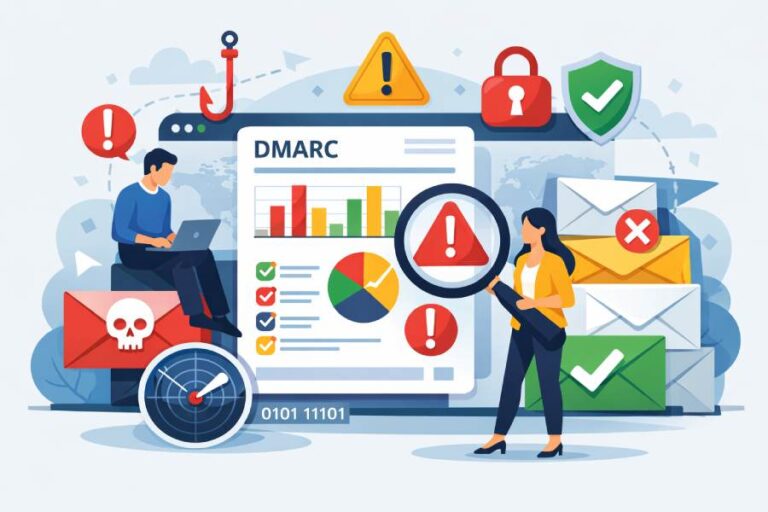
How a DKIM Replay Attack Successfully Spoofed Google — A Deep Dive

How a DKIM Replay Attack Successfully Spoofed Google — A Deep Dive

In today’s email threat landscape, phishing attacks have grown far more sophisticated than ever before. Gone are the days when scammers relied on bad grammar, obvious spoofed domains, or clearly malicious links. Modern attacks can mimic legitimate system alerts so convincingly that even tech-savvy users hesitate to dismiss them. One such evolving threat is what’s…

How can I implement a DMARC policy for domains using Gmail or Google Workspace?

How can I implement a DMARC policy for domains using Gmail or Google Workspace?

You implement a DMARC policy for a domain using Gmail/Google Workspace by configuring SPF and DKIM alignment for all senders, publishing a DMARC TXT record at _dmarc.yourdomain with monitoring (p=none, rua/ruf), analyzing reports, and then progressively enforcing p=quarantine and p=reject—using pct and sp for subdomains—while monitoring results in Google Admin/Postmaster Tools and DMARCReport. Implementing DMARC…

How can a DMARC Analyzer help reduce phishing emails sent from my domain?

How can a DMARC Analyzer help reduce phishing emails sent from my domain?

A DMARC Analyzer like DMARCReport reduces phishing from your domain by enforcing SPF/DKIM alignment through DMARC policy, mapping and eliminating unauthorized senders with aggregate/forensic reporting, and guiding you—via dashboards, alerts, and automated policy recommendations—from monitor to quarantine/reject without disrupting legitimate mail. DMARC (Domain-based Message Authentication, Reporting & Conformance) is the control plane for email identity:…

FreshMail DKIM & SPF Setup — A Complete Guide

FreshMail DKIM & SPF Setup — A Complete Guide

If you send email marketing campaigns using FreshMail, you already know how powerful and flexible the platform is. However, to ensure your emails actually reach the inbox and don’t get blocked, flagged as spam, or rejected outright, you need to authenticate your domain properly. That’s where SPF and DKIM come in — two critical email…

What is a DMARC record and why does it matter for my email security?

What is a DMARC record and why does it matter for my email security?

A DMARC record is a DNS TXT policy that tells receiving mail servers how to handle emails that claim to be from your domain by verifying SPF/DKIM alignment, and it matters because it prevents spoofing, improves deliverability, and gives you visibility through reports to enforce authentication safely. DMARC (Domain-based Message Authentication, Reporting & Conformance) builds…

What are the basic components required to create a DMARC record?

What are the basic components required to create a DMARC record?

To create a DMARC record, you publish a DNS TXT record at _dmarc.yourdomain.com containing at least v=DMARC1 (this must be first) and p=(none|quarantine|reject), and you typically add optional tags like rua, ruf, pct, adkim, aspf, sp, fo, and ri to control reporting, alignment, rollout, and subdomain behavior. DMARC (Domain-based Message Authentication, Reporting, and Conformance) tells…

Understanding Proofpoint’s Inbound DMARC Handling — A DMARCReport Analysis

Understanding Proofpoint’s Inbound DMARC Handling — A DMARCReport Analysis

Email authentication standards like DMARC (Domain‑based Message Authentication, Reporting, and Conformance) have become indispensable in the fight against spoofing, phishing, and domain impersonation. Organizations rely on DMARC not only to protect their brand but also to ensure the authenticity of email traffic traversing the internet. At DMARCReport, we’re passionate about helping security teams, IT administrators,…

Ultimate DreamHost DMARC Setup Guide — By DMARCReport

Ultimate DreamHost DMARC Setup Guide — By DMARCReport

As email threats continue to grow, protecting your domain from phishing, spoofing, and fraudulent use of your brand is no longer a “nice-to-have” — it’s essential. And at the heart of strong email defense is DMARC — Domain-based Message Authentication, Reporting & Conformance. When implemented correctly, DMARC empowers domain owners to take control over how…

Email List Validation: The Essential Guide for Modern Email Marketers

Email List Validation: The Essential Guide for Modern Email Marketers

Email marketing remains one of the most powerful digital communication channels available today — and that’s not going to change anytime soon. Despite new platforms and tools emerging constantly, email continues to deliver unmatched ROI, engagement, and direct audience access. But the key to success in email marketing isn’t the size of your list —…

Email-Borne Insurance Scams: A Complete Guide to Understanding, Preventing & Securing Your Domain

Email-Borne Insurance Scams: A Complete Guide to Understanding, Preventing & Securing Your Domain

In today’s highly digital world, email remains one of the most essential communication channels for businesses — especially in the insurance industry. Unfortunately, as the industry embraces digital transformation, it also becomes an increasingly attractive target for cybercriminals leveraging email to defraud companies and unsuspecting policyholders alike. Email-borne insurance scams aren’t just an annoyance. When…

Understanding DMARC RFC: A Comprehensive Guide by DMARCReport

Understanding DMARC RFC: A Comprehensive Guide by DMARCReport

In today’s digital world, email remains one of the most powerful communication channels, but it is also one of the most abused. Every day, millions of malicious emails are sent to deceive recipients — from phishing to brand spoofing to targeted business email compromise (BEC). As these attacks evolve, so too must our defenses. At…

Why is DMARC important for protecting emails sent from G Suite?

Why is DMARC important for protecting emails sent from G Suite?

DMARC is important for protecting emails sent from G Suite (Google Workspace) because it verifies your domain’s messages via SPF/DKIM alignment and tells receiving servers to quarantine or reject spoofed mail, which dramatically reduces phishing while improving deliverability and visibility through standardized reporting. G Suite’s native security (SPF and DKIM) prevents many spoofing attempts, but…

New ClickFix Scam, Dental Practice Banned, UK MPs Targeted

New ClickFix Scam, Dental Practice Banned, UK MPs Targeted

Cybercriminals are getting smarter, quieter, and far more convincing. From a new browser-based ClickFix variant that slips past traditional security tools, to healthcare organizations facing legal action after phishing breaches, and even UK MPs being targeted through trusted messaging apps, recent incidents show how fast attack methods are evolving. These threats no longer rely on…

Business Email Compromise vs Phishing Attacks — A Deep Dive by DMARCReport

Business Email Compromise vs Phishing Attacks — A Deep Dive by DMARCReport

In today’s hyper-connected digital world, email remains the backbone of business communication — and unfortunately, also one of the most exploited attack vectors used by cybercriminals. Sophisticated threat actors continually refine their techniques to deceive trusted recipients, impersonate legitimate senders, and manipulate end users into disclosing sensitive information or transferring funds. At DMARCReport, we believe…

Does a DMARC check verify SPF and DKIM alignment for my domain?

Does a DMARC check verify SPF and DKIM alignment for my domain?

Yes—DMARC explicitly evaluates SPF and DKIM authentication results and verifies their alignment with the message’s Header From domain, passing if at least one of SPF or DKIM both authenticates and aligns per your DMARC policy. DMARC (Domain-based Message Authentication, Reporting, and Conformance) exists to connect message authentication to domain identity as shown to recipients: the…