The History of Email: From ARPANET to Modern Secure Communication
Email is one of the most transformative technologies in the history of digital communication. Although it may seem like a mundane tool you use every day to send messages, share files, or coordinate with teams, email’s evolution is a remarkable journey that spans decades of innovation, expansion, and adaptation. Today, more than 300 billion emails are sent and received daily worldwide — a staggering figure that would have been hard to imagine when the first electronic message was transmitted.
This article explores that history — from its humble beginnings as an academic experiment to its role as a cornerstone of modern communication — and explains why email security (including technologies like DMARC) has become crucial in the digital age.
The Birth of Email: From Research Labs to Networked Messaging
The earliest foundations of email date back to the mid-1960s. Researchers at the Massachusetts Institute of Technology (MIT) developed an internal messaging system as part of the Compatible Time-Sharing System (CTSS). This allowed users on a shared mainframe computer to leave messages for one another. Though primitive by today’s standards — messages weren’t sent between different machines, and only users of the same machine could communicate — this was a groundbreaking step toward electronic messaging.
However, email as we recognize it today didn’t truly exist until a significant leap in 1971.
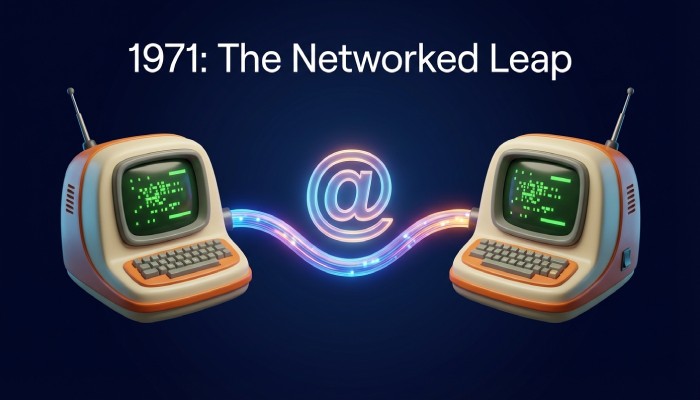
1971: Ray Tomlinson and the “@” Symbol
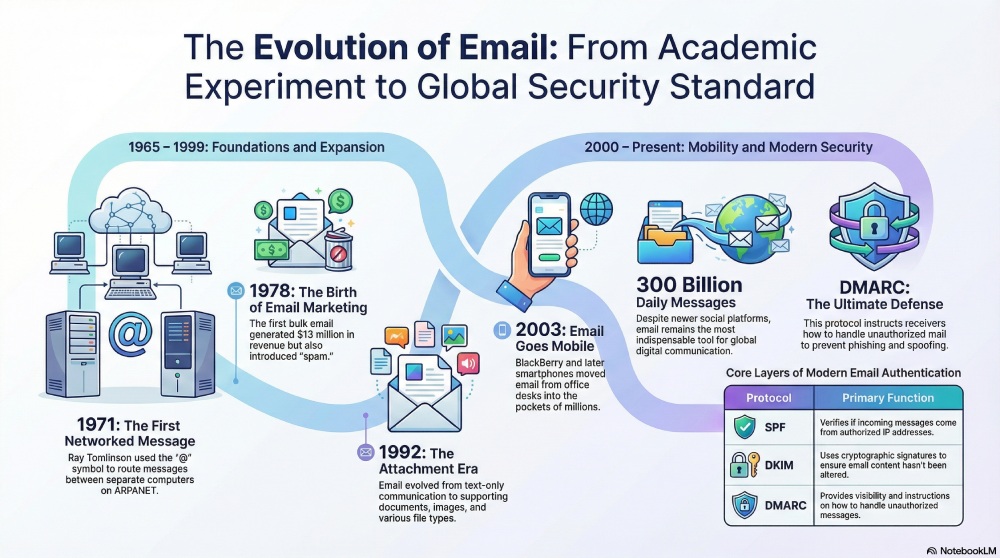
In 1971, computer engineer Ray Tomlinson, working on ARPANET — the precursor to today’s Internet — sent the first message between two separate computers. This event is widely credited as the moment email evolved from a local messaging tool to a networked communications system.
Tomlinson chose the now-ubiquitous “@” symbol to separate the user’s name from the machine they were on. That crucial decision laid the groundwork for email addressing conventions that persist to this day.
Although the exact content of Tomlinson’s first message has been forgotten — he himself joked it was something entirely forgettable — its implications were enormous. Messages could now be routed across computers connected to a network, not just left on a shared disk or machine.

Standardizing Email Structure
It took several more years for email to adopt a standardized format. Between 1973 and 1977, DARPA — the U.S. Defense Advanced Research Projects Agency — helped formalize common elements like “To,” “From,” and “Subject” fields, as well as forwarding capabilities. These developments made email more structured and usable beyond initial experiments.
The concept spread through research and military networks and then into corporate environments as the advantages of electronic communication became clear.
Email Expands: Commercial Adoption and Early Spam
By the late 1970s and early 1980s, email was becoming more than a research tool; it was a communication system with commercial and social potential.
1978: The First Email Marketing Campaign
In 1978, an early marketing experiment — now often cited as the first email marketing campaign — was launched. Gary Thuerk, a marketer at Digital Equipment Corporation, sent an unsolicited message to more than 300 recipients advertising a product. While successful in driving sales (reportedly about $13 million in revenue), this unsolicited bulk message would today be classified as spam — illustrating how quickly misuse can follow innovation.
This was the beginning of a form of communication that would grow into multiple industries — including marketing, customer engagement, and unfortunately, digital threats.
The Rise of Email: The 1980s and 1990s
Email truly began its ascent into mainstream awareness during the 1980s and 1990s.
Microsoft Mail and Consumer Email
Initially, email adoption was limited to technical or corporate environments. In 1988, Microsoft released Microsoft Mail for Mac, and by 1991 it was available on DOS and Windows systems. These developments signaled the arrival of email as a consumer communication tool.
As email gained popularity, more providers entered the space: Microsoft Outlook (1993), Hotmail (1996), Yahoo Mail (later in the 1990s), and eventually Gmail in the early 2000s. By making email accessible outside of complex corporate networks, these platforms brought email to virtually everyone with a computer and internet connection.
Attachments and Mobile Email
1992: Attachments Become Mainstream
For its first two decades, email was primarily text-only. That changed in 1992, when email systems began to support attachments — enabling users to send documents, images, and files along with a message. This innovation unlocked massive new potential for email use, but it also strained early email infrastructures unprepared for large files.
2000s: Email Goes Mobile
Email’s reach expanded even further with the rise of mobile devices. In 2003, BlackBerry brought email to handheld devices in a way that deeply resonated with professionals. However, it was the introduction of the iPhone and other smartphones that propelled email into the pockets of millions worldwide.
Email became not just something you checked at your desk, but something you carried with you, tapping into the social and professional rhythms of daily life.
Challenges: Spam, Overload, and Email Hygiene
As email usage exploded, so did the volume of messages — including unwanted or malicious ones.
Inbox Overload
By the 2010s, many users experienced frustration as inboxes filled with subscription messages, promotions, and junk mail. This led to cultural movements like “inbox zero,” where users aimed to clear their inbox daily, and services that helped manage or unsubscribe from bulk lists emerged.
The Rise of Spam and Security Threats
Unwanted email quickly evolved into a major digital threat. Spam wasn’t just a nuisance — it became a vehicle for phishing attacks, malware distribution, and impersonation scams. For individuals, opening or clicking unsafe messages could compromise personal information. For companies, these threats posed brand and financial risks.
Email Security: Why Authentication Matters
Today, protecting email isn’t just about avoiding spam — it’s about securing communications in an age where trust and safety are paramount.
Protocols That Safeguard Email
Several authentication protocols were introduced to help secure email systems and verify legitimate senders:
- SPF (Sender Policy Framework) — Helps mail servers verify that incoming messages come from IPs authorized by the domain owner.
- DKIM (DomainKeys Identified Mail) — Uses cryptographic signatures to confirm that contents haven’t been altered in transit.
These laid the groundwork for stronger email authentication.
DMARC: Domain-Based Message Authentication, Reporting & Conformance
DMARC is the next layer of email security. It builds on SPF and DKIM by giving domain owners a way to instruct mail receivers on how to handle unauthorized mail. It also provides visibility through reporting, helping organizations understand who is sending email on their behalf — and who is not.
At DMARCReport, we believe email should be trusted and reliable. Implementing DMARC not only protects recipients from phishing and spoofing, but it also safeguards brand reputation and ensures better email deliverability.
Does Email Have a Future?
Despite the emergence of other communication tools — instant messaging apps, social platforms, collaboration suites — email remains indispensable. Statistical forecasts show daily email traffic continuing to grow, with hundreds of billions of messages sent each day.
Whether used for personal correspondence, business negotiation, marketing campaigns, or critical system alerts, email is deeply embedded in how we communicate digitally.
The Legacy and Importance of Email
The journey from early academic messaging systems to the global communication backbone we know today has been extraordinary. Email’s evolution reflects larger shifts in technology — from mainframes to networks to mobile devices and cloud services.
But with opportunity comes responsibility. As email becomes ever more central to how we work and live, protecting it becomes non-negotiable. That’s why understanding the history of email isn’t just a matter of nostalgia — it helps us appreciate the systems that support modern life and why we must defend them.
Conclusion
Email’s history is a story of innovation, adoption, disruption, and resilience. From Ray Tomlinson’s first networked message to the complex ecosystems of Gmail, Outlook, and enterprise email systems, electronic mail has revolutionized communication.
But today’s email landscape also demands vigilance. With threats like phishing and spoofing on the rise, email authentication systems like DMARC are essential defenses for organizations and individuals alike.
At DMARCReport, we help you secure your email infrastructure, build trust in your communications, and ensure the future of email is safe, trusted, and resilient.