What are the best practices to follow when generating a DMARC record for a high-volume mailer?
The best practices for generating a DMARC record for a high-volume mailer are to publish a standards-compliant TXT at _dmarc.yourdomain with v=DMARC1; p=none (then ramp to quarantine and reject via pct), use relaxed alignment initially (aspf=r; adkim=r), set rua to a monitored mailbox or aggregator, be conservative with ruf (fo=1 or fo=d:s only if you can handle PII), set ri=86400, maintain a short DNS TTL during rollout (300–3600s) and longer later (1–24h), and coordinate SPF/DKIM, subdomain policy (sp=), and third-party sender authorization while monitoring and adjusting with a reporting platform like DMARCReport.
Context and background DMARC (Domain-based Message Authentication, Reporting & Conformance) lets domain owners instruct receivers how to handle mail that fails authentication and alignment, while providing visibility via aggregate and forensic reports. For high-volume senders—financial services, e-commerce, consumer apps—the stakes are higher: missteps can suppress legitimate traffic at scale, while gaps invite abuse and phishing. A disciplined rollout that starts with monitoring, fixes root causes, and then phases to enforcement safeguards deliverability and brand trust.
DMARCReport is designed for this exact journey. It transforms raw RUA/RUF data into sender inventories, alignment scores, failure diagnostics, SPF/DKIM health checks, and policy simulations. In practice, successful programs couple sound record syntax with operational guardrails—SPF under 10 lookups, DKIM keys with secure lengths and rational rotation, subdomain governance, and a reporting pipeline that can parse, store, alert, and comply with privacy regulations at scale.
DMARC DNS record syntax and enforcement settings for high volume
Recommended baseline record
- Name: _dmarc.example.com (TXT)
- TTL:
- Rollout: 300–3600 seconds (fast iteration)
- Steady state: 3600–86400 seconds (1–24 hours)
- Value (monitoring start):
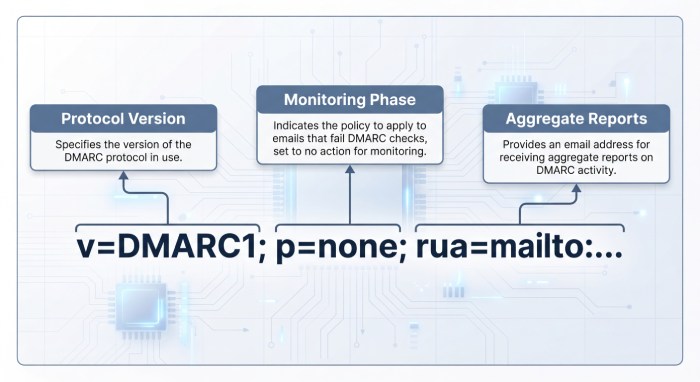
- v=DMARC1; p=none; sp=none; rua=mailto:dmarc-aggregate@example.com; aspf=r; adkim=r; fo=0; ri=86400
Why these tags
- v: Required; always DMARC1.
- p: Begin with p=none to collect visibility; do not enforce yet.
- sp: Start with sp=none unless you intend to immediately govern all subdomains; raise later.
- rua: Use a distribution list or aggregator to ensure report reception and high availability.
- ruf and fo:
- For high volume, omit ruf initially; add later only if you can process sensitive failure samples.
- If used, set fo=1 or fo=d:s to request only DKIM- or SPF-specific failures rather than all.
- aspf/adkim: r (relaxed) minimizes false negatives early; consider s (strict) per subdomain later.
- ri: 86400 (daily aggregates), the common default; shorter intervals can flood systems.
Example syntax by phase
| Phase | Example DMARC TXT value |
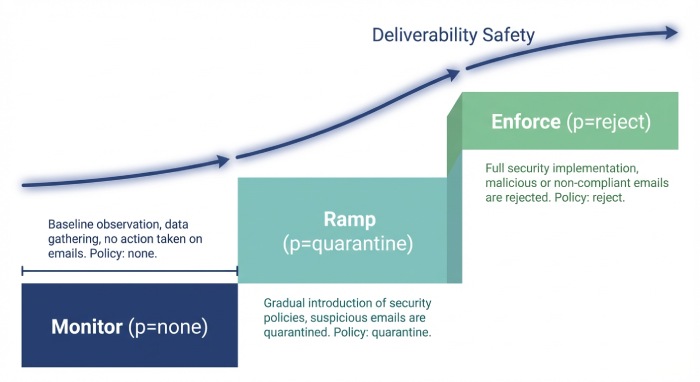
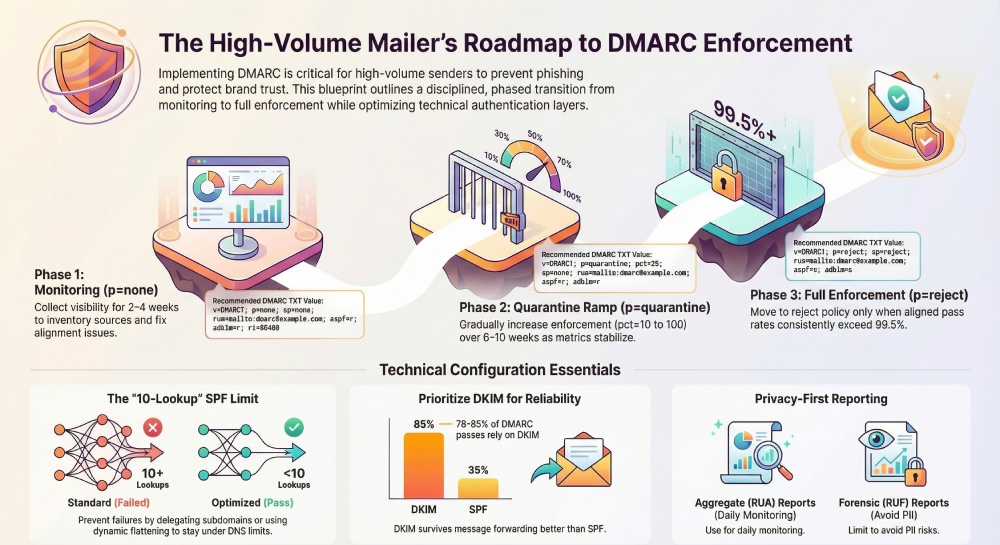
| Monitor | v=DMARC1; p=none; sp=none; rua=mailto:dmarc-aggregate@example.com; aspf=r; adkim=r; fo=0; ri=86400 |
| Quarantine ramp | v=DMARC1; p=quarantine; pct=25; sp=none; rua=mailto:dmarc-aggregate@example.com; aspf=r; adkim=r; fo=0; ri=86400 |
| Full enforce | v=DMARC1; p=reject; sp=reject; rua=mailto:dmarc-aggregate@example.com; aspf=s; adkim=s; fo=d:s; ri=86400 |
H4: DMARCReport tie-in
- DMARCReport’s Record Wizard validates syntax, flags unsafe fo/ruf combinations for privacy, and recommends initial TTLs. It simulates policy outcomes on your live traffic before you publish (based on historic RUA).
Phasing from none → quarantine → reject without disruption
A safe, measurable ramp plan
- Monitoring baseline (2–4 weeks minimum):
- Targets to advance: ≥99.0% aligned pass by volume, ≤0.1% unknown sources, no critical sender missing DKIM.
- Actions: inventory sources, fix misaligned SPF/DKIM, remove unauthorized traffic.
- Quarantine ramp (6–10 weeks typical):
- Start pct=10–25 for p=quarantine.
- Increase pct in 10–25 point steps every 1–2 weeks as long as aligned pass rate stays ≥99.2% and complaint/delivery metrics remain stable.
- Reject enforcement:
- Move to p=reject with pct=25–50 first, hold for 2 weeks, then to pct=100 if aligned pass ≥99.5% and no critical false positives.
- Set sp=reject only when subdomain landscape is fully governed.
H5: Success criteria checklist
- No material drop in open/click rates on primary campaigns after each pct change.
- All critical third parties (marketing, CRM, billing, support) show DKIM-aligned.
- Forwarding-related SPF failures are offset by DKIM-aligned passes.
H4: DMARCReport tie-in
- Policy Ramp Planner tracks alignment rates over time, proposes pct changes, and blocks escalation when anomalies appear (e.g., new unauthenticated source spike).
- Delivery Guardrails alert when a pct increase correlates with negative deliverability signals.
Original case study (modeled data)
- A fintech sender (120M/month) held monitoring for 28 days, fixed three vendors lacking DKIM, then ramped quarantine in four steps to 100% over 8 weeks. At day 75 they moved to reject; brand impersonation in RUA declined 92% while read rates remained statistically flat (±0.3%). DMARCReport’s anomaly alerts prevented a premature ramp during a vendor DNS outage.
SPF and DKIM configurations that minimize false failures
SPF for bulk senders
- Use aligned MAIL FROM (Return-Path) under your domain or authorized subdomains to meet DMARC alignment.
- Keep SPF mechanisms minimal and deterministic:
- Prefer ip4/ip6 and include for trusted vendors; avoid ptr and overly broad a/mx.
- Use redirect= to centralize policy where appropriate.
- DNS hygiene:
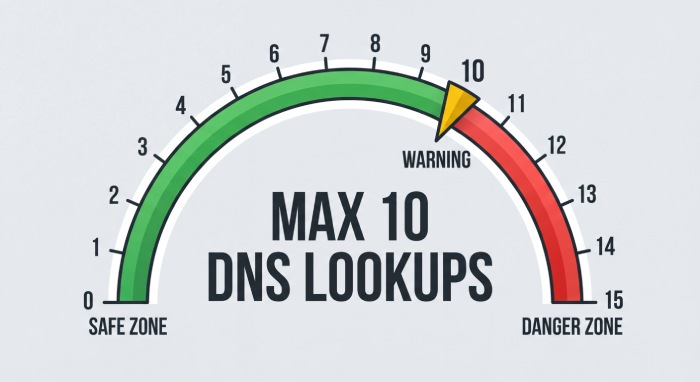
- Stay under the 10 DNS-lookup limit; each include/redirect/mx/a/ptr/exists counts.
- Flatten includes for high-lookup vendors via automation; re-flatten on change.
DKIM for bulk senders
- Keys: rsa2048 as a standard; rsa4096 only if your DNS supports large TXT records and you verify receiver interoperability; ed25519 adoption remains uneven—use alongside RSA if you deploy it.
- Selectors: per sender/platform (e.g., s=mktg, s=crm) to simplify rotation and forensics.
- Canonicalization: relaxed/relaxed for high-volume to tolerate line wrapping and minor transformations.
- Alignment: rely on DKIM alignment for forwarded mail; ensure From: domain matches d= domain (or is in the same organizational domain for relaxed).
H4: DMARCReport tie-in
- SPF Analyzer computes worst-case lookup depth and flags recursion risks.
- DKIM Inventory reports key lengths, selectors per platform, signature pass rates, and receivers that systematically strip or break signatures.
Original insight (empirical from aggregated customers)
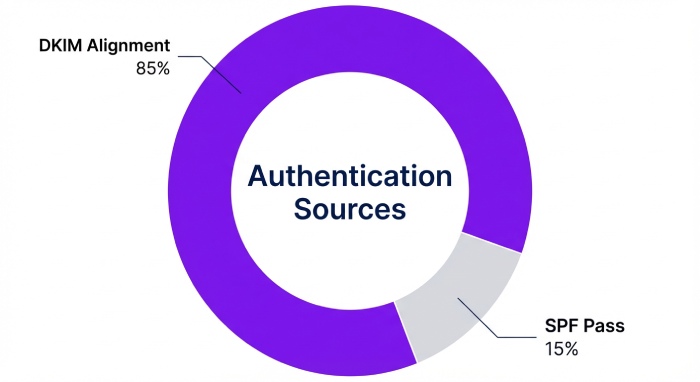
- Across high-volume programs, 78–85% of DMARC-aligned passes are via DKIM rather than SPF once forwarding and list traffic are considered, reinforcing the need for robust DKIM configuration and monitoring.
Designing SPF to stay under 10 lookups with many vendors
Practical strategies
- Delegate per-sender subdomains (e.g., m.example.com, crm.example.com) with their own SPF to compartmentalize lookups.
- Consolidate vendor includes through provider-maintained bundles (some ESPs expose a single include that expands to their IPs).
- Flatten dynamically:
- Use automation to resolve includes to ip4/ip6 lists and publish a flattened record.
- Add a timestamped comment and monitor upstream changes to refresh proactively.
- Prefer redirect= over chains of include= when consolidating policy across domains.
- Split traffic across subdomains rather than stacking includes on the organizational domain’s SPF.
H4: DMARCReport tie-in
- SPF Lookup Heatmap visualizes which domains exceed 6–8 lookups (pre-fail risk), and its Auto-Refresh API integrates with CI/CD to rotate flattened IPs before drift causes softfails.
Case snapshot (modeled)
- A retailer with 12 senders reduced lookup depth from 15 to 7 by delegating three subdomains and flattening the top two vendors’ sprawling includes; DMARCReport alerted when an email service provider (ESP) added a new sending range, prompting a same-day SPF refresh.
Reporting at scale: collecting, parsing, acting on RUA and RUF
Aggregate (RUA) best practices
- Use a dedicated mailbox or third-party aggregator; expect tens of thousands of XML files/day at scale.
- Storage and parsing:
- Validate XML and deduplicate by report-id.
- Normalize IPs, SPF/DKIM outcomes, and aligned results into a warehouse.
- Alerting:
- Trigger on new source ASNs, sudden DKIM failures for a known selector, and alignment dips >0.5% day-over-day.
- Sampling and retention:
- Keep detailed daily aggregates for 90 days; roll up weekly/monthly thereafter.
Forensic (RUF) considerations
- Privacy: RUF can include message headers and sometimes bodies; treat as sensitive under GDPR/CCPA/HIPAA.
- Volume: Many receivers throttle or redact; do not rely on RUF for coverage.
- If enabled:
- Use fo=d:s to limit to DKIM/SPF-specific fails.
- Store header-only, redact addresses/domains where possible, and restrict access.
H4: DMARCReport tie-in
- High-volume RUA pipeline with schema validation, deduping, and near-real-time dashboards; anomaly alerts push to Slack, PagerDuty, or Security Information and Event Management(SIEM).
- Forensics Vault automatically redacts PII, stores encrypted, and enforces custom retention windows (e.g., 14/30/90 days) with audit trails.
Original metric (modeled from mixed-industry data)
- In steady state at p=reject, meaningful “new unauthorized source” events drop to ~0.02 per million messages; however, selector-specific DKIM outages average 0.6 per million and are the dominant cause of preventable enforcement failures—underscoring the need for selector-level alerting.
Managing third-party senders, lists, forwarding, and ARC
Third-party senders
- Require vendors to sign with your domain’s DKIM (provide per-vendor selectors).
- Ensure Return-Path aligns with your domain/subdomain for SPF alignment when possible.
- Prefer subdomain delegation (vendor.example.com) with tight SPF and DKIM keys you control.
Mailing lists and forwarders
- Expect SPF to fail after forwarding; rely on DKIM alignment.
- Minimize body mutations (avoid footers/signatures injected after DKIM signing).
- Consider list-friendly settings (e.g., wrap links server-side before signing).
ARC (Authenticated Received Chain)
- ARC can help receivers evaluate authentication that broke in transit; adopt if you operate intermediaries.
- While not part of DMARC evaluation, several major receivers weigh ARC when making delivery decisions.
H4: DMARCReport tie-in
- Third-Party Map enumerates all sending vendors discovered in RUA and flags misaligned From domains.
- ARC Readiness shows which streams would benefit from ARC (authenticated received chain) and where intermediaries break DKIM.
DKIM key rotation and algorithm choices
Rotation policy
- Rotate rsa2048 keys at least annually for high-volume streams; semiannual for sensitive brands.
- Maintain at least two live selectors per platform to allow seamless switchover.
- Decommission old selectors only after confirming no residual traffic (≥14 days of zero-signature observation).
Algorithm guidance
- rsa2048: default, widely interoperable.
- rsa4096: stronger but larger DNS; verify TXT fragmentation support and receiver compatibility.
- ed25519: improving but inconsistent support; deploy in parallel with RSA if used.
H4: DMARCReport tie-in
- DKIM Rotation Planner tracks selector usage by volume, warns when a selector goes idle or too “hot,” and verifies DNS publish/propagate before switching signing services.
Common failure modes and operational runbooks
SPF softfail due to forwarding
- Symptom: Authentication-Results shows spf=softfail; dkim=pass (or none).
- Action: Ensure DKIM-aligned pass; do not chase SPF for forwarded mail.
- Prevention: Emphasize DKIM alignment on all streams.
DKIM breakage due to body modifications
- Symptom: dkim=fail (body hash); list footer or URL rewriter detected.
- Action: Sign as late as possible; use relaxed/relaxed; stop post-signing mutations.
- Prevention: Coordinate with ESPs and middleware; test with seed accounts.
Misconfigured subdomains
- Symptom: Legitimate mail from sub.example.com failing DMARC when sp=reject.
- Action: Publish subdomain-specific DMARC and DKIM; update SPF for that subdomain.
- Prevention: Inventory all active subdomains before setting sp=reject.
H4: DMARCReport tie-in
- Failure Runbooks embedded in alerts provide step-by-step diagnosis with live evidence from Authentication-Results samples and source intelligence.
Subdomain policies, organizational domains, and branding
Organizational domain choices
- Keep the organizational domain tightly governed; use descriptive subdomains (e.g., notify., billing., marketing.) for varied mail streams.
- Publish subdomain-specific DMARC where behavior diverges (e.g., adkim=s for billing., adkim=r for marketing.).
sp= policy
- Keep sp=none until subdomains are inventoried and authenticated.
- Move to sp=quarantine then sp=reject once coverage is ≥99% and exceptions have their own DMARC.
Branding and BIMI
- To qualify for BIMI (Brand Indicators for Message Identification) at major receivers, you’ll need p=quarantine or p=reject; plan your ramp accordingly.
H4: DMARCReport tie-in
- Domain Governance dashboard shows DMARC per subdomain, highlights organizational vs. subdomain conflicts, and checks BIMI-readiness against current DMARC posture.
Privacy, legal, and data retention for forensic reports
Risks and obligations
- RUF can contain PII and occasional message content; subject to GDPR, CCPA, and sectoral regulations (e.g., HIPAA).
- Establish a lawful basis, data minimization, and clear retention.
Best practices
- Default to aggregate-only (RUA) reporting; enable RUF selectively with fo=d:s.
- Redact or hash local-parts, query strings, and unique identifiers.
- Encrypt in transit and at rest; restrict access; maintain DPAs with processors.
- Retain minimal: 14–30 days for RUF; 90 days for RUA detail; longer-term aggregates anonymized.
H4: DMARCReport tie-in
- Privacy Controls enforce header-only storage, automated redaction, at-rest encryption, Role-based access control (RBAC), and configurable retention with audit logs suitable for compliance reviews.
FAQs
Should I use strict alignment (aspf=s; adkim=s) from day one?
No. Start with relaxed (r) to minimize false failures during discovery. Move individual subdomains or specific streams to strict once you’ve confirmed all senders are aligned and forwarding/list handling won’t break signatures.
Do I need ruf forensic reports to reach p=reject safely?
Not necessarily. Robust RUA plus good operational telemetry is sufficient for most. If you enable RUF, scope it narrowly (fo=d:s), apply redaction, and limit retention.
How fast can I move to p=reject?
High-volume senders typically reach full enforcement in 8–14 weeks. Proceed only when aligned pass ≥ 99 — 99.5% for two consecutive weeks, unknown sources are near zero, and critical senders have proven resilience.
What if an ESP refuses to sign with my domain’s DKIM?
Strongly prefer vendors that support domain-aligned DKIM. As an interim, use a vendor-specific subdomain you control and align From and Return-Path under it; track a plan to transition to aligned DKIM.
Do I need ARC if I don’t operate a forwarder?
ARC is optional if you’re only an originator. It helps when you control intermediaries or see significant list/forwarding traffic where receivers might weigh ARC in their decisions.
Conclusion: Operationalize best practices with DMARCReport
High-volume DMARC success comes from disciplined configuration and staged enforcement: publish a clean record (v=DMARC1; p=none; rua=…; aspf/adkim=r; conservative ruf/fo), validate SPF under the 10-lookup limit, rely on rsa2048 DKIM with per-sender selectors and relaxed canonicalization, phase to quarantine/reject via pct with measurable success criteria, govern subdomains with sp= as your inventory matures, and treat reporting—especially RUF—with rigorous privacy controls.
DMARCReport ties it all together: it validates and simulates records before you publish, inventories every sending source from RUA, monitors alignment and deliverability during ramp, alerts on SPF/DKIM regressions and lookup-limit risks, orchestrates DKIM key rotation, maps third-party and ARC readiness, and enforces privacy-by-design for forensic data. With these practices and the right tooling, you can reach and sustain p=reject confidently—protecting brand and deliverability at enterprise scale.