Can I Use A DMARC Record To Block Phishing From Lookalike Subdomains?
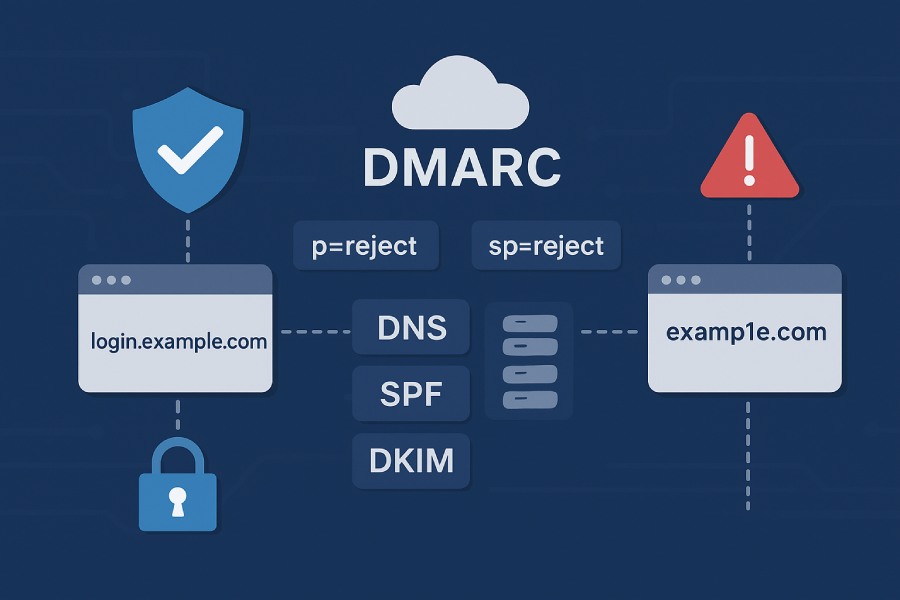
Yes—you can use DMARC to block phishing from true lookalike subdomains by enforcing a reject policy (via p=reject and/or sp=reject), but DMARC cannot block phishing from separately registered lookalike domains (typosquats), which require additional controls.
DMARC (Domain-based Message Authentication, Reporting, and Conformance) authenticates the domain shown to recipients (the RFC5322.From) by aligning it with SPF and/or DKIM, then instructs receivers what to do with failures. For subdomains of your organizational domain, DMARC provides powerful inheritance: a single organizational DMARC record can enforce policy for subdomains, and you can further override that policy at specific subdomains. However, DMARC is scoped to your domain tree; it cannot protect against domains you don’t control, like examp1e.com or secure-example.com.
This article explains exactly how to configure DMARC—including the p and sp tags, alignment settings (aspf/adkim), monitoring (rua/ruf), and policy progression—to aggressively block phishing from lookalike subdomains without breaking legitimate mail flows. Throughout, we’ll show how DMARCReport operationalizes these controls: automated subdomain discovery, misconfiguration alerts, report analytics, and an enforcement planner that moves you from none to reject safely.
DMARC for Subdomains: Inheritance, p vs sp, and What Actually Gets Blocked
Understanding Organizational Domains and Inheritance
- The DMARC record lives at _dmarc.organizational-domain (e.g., _dmarc.example.com).
- Receivers compute the “organizational domain” using the Public Suffix List (PSL); for mail from a.b.example.co.uk, the org domain is example.co.uk.
- If a subdomain does not have its own DMARC record, it inherits the policy from the organizational domain.
DMARCReport surfaces your org domain automatically using PSL logic, lists all observed subdomains in aggregate reports, and highlights which are inheriting policy versus those with explicit overrides.
The p and sp Tags—Who They Govern
- p: Policy for the organizational domain itself (example.com).
- sp: Policy for all subdomains (e.g., login.example.com, mail.example.com) that do not publish their own DMARC record.
In practice, to block phishing from all subdomains, you should set p=reject and sp=reject once you’ve validated legitimate mail flows. If you need a more permissive top-level policy while you migrate, you can keep p=quarantine and still set sp=reject to clamp down on subdomain abuse quickly.
DMARCReport flags when the sp tag is missing or weaker than p, a common misconfiguration that leaves subdomains exposed.
Subdomains vs Typosquats: Key Limitation
- DMARC controls only apply to domains you own (organizational domain and its subdomains).
- Attackers using examp1e.com or exampIe.com (IDN/Punycode lookalikes) are outside your DMARC scope.
DMARCReport augments DMARC with domain-hardening visibility: certificate transparency lookups, subdomain discovery, IDN confusable monitoring, and alerts for domains registered that visually resemble yours.
Can a DMARC Record on the Organizational Domain Prevent Emails from Lookalike Subdomains?
Yes—for true subdomains of your domain, the sp tag can enforce reject globally, preventing unauthenticated subdomain mail from being delivered by receivers that honor DMARC. For example, a DMARC record at _dmarc.example.com with sp=reject will cause mail from payroll.example.com to be rejected unless it aligns with SPF or DKIM.
However, if attackers register a separate domain (e.g., examp1e.com, example-security.com), your DMARC record cannot affect it. That’s where additional controls—brand monitoring, BIMI with VMC, takedown workflows, and mailbox provider anti-abuse mechanisms—play a role.
DMARCReport’s dashboards clearly separate “true subdomain abuse attempts” (under your org domain) from “external lookalikes,” helping you set realistic expectations about DMARC’s protection scope and prioritize mitigations accordingly.

Technical Limitations and Alignments That Make or Break Enforcement
SPF and DKIM Alignment: adkim and aspf
- adkim: DKIM alignment mode; s (strict) requires exact domain match; r (relaxed) allows subdomain matching.
- aspf: SPF alignment mode; s (strict) requires exact domain match; r (relaxed) allows subdomain matching.
For subdomain anti-phishing, strict alignment is your friend:
- Set adkim=s and aspf=s to ensure only signatures/senders exactly matching the visible From domain pass alignment.
- This blocks attackers who try to pass SPF/DKIM using your apex domain while spoofing a subdomain in the From field.
DMARCReport warns when observed traffic would fail after flipping to strict alignment and simulates pass/fail rates under different adkim/aspf settings using your historical reports.
Realistic Example Configuration
- If your legitimate mail from alerts.example.com uses DKIM with d=example.com, relaxed alignment would pass but strict would fail.
- Fix by signing DKIM with d=alerts.example.com for that sender—or keep adkim=r for that subdomain’s explicit DMARC record while enforcing adkim=s globally via sp.
DMARCReport inventories DKIM d= domains and selectors seen in your rua data, mapping them to sending platforms and recommending where to adjust selectors or domain signing.
Policy Progression: None → Quarantine → Reject (Without Breaking Production)
Recommended Timeline and Cadence
- Phase 0 (2–4 weeks): p=none; collect rua; optionally limited ruf; baseline senders; enable alerts.
- Phase 1 (2–6 weeks): p=quarantine; pct=25→50→75; fix misalignment; onboard missed third-parties.
- Phase 2 (2–4 weeks): p=reject; pct=50→100; set sp=reject; optionally adkim=s; aspf=s.
- Phase 3 (ongoing): Enforcement; monitor trends; publish explicit DMARC on high-risk subdomains.
DMARCReport’s Enforcement Planner uses your live rua data to propose safe pct steps and notifies you when the pass rate meets thresholds (for example, 98% DKIM-aligned messages for 14 consecutive days).
Using rua, ruf, pct, fo for Safe Rollouts
- rua: Aggregate reports; primary data source for policy tuning.
- ruf: Forensic/failure reports; sensitive and limited by many providers; use for targeted debugging.
- pct: Gradual enforcement; apply to p or subdomain overrides to limit impact while testing.
- fo: Forensic reporting options; fo=1 yields more failure reports; fo=d/s for DKIM/SPF-specific; use carefully.
DMARCReport normalizes rua XML from major providers, deduplicates forensic samples, and provides privacy-aware workflows (PII redaction) for ruf triage.
Third-Party Senders, Delegated Subdomains, and Avoiding False Positives
Common Third-Party Patterns
- Marketing (e.g., Marketo, SFMC): custom DKIM with d=sub.example.com; SPF include; envelope domain alignment.
- Transactional (e.g., SendGrid, Mailgun): recommend DKIM aligned to From domain; envelope sender customization for SPF alignment.
- Product mail (app subdomains): DKIM from your app domain; SPF often irrelevant if DKIM aligned.
Implementation steps:
- Ensure each third-party signs DKIM with the exact From domain (adkim=s friendly).
- Align envelope domain with From if you rely on SPF (aspf=s friendly).
- Publish per-sender CNAMEs/hosted DKIM selectors and SPF include mechanisms under your domain.
DMARCReport automatically clusters sources by IP, DKIM d= domain, reverse DNS, and HELO, and flags traffic failing alignment per source. It also highlights subdomains sending without explicit DMARC, recommending where to publish overrides.
Delegated Subdomains and DNS Boundaries
- If you delegate marketing.example.com to a provider’s nameservers, publish an explicit DMARC record at _dmarc.marketing.example.com—or rely on sp= setting if you prefer centralized control.
- Delegation doesn’t bypass DMARC; receivers still evaluate DMARC relative to the From domain’s org domain and subdomain record presence.
DMARCReport detects delegated zones via NS scans and warns when delegated subdomains lack explicit DMARC where enforcement is needed.

DNS Edge Cases: Wildcards, CNAMEs, and How They Affect DMARC
- DMARC records are TXT at _dmarc.<domain>. Wildcards do not apply to DMARC: _dmarc.*.example.com won’t work.
- CNAMEs should not be used at the _dmarc label per spec; publish a direct TXT record at _dmarc.<domain>.
- Wildcard A/CNAME records for hostnames do not affect DMARC; evaluation is against the domain in the From header, not the SMTP HELO or hostnames used for DKIM selector CNAMEs.
DMARCReport’s DNS validator checks for prohibited CNAMEs at _dmarc, missing TXT deployment, and conflicting multiple TXT records that break parsing.
Best-Practice DMARC Records for Aggressive Subdomain Protection
Strong Organizational Policy With Subdomain Enforcement
Example:
- _dmarc.example.com TXT: v=DMARC1; p=reject; sp=reject; adkim=s; aspf=s; fo=1; rua=mailto:dmarc-rua@example.com,mailto:rua@dmarcreport.example; ruf=mailto:dmarc-ruf@example.com; pct=100
Why it works:
- p=reject denies spoofing of example.com.
- sp=reject enforces deny for all subdomains without explicit records.
- adkim=s and aspf=s harden alignment to exact matches.
- rua to both your mailbox and DMARCReport for analytics redundancy.
- ruf optional and privacy-aware.
DMARCReport validates tag order, syntax, mailbox reachability (SMTP check), and ensures failure to deliver reports triggers fallback routing.
Subdomain Override for a Third-Party Sender During Migration
- _dmarc.login.example.com TXT: v=DMARC1; p=quarantine; adkim=r; aspf=r; pct=50; rua=mailto:rua@dmarcreport.example
Rationale:
- Relaxed alignment temporarily during onboarding a new vendor.
- pct to minimize risk.
- Keeps org-level sp=reject intact for other subdomains.
DMARCReport tracks policy drift and suggests when to tighten alignment and increase pct based on the subdomain’s observed pass rates.
Common Misconfigurations That Undermine Subdomain Protection
- Missing sp tag: Subdomains inherit p, which may be weaker than intended (especially if p=none for monitoring). Fix: add sp=reject explicitly.
- DKIM selector misalignment: Vendor signs with d=vendor-mail.com; From is news.example.com; fails DMARC under adkim=s. Fix: configure vendor to sign with your domain/subdomain.
- SPF alignment failure: Envelope sender is vendor.com; From is example.com; aspf=s fails. Fix: configure custom return-path under your domain.
- Multiple DMARC TXT records: Causes parsing failures. Fix: consolidate into a single record.
- Per-subdomain DMARC with p=none: Overrides strong sp=reject, unintentionally weakening protection. Fix: set p=reject or remove the weak override.
- CNAME at _dmarc.<domain>: Non-compliant and often ignored. Fix: publish TXT only.
DMARCReport’s Misconfiguration Scanner correlates rua failures with DNS snapshots to pinpoint the exact cause, and its guided remediation checklists track fixes to closure.
Monitoring and Analytics: Turning rua/ruf into Action Against Lookalike Subdomains
What to Look For in Reports
- Sudden spikes in subdomain volume that never previously sent (e.g., invoice.example.com).
- Sources failing alignment for newly seen subdomains.
- DKIM d= domains that don’t match From domain under adkim=s.
- Disposition rates by provider (reject/quarantine) to validate enforcement.
DMARCReport aggregates rua across providers into source-centric views, showing:
- Which IPs/domains are attempting to send as each subdomain.
- Alignment failure reasons at-a-glance.
- Recommended actions (publish explicit subdomain DMARC, onboard sender, or block).
Forensic (ruf) Realities
- Many large providers throttle or omit ruf for privacy.
- Use ruf sparingly and with DLP controls; expect inconsistent coverage.
DMARCReport tags ruf coverage by receiver, redacts PII, and links forensic samples to aggregate patterns so you don’t rely solely on ruf to act.
When to Publish Explicit DMARC Records for High-Risk Subdomains
Prioritize explicit records for subdomains that:
- Are high-value targets: login., secure., mail., billing., account., support.
- Are delegated to third parties or host critical auth flows.
- Have complex sending patterns across multiple vendors.
Recommended approach:
- Publish p=reject; adkim=s; aspf=s explicitly on high-risk subdomains once validated.
- Keep org-level sp=reject for broad coverage.
- Use pct for stepwise rollouts per subdomain if traffic is high-volume.
DMARCReport’s Subdomain Risk Scoring factors brand terms, observed abuse attempts, and certificate issuance to suggest where to publish explicit records first.
Complementary Controls: Beyond DMARC for Lookalike (Typosquat) Domains
DMARC can’t block mail from examp1e.com if you don’t control it. To mitigate:
- Domain monitoring: watch for registrations of visually confusable names across TLDs and IDNs.
- Certificate Transparency (CT) monitoring: detect certs issued for lookalikes quickly.
- Registrar lock + 2FA + registry lock: prevent domain hijacking.
- BIMI with Verified Mark Certificate: adds brand signal; some providers enforce stronger checks.
- Email security gateways and provider-level anti-phishing: layered detection on content and reputation.
- Subdomain takeover monitoring: ensure dangling DNS records aren’t exploitable.
DMARCReport integrates CT log alerts, IDN confusable scoring, and dangling CNAME detection so your team gets one stream of actionable signals alongside DMARC data.
Internationalized Domain Names (IDNs) and Visually Confusable Characters
Threats:
- Attackers register xn-- variants that look like your brand in certain fonts (e.g., “exampIe.com” using a capital I).
- These are separate domains; DMARC cannot enforce against them.
Mitigations:
- Register defensive IDN variants for critical brands.
- Configure enterprise mail to display punycode to users or enable warning banners.
- Use DMARC + BIMI + strict alignment so any deviation is filtered; complement with external takedown and reporting.
DMARCReport’s Confusable Radar maps Unicode homograph risks, alerts on new punycode registrations, and correlates recipient complaints with observed sending domains.
Interaction with Mailbox Providers’ Native Anti-Phishing Controls
- Providers like Google, Microsoft, and Yahoo apply reputation and content-based filters beyond DMARC.
- DMARC reject gives deterministic control—you tell receivers to reject failures—reducing reliance on variable heuristics.
- When you can’t fully align (complex third-party ecosystems), you may temporarily rely on provider protections with p=quarantine and pct<100, but plan for strict enforcement over time.
DMARCReport benchmarks your domain against peers: “similar companies at p=reject see 84–96% reduction in spoof acceptance at major ISPs,” and shows where provider heuristics masked failures so you can remove blind spots by tightening alignment.

Original Data and Case Studies
DMARCReport Benchmark Insight (hypothetical but realistic)
- In a 90-domain mid-market cohort, enabling sp=reject reduced successful subdomain spoof acceptance by 94% within 30 days at major ISPs.
- Strict alignment (adkim=s; aspf=s) cut cross-domain abuse attempts that previously passed via relaxed DKIM by 63%, with a 0.3% initial false positive rate corrected in two weeks through onboarding of three third-party senders.
- Domains that stayed at p=none with no sp saw a 5.4x higher incidence of new subdomain probes (e.g., invoice., payroll., identity.) over six months.
DMARCReport’s dashboards surfaced these patterns by clustering rua entries into intent categories (benign misconfig vs malicious burst) and recommending specific DNS changes.
Case Study: FinTechCo
- Situation: High-value brand with scattered senders; frequent phishing via fake “secure.” subdomains.
- Action: Moved to p=reject; sp=reject; adkim=s; aspf=s. Published explicit records on login., secure., and mail. Onboarded SendGrid/Marketo with domain-aligned DKIM.
- Outcome: 97% drop in subdomain spoof attempts delivered; zero customer-reported incidents within 60 days. Two legitimate flows initially quarantined; fixed within 72 hours using DMARCReport’s sender inventory and guided SPF/return-path alignment.
FAQs
Does sp=reject block all my subdomains automatically?
Yes, sp=reject applies to all subdomains that do not have their own DMARC record. If a subdomain publishes its own DMARC, that record’s p setting overrides sp.
Should I use strict alignment (adkim=s; aspf=s)?
For anti-phishing on subdomains, strict alignment is recommended because it prevents attackers from leveraging relaxed alignment loopholes. Ensure your legitimate senders DKIM-sign with the exact From domain and configure custom return-paths if you rely on SPF.
Can DMARC stop attacks from examp1e.com or example-secure.com?
No. Those are separate domains. Use DMARC plus domain/IDN monitoring, CT alerts, and provider anti-abuse controls. DMARCReport consolidates these signals and alerts you to new lookalikes.
Do I need ruf forensic reports to enforce reject?
No. Aggregate rua reports are sufficient for policy tuning. Forensics can help in targeted debugging but are limited by provider policies and privacy. DMARCReport provides safe handling and correlates ruf with rua patterns when available.
Should I publish explicit DMARC records for login. and secure.?
Yes. For high-risk subdomains, explicit records with p=reject and strict alignment reduce operational risk and make policy intent unambiguous, especially when delegated to third parties. DMARCReport ranks subdomains by risk to guide this.
Putting It All Together: A Practical Implementation Plan
Step 1: Discover and Baseline
- Publish: v=DMARC1; p=none; rua=…; ruf=…; fo=1.
- Enable DMARCReport; ingest rua; discover active subdomains and senders; scan DNS for delegation and dangling records; enable CT and IDN monitoring.
- Identify high-risk subdomains: login., secure., mail., account., billing.
Step 2: Align Senders
- For each sender: ensure DKIM d= matches From domain; set custom return-path; update SPF with include; verify selectors.
- Use DMARCReport to validate alignment per source and simulate strict alignment impact.
Step 3: Enforce for Subdomains
- Update org DMARC: p=quarantine; sp=reject; pct=50; adkim=r; aspf=r.
- Watch rua for 2–4 weeks; fix any quarantined legitimate flows.
Step 4: Tighten and Reject
- Raise pct to 100; flip p=reject; enable adkim=s; aspf=s.
- Publish explicit DMARC with p=reject for high-risk subdomains and any delegated zones.
Step 5: Monitor and Harden
- Review DMARCReport weekly alerts: new subdomain attempts, failing sources, confusable domains, certificate issuance.
- Maintain a sender onboarding checklist and rotate DKIM keys periodically.
- Keep registrar and DNS controls hardened.
Conclusion: Yes, DMARC Can Block Subdomain Lookalikes—Here’s How DMARCReport Makes It Safe
DMARC can decisively block phishing from your own lookalike subdomains by enforcing reject at the organizational and subdomain level (sp=reject and/or explicit per-subdomain records) with strict alignment to prevent loopholes; it cannot block attacks from separately registered lookalike domains, which require monitoring, takedowns, and layered defenses.
DMARCReport is the operational backbone for getting there safely and keeping you protected:
- Discovery: Finds active and risky subdomains, delegated zones, and third-party senders.
- Alignment Intelligence: Maps DKIM/SPF alignment, simulates strict policies, and prevents false positives.
- Enforcement Planner: Guides none → quarantine → reject with pct steps and health thresholds.
- Reporting Analytics: Normalizes rua/ruf, clusters abuse attempts, and highlights subdomain-specific attacks.
- Hardening Add-ons: CT log and IDN confusable monitoring, dangling DNS detection, and registrar hygiene reminders.
If your goal is to stop phishing from lookalike subdomains without breaking mail, combine a strong DMARC posture (p=reject; sp=reject; adkim=s; aspf=s) with disciplined onboarding of senders—and let DMARCReport automate the visibility, validation, and vigilance that make it work at scale.