Why Some MSPs Keep Growing While Others Stall: 5 Behavioural Differences That Matter
The divide between MSPs that grow year after year and those that plateau is getting wider.
And it has nothing to do with:
- Team size
- Marketing spend
- Fancy tools or platforms
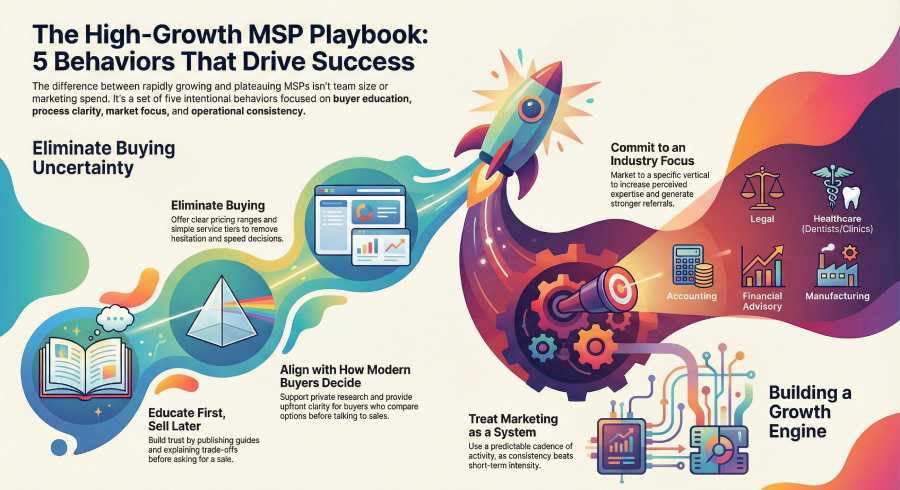
What separates growing MSPs from stagnant ones is how they operate day to day.
The MSPs that scale intentionally adopt a small set of behaviours that most others either postpone, overthink, or never fully commit to. As we move toward 2026, these differences are becoming non-negotiable.
Here are five reasons growth-focused MSPs consistently pull ahead—and how you can apply the same principles.
1) They educate the market before asking for the sale
High-growth MSPs don’t start conversations with pitches. They start with insight.
They focus on attracting business owners and decision-makers, then helping them understand:
- Why layered security actually reduces business risk
- How downtime impacts revenue and operations
- What “well-managed IT” looks like in real environments
- How pricing is structured and what variables influence cost
They publish guides, explain trade-offs, share real client outcomes, and show proof that others already trust them.
Instead of saying, “Talk to us to find out,” they say, “Here’s everything you need to understand first.”
Familiarity leads to confidence. Confidence leads to trust. And trust drives buying decisions.
In most markets, the MSP that becomes the most reliable source of clarity is the one that wins the most deals.
2) They remove uncertainty from the buying process
Growth-oriented MSPs recognise that confusion creates hesitation—and hesitation slows decisions.
That’s why they work to eliminate ambiguity wherever possible by offering:
- Clear pricing ranges instead of secrecy
- Well-defined service tiers
- Simple explanations of onboarding and delivery
- Direct guidance without technical jargon
- Real-world examples instead of abstract claims
Today’s buyers want to feel informed before engaging sales. MSPs that enable that behaviour earn momentum. Those that resist it lose attention.
3) They commit to at least one clear industry focus
While growing MSPs can still support a broad client base, they don’t market like generalists.
They intentionally build messaging around one or more specific industries. This makes it easier to:
- Reach the right prospects
- Speak directly to real problems
- Increase perceived expertise
- Generate stronger referrals
You don’t need to abandon your existing clients to do this. Many MSPs build a vertical practice alongside their general offering.
Industries where MSPs commonly see strong traction include:
- Accounting and finance
- Legal services
- Financial advisory firms
- Healthcare providers (dentists, clinics, veterinary practices)
- Manufacturing
Some MSPs also perform exceptionally well in retail and hospitality environments.
4) They treat marketing as a system, not a sporadic activity
One of the biggest differences between growing MSPs and stuck ones is consistency.
Successful MSPs don’t market “when things slow down.” They follow a predictable cadence, such as:
- Daily LinkedIn activity (posts, videos, carousels)
- Weekly newsletters
- Weekly website content (blogs and videos)
- Regular Google Business Profile updates
- Monthly outreach to high-value prospects
- Ongoing case study development
Most MSPs rely on bursts of activity followed by long periods of silence. But buyers only act when the timing is right—and your message has to be visible when that moment arrives.
Consistency always beats short-term intensity.
5) They design their business around how modern buyers actually decide
This is the missing piece many MSPs overlook.
Growth-focused MSPs align their sales and marketing with real buyer behaviour—not outdated assumptions.
They accept that buyers:
- Want to research privately
- Prefer control over early exploration
- Compare options before speaking to sales
- Expect clarity and speed
Tools like clear service breakdowns, educational content, and pricing estimators support how decisions are made today. MSPs that adapt to this reality gain trust earlier and close faster.
The takeaway
The MSPs pulling ahead aren’t doing anything extreme or complicated.
They’re simply consistent, intentional, and aligned with how buyers think and behave now.
The question is:
Which of these five behaviours does your MSP need to commit to next?