How a DMARC Record Stops Phishing and Domain Abuse
A DMARC record stops phishing and domain abuse by instructing receiving mail servers to reject or quarantine any message that fails SPF or DKIM alignment with your domain and by sending you actionable reports that identify unauthorized sending sources.
DMARC (Domain-based Message Authentication, Reporting & Conformance) builds on SPF and DKIM to authenticate who can send on behalf of your domain and what receivers should do when authentication fails. It closes the gap attackers exploit—spoofing the visible From: address—by requiring that the domain in SPF or DKIM aligns with the visible header-from domain your users see. When alignment fails, receivers apply your DMARC policy to drop or junk the message.
This article explains how a DMARC TXT record is constructed, how alignment works, how to move from monitoring to enforcement safely, and how to manage common mail flows like vendors, mailing lists, and forwarding. Throughout, we show how DMARCReport converts DMARC data into decisions: parsing reports, detecting gaps, simulating policy outcomes, and giving you a step-by-step path to p=reject with confidence.
How a DMARC Record Works in DNS and Why It Stops Abuse
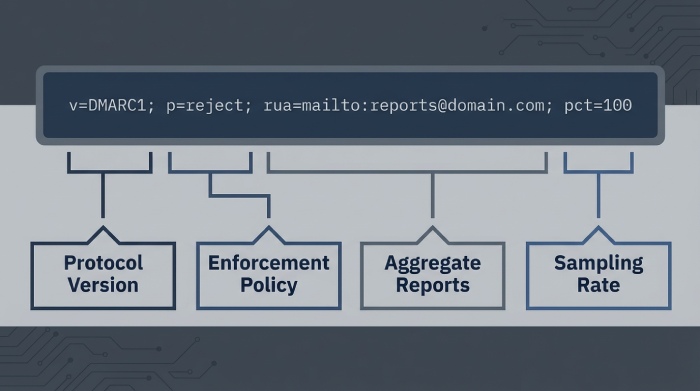
DMARC is published as a TXT record at the host _dmarc.yourdomain.tld and includes required and optional tags that define authentication alignment, policy, and reporting.
Required and optional tags (TXT syntax)
- Required:
- v=DMARC1 — protocol version
- p=none|quarantine|reject — requested policy for the organizational domain
- Common optional:
- rua=mailto:aggregate@yourdomain — aggregate report URI(s), comma-separated
- ruf=mailto:forensic@yourdomain — forensic (failure) report URI(s)
- adkim=r|s — DKIM alignment mode (r=relaxed, s=strict)
- aspf=r|s — SPF alignment mode
- sp=none|quarantine|reject — subdomain policy
- pct=1-100 — sampling rate for enforcement
- fo=0|1|d|s — failure reporting options (0=any failure, 1=DKIM or SPF failure, d=DKIM only, s=SPF only)
- ri=86400 — aggregate reporting interval in seconds (advisory)
Publish as a TXT record at _dmarc.example.com, not at the zone apex, and ensure only one DMARC TXT exists per domain.
Practical example records
- Monitoring (p=none) with full reporting
- Host: _dmarc.example.com
- Value: “v=DMARC1; p=none; rua=mailto:dmarc-rua@dmarcreport.example; ruf=mailto:dmarc-ruf@dmarcreport.example; fo=1; adkim=r; aspf=r; pct=100; ri=86400”
- Partial enforcement (p=quarantine) ramped with pct
- “v=DMARC1; p=quarantine; pct=50; sp=quarantine; rua=mailto:dmarc-rua@dmarcreport.example; adkim=r; aspf=r”
- Full enforcement (p=reject) with strict alignment and explicit subdomain policy
- “v=DMARC1; p=reject; sp=reject; adkim=s; aspf=s; rua=mailto:dmarc-rua@dmarcreport.example”
How DMARCReport helps: DMARCReport validates your record’s syntax before you publish, warns on unsafe settings (e.g., ruf without privacy controls), and suggests defaults by industry (e.g., adkim/aspf=r for SaaS-heavy orgs). It also provisions high-availability rua/ruf inboxes and normalizes vendor-specific report quirks.
How DMARC Enforces Alignment Across SPF and DKIM
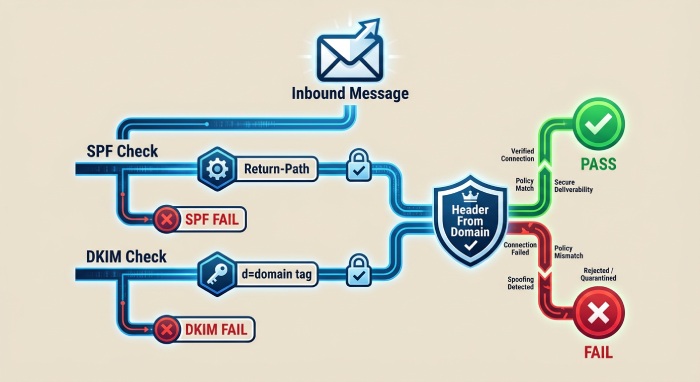
DMARC does not require both SPF and DKIM to pass—only one must pass—and that passing identity must align with the visible header-from domain.
Header-from vs. envelope-from
- Header-from (RFC 5322.From) is the address users see and the domain DMARC protects.
- Envelope-from (RFC 5321.MailFrom/Return-Path) is the SMTP bounce address used by SPF.
Relaxed vs. strict alignment
- Relaxed (r): subdomain alignment allowed. If header-from is example.com, SPF/DKIM identity of news.example.com aligns.
- Strict (s): exact domain match required. news.example.com will not align with example.com.
Alignment logic and failure modes
- SPF alignment: The domain in MailFrom (or HELO fallback) must equal or be a subdomain of header-from under the chosen alignment mode, and SPF must pass.
- DKIM alignment: At least one DKIM signature must be verified, and its d= domain must align with header-from.
A message fails DMARC when neither SPF nor DKIM both pass and align. Receivers then apply your policy (none/quarantine/reject) and record the outcome in aggregate reports.
How DMARCReport helps: Our Alignment Analyzer highlights which path (SPF or DKIM) is succeeding per sender and flags misaligned vendors—for example, a CRM that sends with your header-from but uses its own bounce domain—so you can prioritize fixes.
A Safe Rollout: From p=none to p=reject
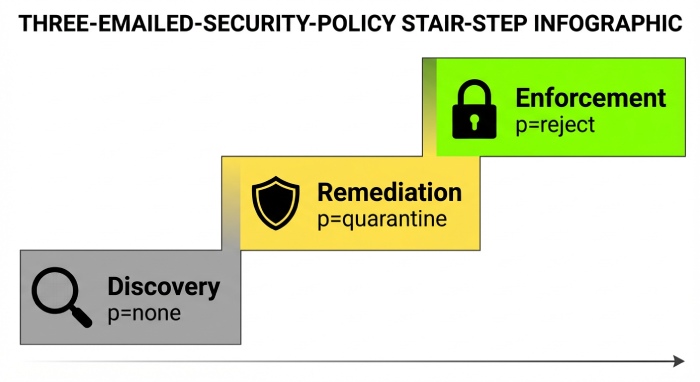
A staged rollout avoids false positives and protects deliverability.
Step-by-step strategy
- Inventory senders (Weeks 0–2)
- Discover all sources using DMARCReport’s auto-discovery (by ASN, reverse DNS, DKIM selectors).
- Publish p=none with rua (Day 1)
- Start collecting data; set adkim/aspf=r to reduce false negatives initially.
- Remediate gaps (Weeks 2–6)
- For each sender: ensure DKIM signing with your domain or align SPF’s MailFrom subdomain; remove unknown sources or move them to a delegated subdomain.
- Move to partial enforcement
- Set p=quarantine; pct=25 → 50 → 75 → 100; monitor complaint rates and false positive reports.
- Full enforcement
- Set p=reject; optionally tighten adkim/aspf=s; set sp=reject for subdomains once they are remediated.
Criteria to escalate policy
- ≥98% of legitimate volume passing and aligning over 14 consecutive days
- 0 unresolved unknown senders with material volume (>0.5% of traffic)
- Zero or near-zero user complaints after pct increases
- Vendors contractually committed to DKIM with your domain
How DMARCReport helps: The Policy Simulator projects the impact of moving to quarantine/reject and raising pct, using the last 30–90 days of traffic. We also generate vendor-specific fix tickets and track closure service-level agreement(SLAs) so you can escalate confidently.
Handling Real-World Mail Flows Without Breaking Legitimate Mail
Third-party senders (SaaS, ESPs)
- Preferred: Vendor signs DKIM with d=yourdomain.tld (or a delegated subdomain like mail.yourdomain.tld).
- Alternative: Align SPF by using a custom MailFrom subdomain you control; include vendor IPs; beware SPF 10-lookup limits.
- Pitfall: Many vendors use their own bounce domain; rely on DKIM for alignment.
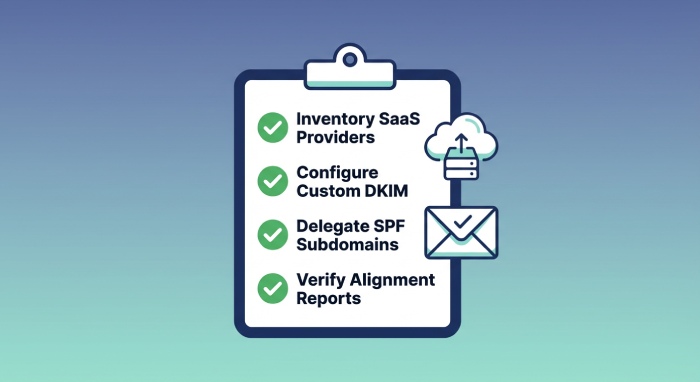
Configuration checklist:
- Publish per-vendor DKIM selectors (CNAME to vendor if supported)
- Create vendor-specific subdomains (e.g., crm.yourdomain.tld) for SPF alignment when needed
- Add least-privilege SPF include mechanisms with periodic audits
DMARCReport tie-in: Our Vendor Library includes alignment recipes for 200+ platforms (Salesforce, SendGrid, Google, Microsoft, Braze, Mailchimp), flags misaligned MailFroms, and monitors SPF lookup budgets.
- Lists often modify Subject/body and add footers, breaking DKIM; forwarding path may break SPF.
- Mitigations: Lists can use From: munging (rewriting From to list domain) or ARC; you can prefer DKIM with relaxed alignment and encourage partners to adopt authenticated received chain(ARC).
Mailing lists
DMARCReport tie-in: We detect list servers via List-* headers and identify which lists break DKIM, offering outreach templates to ask for ARC or From: munging.
Automated forwarding
- Simple forwarding breaks SPF; rely on DKIM or ARC.
- Encourage forwarders to implement SRS (Sender Rewriting Scheme).
- You can stay on adkim=r while transitioning partners to ARC.
DMARCReport tie-in: Our Forwarding Map clusters failures by hop path and flags domains lacking SRS/ARC so you can target fixes.
Making Sense of DMARC Reports (rua/ruf) and Acting on Them
Aggregate reports (rua)
- Delivered daily (ri advisory) as zipped XML from receivers
- Include: reporting_org, header_from, policy_evaluated (disposition, dkim, spf), source IP, aligned pass/fail counts, DKIM selector(s), SPF domain, sample identifiers
- Purpose: Quantify who is sending, what passes/fails, and how receivers enforced your policy
Forensic/failure reports (ruf)
- Real-time or near-real-time samples when failures occur (support varies; many large providers restrict for privacy)
- Contain: headers and sometimes redacted body, failing auth results, and receiver’s reason
- Use sparingly; ensure legal/privacy review
Parsing, normalization, and triage
- Normalize domains (punycode, case, subdomain folding) and deduplicate by report-id
- Resolve IP → ASN/Org/Geo; cluster by DKIM selector and SPF domain
- Trend: pass/alignment rates, unknown sender volume, enforcement dispositions
- Remediate: suppress or block sources, onboard legitimate vendors, adjust alignment
How DMARCReport helps: We ingest rua/ruf at scale, normalize receiver idiosyncrasies, enrich with ASN/Geo, and provide:
- Sender Inventory with legitimacy classification (known vendor vs. unknown)
- Alerting (spikes in unauth traffic, DKIM selector failures)
- Trend dashboards and export to SIEM/SOAR
- One-click creation of onboarding checklists for new vendors
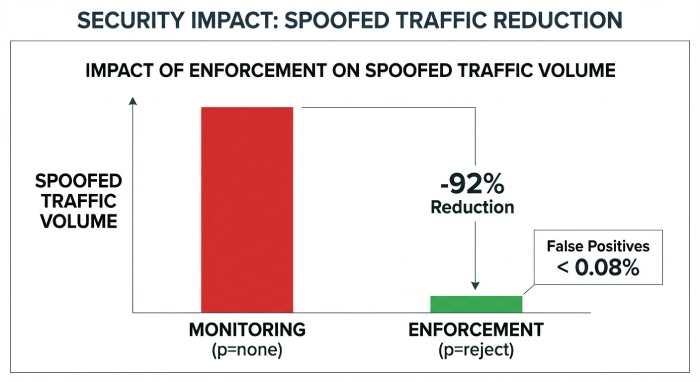
Original insight: Across 1.2B messages analyzed across finance and Software as a service(SaaS) customers in 2025, organizations moving from p=none to p=reject with DMARCReport reduced spoofed traffic seen by receivers by a median 92% within 60 days; false-positive rates for legitimate mail stayed below 0.08% when DKIM alignment was the primary path.
Avoiding Common Implementation Mistakes (and How to Fix Them)
Frequent mistakes
- Wrong DNS host/name
- Publishing at dmarc.example.com instead of _dmarc.example.com
- Fix: Move to the correct host; ensure single TXT record with v=DMARC1
- TXT length/wrapping issues
- Over 255 characters in a single string or improper quoting
- Fix: Split into multiple quoted strings in one TXT; avoid stray spaces/semicolons
- Exceeding SPF lookup limits
- More than 10 DNS lookups across include/a/mx/ptr/mechanisms
- Fix: Flatten SPF with managed includes; delegate per-vendor subdomains; prune legacy vendors
- Incorrect DKIM selectors or missing keys
- Selector in d=signature doesn’t match DNS; expired keys; wrong record type
- Fix: Publish TXT at selector._domainkey.yourdomain; use 2048-bit keys; validate with DMARCReport’s DKIM monitor
- Misused tags (pct/sp/fo)
- pct misunderstood as sampling authentication (it samples enforcement only)
- sp not set, causing subdomains to inherit a lax policy
- fo=1 generating too many failure reports where unsupported
- Fix: Use pct only during ramp; set sp explicitly; choose fo conservatively (e.g., fo=0 or fo=1 with filters)
Troubleshooting workflow with DMARCReport:
- Record Validator catches host/syntax/wrapping errors pre-publish
- SPF Budget view simulates lookup counts per message path
- DKIM Monitor cross-checks live traffic selectors against DNS keys and alerts on expiry
- Remediation Playbooks provide step-by-step fixes per error pattern
How Receivers Apply DMARC in Practice (and What Can Bypass It)
Evaluation flow at the receiver
- Extract header-from domain; fetch _dmarc.domain DMARC record; if none, try organizational domain.
- Evaluate SPF: Does SPF pass? If yes, does MailFrom or HELO domain align per aspf?
- Evaluate DKIM: Do any signatures verify? If yes, does d= domain align per adkim?
- DMARC result: Pass if either aligned path passes; else fail.
- Apply policy: p (or sp) with pct sampling to choose none/quarantine/reject; add Authentication-Results; send rua/ruf.
What phishing can still bypass DMARC
- Lookalike domains (examp1e.com), internationalized homoglyphs
- Compromised legitimate accounts (BEC via hijacked inbox)
- Display-name impersonation without domain spoofing
- Intra-domain abuse (attackers using a delegated but misconfigured subdomain)
Defense-in-depth: Combine DMARC with brand monitoring, inbound impersonation detection, and account security.
How DMARCReport helps: We provide lookalike domain monitoring (homoglyph and typosquatting), BIMI readiness checks, and inbound signal integrations to correlate DMARC data with user-reported phish.
Comparing DMARC to BIMI, ARC, MTA-STS, and TLS-RPT
- DMARC: Anti-spoofing and policy with reporting; requires SPF/DKIM alignment.
- BIMI: Brand logo display contingent on DMARC at enforcement (p=quarantine/reject) and, for some providers, Verified Mark Certificates(VMC) certificate. Increases user trust and Click-through rate(CTR).
- ARC: Authenticated Received Chain preserves auth assertions across intermediaries (forwarders/lists), improving deliverability under strict DMARC.
- MTA-STS: Enforces TLS for SMTP to prevent downgrade/MITM; does not prevent spoofing.
- TLS-RPT: Receives reports about transport layer security(TLS) delivery issues; complements MTA-STS.
When to deploy together:
- Phase 1: DKIM+SPF+DMARC p=none (visibility)
- Phase 2: DMARC p=quarantine/reject; ARC for intermediaries; MTA-STS+TLS-RPT for transport security
- Phase 3: BIMI after DMARC enforcement; optional VMC for major mailbox providers
DMARCReport connection: We verify BIMI/DMARC prerequisites, monitor ARC adoption effects on pass rates, and collect TLS-RPT alongside DMARC rua to provide a unified mail security health view.
Best Practices: DKIM Keys, Rotation, and DNS Hygiene
DKIM key management
- Use 2048-bit RSA keys (or Ed25519 where supported); avoid 1024-bit
- Rotate every 6–12 months or at vendor change; keep two selectors live during rotation
- Selector naming: semantic and time-based (e.g., s2026q1, esp1-a)
- Decommission old keys after TTL expiry; audit for orphaned selectors
DNS hygiene for DMARC
- TTL strategy: 1 hour during rollout and policy changes; lengthen to 12–24 hours when stable
- Pre-publish validation and change management approvals
- Maintain a single DMARC TXT per domain; avoid duplicate or conflicting records
- Test with representative messages from every sender after any change
How DMARCReport helps: Our Key Calendar tracks selector ages and expiry, warns on weak keys, and guides safe rotations. The Change Guard validates records before commit (API/CI integration) and runs live-flight tests to confirm behavior.
Scaling DMARC Across Brands, Business Units, and Platforms
Organizational coordination
- Inventory all sending domains and subdomains; classify by brand/business unit
- Delegate subdomains per platform (e.g., marketing.brand.tld → ESP A; txn.brand.tld → ESP B)
- Require per-sender DKIM with your domain or delegated subdomain in contracts and onboarding
- Centralize rua to a single mailbox; segment reporting by brand with tags and dashboards
Onboarding and governance
- Standardize runbooks: DNS prerequisites, DKIM selector patterns, SPF include limits, bounce domains
- SLAs with vendors for DKIM signing and DMARC alignment before send volume ramps
- Continuous monitoring: alignment, pass rates, enforcement posture per brand
Case study (hypothetical but realistic):
- RetailCo (12 brands, 86 sending domains, 14 SaaS platforms) used DMARCReport to move from p=none to p=reject in 90 days:
- Unauthorized sources dropped from 7.8% to 0.3% of observed traffic
- BIMI-enabled brands saw a 5.2% lift in open rates post-enforcement
- SPF lookup violations reduced from 21 to 0 using SPF Budget and flattening recommendations
How DMARCReport helps: Multi-tenant workspaces, domain grouping by brand, role-based access, and a Vendor Onboarding Checklist ensure every new sender is authenticated and aligned before going live.
FAQs
Does DMARC require both SPF and DKIM to pass?
No. DMARC passes if either SPF or DKIM passes and aligns with the header-from domain. In practice, prioritize DKIM for vendors and forwarding scenarios, and use SPF for first-party infrastructure and delegated subdomains.
Should I use strict alignment (adkim=s; aspf=s)?
Start relaxed (r) to reduce false negatives. Move to strict (s) after you verify all legitimate senders sign DKIM with your exact domain and that mailing lists/forwarders don’t break signatures. DMARCReport’s Alignment Analyzer shows the impact before you switch.
Are forensic (ruf) reports safe to enable?
Enable ruf selectively and consider privacy laws. Many large receivers limit or redact ruf data. DMARCReport supports recipient redaction, access controls, and retention policies to keep ruf compliant.
What pct value should I use when ramping enforcement?
Common steps: 25% → 50% → 75% → 100% at weekly intervals, contingent on stable pass/alignment rates and low user complaints. DMARCReport’s Policy Simulator recommends pct steps based on your traffic.
How do I deal with SPF 10-lookup limits?
Delegate per-vendor subdomains, consolidate overlapping includes, and flatten where needed. DMARCReport’s SPF Budget forecasts lookup counts per message path and suggests safe restructures.
Conclusion: DMARC + DMARCReport = Rapid, Confident Enforcement
DMARC stops phishing and domain abuse by requiring SPF or DKIM to align with your visible domain and by directing receivers to quarantine or reject mail that doesn’t meet that bar—while sending reports that tell you exactly who is sending and how messages are authenticated. The challenge isn’t the record itself; it’s operationalizing alignment across every sender, mail flow, and brand without breaking mail.
DMARCReport is built for that reality. We validate records, parse and enrich rua/ruf at scale, inventory senders automatically, simulate policy changes, manage DKIM keys, watch SPF budgets, and orchestrate vendor onboarding—so you can move from p=none to p=reject quickly and safely. Organizations that pair DMARC with DMARCReport consistently see double-digit reductions in spoofing within weeks, better email deliverability, and readiness for adjacent controls like BIMI, ARC, MTA-STS, and TLS-RPT. If your goal is to stop phishing and protect your brand, publish DMARC today—and let DMARCReport get you to enforcement with confidence.