How can DMARC improve email deliverability and reduce phishing risks?

How can DMARC improve email deliverability and reduce phishing risks?

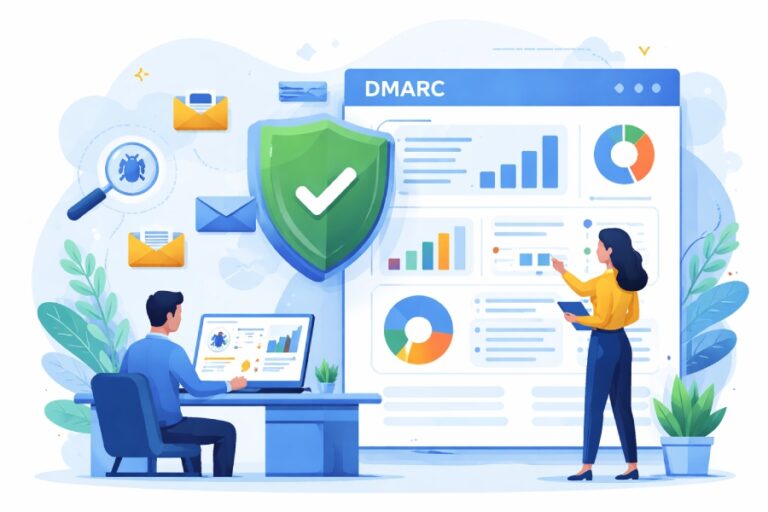
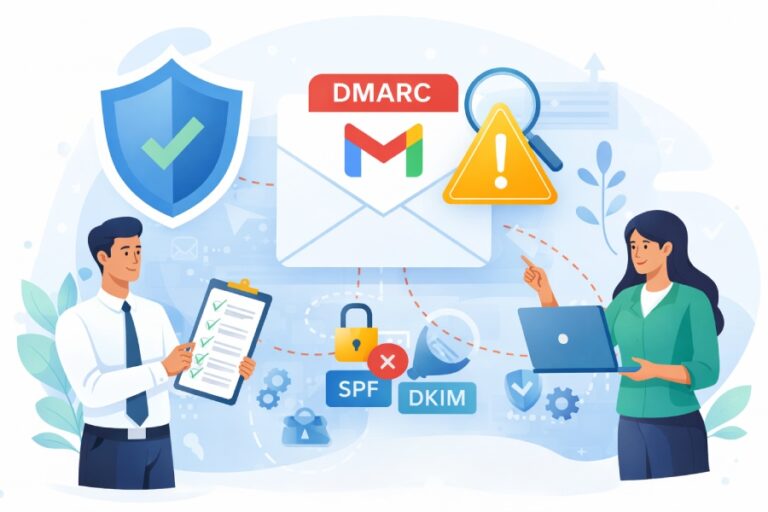
DMARC improves deliverability and reduces phishing by enforcing domain-aligned authentication (SPF/DKIM) that mailbox providers trust to place legitimate emails in the inbox while blocking or quarantining spoofed messages at scale. DMARC—Domain-based Message Authentication, Reporting, and Conformance—adds a policy and reporting layer on top of SPF and DKIM so receivers can verify that a message claiming…

How Can I Verify If My DMARC Record Is Using SPF Or DKIM Alignment?

How Can I Verify If My DMARC Record Is Using SPF Or DKIM Alignment?

To verify whether your DMARC policy uses SPF or DKIM alignment and whether messages align, query your domain’s _dmarc TXT record to read the adkim (for DKIM) and aspf (for SPF) flags (set to r for relaxed or s for strict), then inspect a delivered message’s Authentication-Results, Header From, Return-Path, and DKIM-Signature (d=) fields to…

Data Leak vs. Data Breach — A DMARCReport Perspective

Data Leak vs. Data Breach — A DMARCReport Perspective

In today’s digital world, terms like data leak and data breach are frequently used by news outlets, security blogs, and IT professionals—often interchangeably, but incorrectly. At DMARCReport, we believe that understanding the distinction between a data leak and a data breach is essential for building strong data-protection strategies. When combined with security measures like DMARC,…

How can I create a DMARC record for my domain to stop email spoofing?

How can I create a DMARC record for my domain to stop email spoofing?

To stop email spoofing, create and publish a TXT record at _dmarc.yourdomain.com with a value like v=DMARC1; p=reject; rua=mailto:dmarc-reports@yourdomain.com; ruf=mailto:dmarc-forensics@yourdomain.com; adkim=s; aspf=s; pct=100; fo=1; ri=86400 only after verifying that all your senders pass SPF and/or DKIM in alignment with your From domain. DMARC (Domain-based Message Authentication, Reporting, and Conformance) lets domain owners tell receivers how…

Can I Use A DMARC Record To Block Phishing From Lookalike Subdomains?

Can I Use A DMARC Record To Block Phishing From Lookalike Subdomains?

Yes—you can use DMARC to block phishing from true lookalike subdomains by enforcing a reject policy (via p=reject and/or sp=reject), but DMARC cannot block phishing from separately registered lookalike domains (typosquats), which require additional controls. DMARC (Domain-based Message Authentication, Reporting, and Conformance) authenticates the domain shown to recipients (the RFC5322.From) by aligning it with SPF…

CNAME vs ALIAS Records — A Guide by DMARCReport

CNAME vs ALIAS Records — A Guide by DMARCReport

As DNS users, domain administrators, and website operators know all too well: DNS configuration often feels like walking a tightrope. A small misconfiguration can mean your users can’t reach your site — or your email goes missing. Two DNS record types that are often sources of confusion are CNAME and ALIAS records. They can look…

Boost Deliverability with Gmail DMARC: What Every Sender Must Know

Boost Deliverability with Gmail DMARC: What Every Sender Must Know

To boost Gmail deliverability with DMARC, you must implement aligned SPF/DKIM/DMARC on your Google Workspace domain, stage policy from p=none to quarantine to reject while monitoring Gmail-specific signals, authorize third-party senders with aligned keys and SPF, handle forwarding with ARC, optimize SPF under lookup limits, enable BIMI, and continuously analyze RUA data with DMARCReport for…

CNAME vs A Record: What Every Domain Owner Should Know

CNAME vs A Record: What Every Domain Owner Should Know

By DMARCReport When you register a domain name — say mywebsite.com — you’re not done yet. To get the domain to actually load your website, or allow email to be delivered, you need to configure the Domain Name System (DNS) appropriately. Think of DNS as the internet’s “phone book.” Instead of human-readable domain names, computers…

What are the privacy concerns associated with DMARC reports, and how can you address them?

What are the privacy concerns associated with DMARC reports, and how can you address them?

When you implement DMARC, you do not just do it for the policy enforcement feature; it’s also the reporting aspect that makes the authentication protocol so effective. These reports give you a behind-the-scenes view of your email activity, from who is sending emails on your behalf, how those emails are being authenticated, to any suspicious…

Can DMARC Reports Help Me Detect Spoofing And Phishing Attempts?

Can DMARC Reports Help Me Detect Spoofing And Phishing Attempts?

Yes—DMARC aggregate (RUA) and forensic (RUF) reports can absolutely help you detect spoofing and phishing attempts by revealing who is sending as your domain, whether SPF/DKIM align, and where non-aligned traffic spikes point to active impersonation. DMARC sits on top of SPF and DKIM to answer a single question: did this message actually come from…