25 practical reasons every MSP should add a pricing estimator to their website
1) Unclear pricing creates unnecessary stress
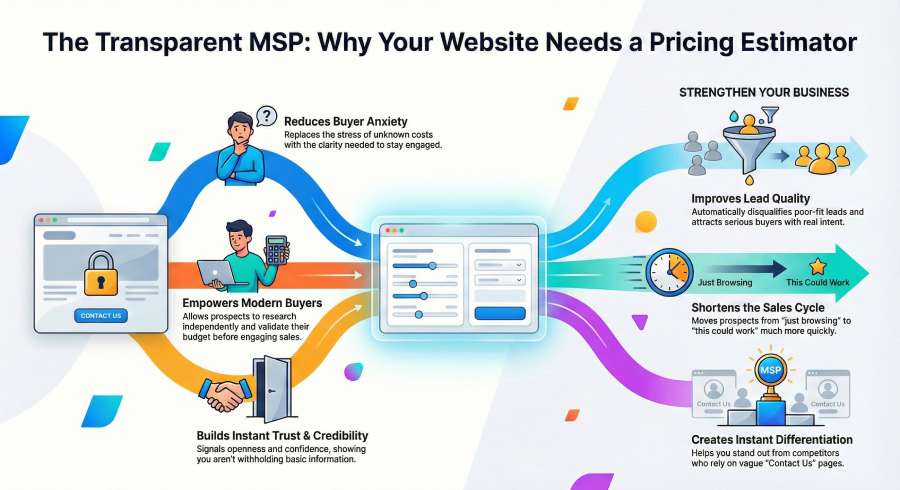
When buyers can’t even estimate affordability, anxiety replaces curiosity. A pricing estimator lowers emotional friction and keeps prospects engaged instead of guarded.
2) It quietly disqualifies the wrong leads
People far outside your price range self-select out early, which saves your sales team time, energy, and morale.
3) Serious buyers engage more deeply
Prospects with real budgets don’t fear numbers—they seek them. Clarity signals professionalism and operational maturity.
4) It positions your MSP as open and confident
Most providers avoid pricing because they’re unsure of it. Showing ranges communicates confidence, not risk.
5) It neutralizes price shock before it happens
By the time you speak, the buyer already understands the cost landscape. That removes defensiveness from the conversation.
6) It shortens the decision timeline
Estimators help prospects move from “just browsing” to “this could work for us” without multiple back-and-forths.
7) It removes uncomfortable early conversations
No more calls that exist solely to ask for a number. Every discussion starts at a higher level.
8) It improves lead quality across the funnel
Sales conversations become calmer and more productive because expectations are already aligned.
9) It teaches prospects how pricing actually works
When buyers see what drives cost—users, devices, security layers—they understand the value behind the number.
10) It shifts perception from vendor to advisor
Instead of selling blocks of IT, you’re guiding buyers through risk management and operational decisions.
11) It instantly differentiates you from competitors
In a sea of vague “contact us” pages, clarity stands out without extra marketing spend.
12) It builds credibility before you ever speak
Trust doesn’t start on the first call—it starts when buyers feel you’re not withholding basics.
13) It matches how modern buyers research
Today’s buyers want to explore independently, compare options, and validate fit before engaging sales.
14) It gives buyers control over the process
Letting prospects adjust inputs makes them feel ownership over the solution, not pressure from sales.
15) It increases time-on-site and interaction
Interactive tools naturally hold attention longer than static pages or PDFs.
16) It reveals real buying behavior
Estimator data shows what buyers want, what they avoid, and where pricing sensitivity actually exists.
17) It removes barriers for quieter decision-makers
Not everyone is comfortable jumping on a call. Estimators invite those buyers in without forcing interaction.
18) It informs smarter content and offers
Repeated pricing patterns highlight which services need better explanation—or better packaging.
19) It attracts buyers with intent, not curiosity
People who complete estimators are typically evaluating real solutions, not browsing casually.
20) It proves you understand how decisions are made today
Buyers value speed, clarity, and autonomy. Estimators support all three without pressure.
21) It consistently converts better than generic forms
Across industries, interactive pricing tools outperform “request a quote” pages.
22) It anchors conversations around outcomes, not discounts
When buyers see cost drivers, negotiations focus on scope and priorities instead of price cuts.
23) It aligns sales promises with delivery reality
Clear pricing inputs reduce mismatched expectations that cause churn later.
24) It reduces post-proposal silence
When pricing is familiar, proposals don’t shock—and shock is the #1 cause of ghosting.
25) It signals confidence in your business model
Displaying pricing means you trust your numbers, your value, and your positioning.