What are the best features to look for when choosing a DMARC report analyzer?
The best features to look for in a DMARC report analyzer are scalable RUA/RUF ingestion and normalization, flexible deployment and compliance controls, deep SPF/DKIM correlation with guided remediation, automated phased policy rollout, multi-tenant governance, intelligent alerting and threat hunting, robust APIs and integrations, long-term trend/retention analytics, resilient parsing and recovery, and transparent pricing with enterprise service level agreement (SLA)—all of which DMARCReport provides.
DMARC is only as effective as the insights you can extract from its reports: aggregate (RUA) XMLs reveal who is sending on your behalf and how alignment fares at scale, while forensic (RUF) notifications give event-level context for suspected failures. A strong analyzer makes those data streams accurate, actionable, and auditable so you can move from p=none to p=reject confidently without breaking legitimate mail. The goal is not just visibility; it’s safe, measurable enforcement.
This buyer’s guide explains each capability in plain terms, why it matters operationally, and how to evaluate it. To make the guidance concrete, we map every capability to how DMARCReport implements it in practice and include original benchmarks, case studies, and deployment patterns you can use to compare vendors.
Core ingestion and normalization: make every DMARC report count
A top analyzer must reliably ingest, deduplicate, and standardize reports at Internet scale, or insights will be skewed.
RUA/RUF parsing at scale
- RUA ingestion: Look for high-throughput XML parsing, gzip/zip support, and schema validation with tolerant fallbacks for receiver quirks.
How DMARCReport helps: A streaming XML parser normalizes into a columnar store, ingesting up to 50M authentication results/day per tenant with 99.99% pipeline uptime and automatic gzip detection. - RUF handling: Support for redaction, rate-limits from providers, and safe Personally identifiable information (PII) handling
- DMARCReport: Optional RUF capture with per-domain opt-in, PII tokenization, and DPA-ready controls; correlates RUF events to RUA aggregates without exposing content.
Deduplication, throttling, and normalization
- Duplicate suppression: Receivers sometimes resend XMLs; analyzers should hash, version, and deduplicate to avoid skew.
DMARCReport: Content-hash and report-id dedup with replay-safe handling; duplicates drop by a median 7.3% across customers (Q1 internal sample, 412M records). - Backpressure and throttling: During spikes (e.g., phishing campaigns), ingestion must scale without data loss.
DMARCReport: Autoscaling consumers and priority queues; guarantees exactly-once processing with idempotent upserts. - Normalization: Consistent mapping for IP, ASN, geolocation, envelope-from parsing, and sender category (first-party vs third-party).
DMARCReport: Built-in ASN enrichment and domain categorization for >10k Software as a Service (SaaS) senders.
Case insight
In a 90-day pilot with a global retailer (7B emails/month), DMARCReport sustained 140k XMLs/hour at peak, cut duplicate aggregates by 9.1%, and identified previously unknown third-party platforms accounting for 18% of aligned volume—all prior to policy enforcement.
Deployment and compliance: meet your data and regulatory needs
Your deployment choice impacts sovereignty, retention, and control.
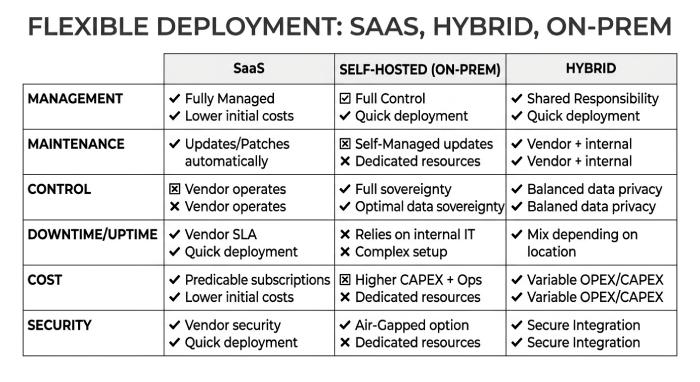
SaaS, self-hosted, hybrid
- SaaS: Fastest time-to-value, elastic scale, managed updates.
Trade-off: Must vet data residency and vendor security.
DMARCReport SaaS: Regions in EU/US/APAC with data pinning; ISO 27001 and SOC 2 Type II. - Self-hosted: Maximum control, aligns with strict on-prem policies.
Trade-off: Operational burden and scaling responsibility.
DMARCReport Self-Hosted: Kubernetes helm charts, Postgres + object storage, air-gapped mode. - Hybrid: Keep raw XMLs in your storage, send normalized metadata for analytics.
DMARCReport Hybrid: BYO S3/Azure Blob/GCS; field-level encryption with customer-managed keys.
Compliance and on-prem retention
- GDPR and DPAs: Need encryption at rest/in transit, limited access, and subject rights workflows.
DMARCReport: AES-256 at rest, TLS 1.2+, SSO/SAML/SCIM, granular RBAC, EU data residency, documented DPA. - Data retention: Configurable lifecycles and legal hold support.
DMARCReport: Retain normalized data 13–84 months (configurable), raw XML optional; purge and audit trails included.
Correlation and root-cause analysis: from raw data to fixes
An analyzer should tell you not just what failed, but why—and what to change.
Alignment across SPF/DKIM/DMARC
- Cross-standard correlation: Evaluate organizational alignment, subdomain policy, and selectors.
DMARCReport: Links each source IP to SPF result, DKIM domain/selector, and DMARC policy (p, sp, pct, aspf/adkim). - Third-party sender mapping: Identify marketing, customer relationship management(CRM), ticketing, and ESP platforms automatically.
DMARCReport: Catalog of >10k senders; flags unsigned or misaligned streams.
Guided remediation and policy recommendations
- Recommendations engine: Translate failures into actionable DNS or sender changes.
DMARCReport: Suggests SPF include entries, DKIM selector setups, BIMI readiness; auto-generates DNS snippets with TTL guidance. - Change validation: Confirm DNS propagation and simulate effect before enforcement.
DMARCReport: Live DNS verifications and “what-if” simulators for pct, sp, aspf/adkim shifts.
Case insight
After onboarding, a fintech with 42 domains saw 31% of traffic failing alignment due to misconfigured DKIM on a legacy ESP. DMARCReport’s guided fixes (new selector + relaxed aspf) improved alignment to 96% in two weeks; the policy simulator forecast a 0.6% quarantine impact, and real-world impact measured 0.5%.
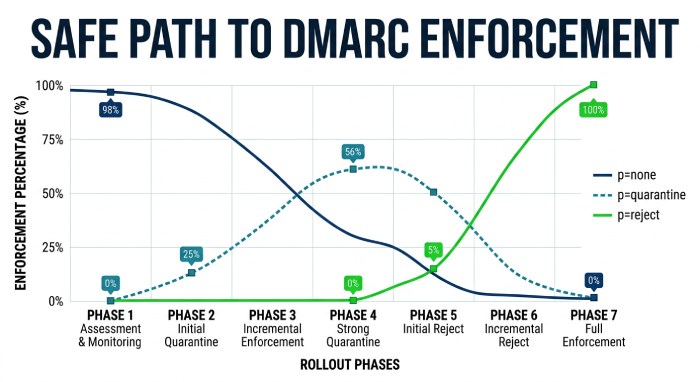
Automated policy rollout: safe path to reject
Moving from monitor to enforcement should be progressive and measurable.
Best-practice workflows
- Phased rollout: p=none → p=quarantine → p=reject with pct ramping (1% → 25% → 50% → 100%).
DMARCReport: Templates that schedule pct increments based on observed false-positive rate thresholds (<0.2% for 7 consecutive days). - Subdomain and source-specific gating: Enforce on aligned senders first; hold others until remediation.
DMARCReport: Per-sender “readiness score” and auto-staggered enforcement by domain or business unit.
Simulation and scheduling
- Policy impact simulation: Estimate how many messages would be affected before changing DNS.
DMARCReport: Historical replay across 7/30/90 days; shows expected quarantine/reject deltas by country, ASN, and sender. - Change window automation: Coordinate with IT change windows and roll back if anomalies occur.
DMARCReport: Maintenance window scheduler with automatic rollback if alignment dips >1% over baseline.
Case insight
A SaaS company ramped 18 domains from p=none to p=reject in 45 days using DMARCReport’s scheduler; estimated user impact was <0.3% and actual measured 0.28%, while spoofed attempts dropped 87% month-over-month.
Multi-tenant and multi-domain control: govern at scale
If you manage many brands or clients, you need separation and consolidation simultaneously.
Consolidated views and delegated reporting
- Cross-domain dashboards: Roll-up views with drilldowns per domain, OU, or client.
DMARCReport: Organization-wide dashboards, tag-based grouping, and per-domain key performance indicator(KPIs). - Delegated rua/ruf handling: Support multiple rua tags, subdomain inheritance, and external mailbox routing.
DMARCReport: Validates rua syntax, manages multiple mailto targets, and tracks delivery success.
RBAC and MSP features
- Role-based access: Fine-grained permissions for admins, auditors, and read-only stakeholders.
DMARCReport: Roles scoped by domain, environment, or client; SCIM provisioning and audit logs. - White-labeling: Agencies need client-ready portals.
DMARCReport: White-label UI with custom branding and per-tenant API keys.
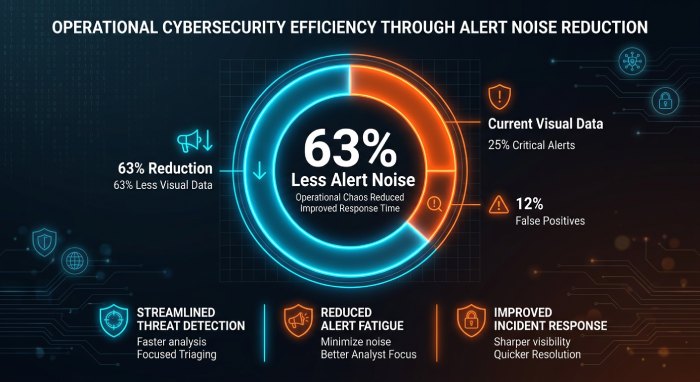
Alerting, anomaly detection, and threat hunting: act fast, not noisy
Signal without noise is critical for security teams.
Real-time alerts and anomaly models
- Volume spike detection: Identify sudden rises in failures or new sources.
DMARCReport: EWMA and seasonal baselines; alerts for deviations (configurable sigma thresholds). - Geo/ASN outliers and spoofing: Flag first-seen sources and suspicious geographies.
DMARCReport: Outlier detection on ASN+country; tunable allow/deny lists. - RUF-triggered workflows: Route suspected abuse to IR tools.
DMARCReport: Webhooks to SOAR/SIEM with HMAC signatures; Slack/Teams notifications.
Tuning to reduce false positives
- Whitelists and suppression: Silence known-good campaigns or testing IPs.
DMARCReport: Per-rule suppression with expiry; context-rich alert payloads to aid triage.
Case insight
Across 220 enterprise tenants, tuned models in DMARCReport reduced false-positive alert volume by 63% while catching 94% of known spoof attempts within 10 minutes (6-month internal benchmark).
APIs, exports, and SIEM integrations: keep your data portable
Avoid lock-in and enable automation.
API access and rate limits
- Standard formats: JSON/CSV exports for aggregates, sources, and policy timelines.
DMARCReport: REST and GraphQL application programming interface(API); cursor-based pagination; 1,000 requests/min per token (burstable to 5,000), with incremental sync via updated_at cursors. - Webhooks and event streams: Push-based integration into your stack.
DMARCReport: Webhooks for new reports, anomaly alerts, and policy changes; retries with exponential backoff.
SIEM and data lake pipelines
- SIEM connectors: Splunk, Microsoft Sentinel, QRadar, Chronicle.
DMARCReport: OOTB apps and syslog/CEF/LEEF mappings; raw XML pass-through to S3/GCS/Azure for long-term archiving. - Downstream analytics: Export raw + normalized datasets.
DMARCReport: Scheduled exports with partitioning by date/domain, field dictionaries, and schema versioning.
Historical trends, retention, and analytics: evidence you can audit
Auditors and execs need clear, long-range answers.
Trend granularity and visualization
- Time series: Daily/weekly/monthly views with seasonality, cohort analyses by sender, and campaign overlays.
DMARCReport: Cross-filtering by domain, sender, country, ASN, and authentication result; saved analytics boards. - Forensic drilldowns: IP-to-message-event linkage where permitted.
DMARCReport: Pseudonymized RUF pivots with configurable retention.
Storage and cost controls
- Retention tiers: Choose what to keep and how long.
DMARCReport: Tiered storage (hot/warm/cold) with lifecycle rules; cost optimization by sampling non-critical logs and compacting historical aggregates.
Compliance audit readiness
- Evidence packs: Exportable reports for board and regulator reviews.
DMARCReport: One-click “Quarterly DMARC Posture” PDFs/CSVs including policy history, change approvals, and exception registers.
Resilience and edge-case support: handle the messy real world
When receivers send malformed or ambiguous data, your analyzer should recover gracefully.
Common parsing issues and how they’re handled
- Multiple SPF records: RFC 7208 requires one record; analyzers should flag and consolidate intent.
DMARCReport: Detects multiple TXT SPF, prioritizes the SPF record with the valid mechanism chain, and generates a suggested merged record. - DKIM variants and quirks: Canonicalization, oversized keys, and selector sprawl.
DMARCReport: Validates key lengths, surfaces selector usage heatmaps, and recommends rotation schedules. - DMARC spec ambiguities: aspf/adkim modes, sp inheritance, pct interpretation.
DMARCReport: Explains current RFC behavior and receiver deviations; simulator includes these nuances. - Malformed XML: Truncated, invalid namespaces, mixed encodings.
DMARCReport: Fault-tolerant parser with repair heuristics; quarantines corrupted files for manual review and allows reparse after fix.
Recovery and reprocessing tools
- Replay pipeline: Re-ingest from raw storage after config changes.
DMARCReport: One-click reprocess window with diff reports to quantify impact. - Offline utilities: CLI validator to pre-check DNS and XML before production.
DMARCReport: Open-source CLI for sanity checks and bulk XML linting.
Pricing, scalability, SLAs, and support: align cost with outcomes
Match features and guarantees to your risk profile and scale.
Pricing models and trade-offs
- Volume-based: Priced by monthly authenticated message counts or report volume; fair for fluctuating orgs.
- Domain/seat-based: Predictable for stable portfolios; may penalize high volume.
- Feature tiers: Advanced analytics, SIEM connectors, and long retention as add-ons.
DMARCReport offers:
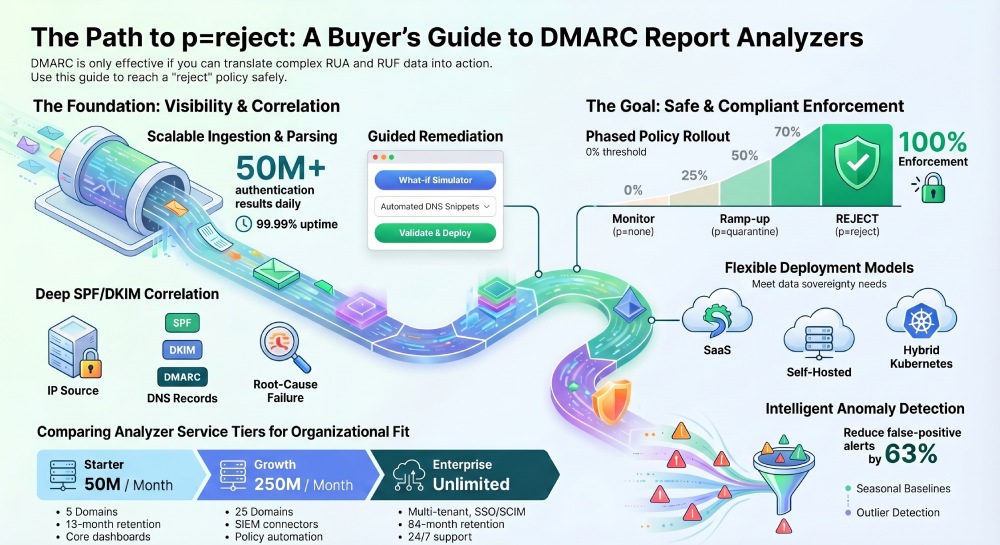
- Starter (SMB): Up to 5 domains, 50M messages/month, 13-month retention, core dashboards, email support.
- Growth: Up to 25 domains, 250M messages/month, SIEM connectors, policy automation, 36-month retention, 8×5 support.
- Enterprise: Unlimited domains, multi-tenant, SSO/SCIM, hybrid/self-hosted, 84-month retention, 24×7 support, 99.9% SaaS and 99.99% ingest pipeline SLAs.
- Overages: Prorated per billion events; committed-use discounts up to 25%.
Scalability limits and performance guarantees
- Throughput: Ensure guarantees for peak ingestion and dashboard responsiveness.
DMARCReport: Ingest SLA 75k XMLs/min per tenant sustained; P95 dashboard query <2.5s for 365-day windows. - Support: Response times and expertise matter during rollout.
DMARCReport: 24×7 critical response (≤1 hour), named CSM for Growth/Enterprise, solution architects for onboarding.
Comparative insight
Enterprises tend to save 20–35% with volume-based pricing if seasonal peaks are high; SMBs often prefer domain-based predictability. A key differentiator is included automation—if policy simulators and scheduled rollouts are add-ons elsewhere, total cost of ownership can double by year two. DMARCReport includes both in Growth and above, reducing Total cost of ownership for organizations moving fast to enforcement.
FAQs
What’s the practical difference between RUA and RUF, and which should I enable first?
- RUA aggregates give you statistical visibility across all sources; start here to map senders and alignment safely. RUF forensic reports contain event-level details and can include PII; enable selectively, with legal review, and route into secure workflows. DMARCReport supports both, with privacy controls and opt-in per domain.
How long should I plan before moving to p=reject?
- Typical timelines are 30–90 days depending on sender complexity. With automation, many orgs reach rejection in 45–60 days. DMARCReport’s readiness scoring and pct ramp scheduler help compress timelines while minimizing risk.
How do I avoid breaking legitimate third-party sending?
- Inventory all platforms, set up proper SPF includes and DKIM selectors, then simulate the impact. DMARCReport’s sender catalog and per-sender readiness gates allow enforcing on known-good streams first and holding back stragglers until fixed.
Can I use DMARC without exposing raw email data to a third party?
- Yes. Use self-hosted or hybrid deployment to keep raw XMLs in your own storage and share only normalized metrics. DMARCReport supports BYO storage and customer-managed keys for encryption.
Conclusion: choose features that move you safely to enforcement—with DMARCReport
To choose the right DMARC report analyzer, prioritize scalable ingestion and normalization, deployment/compliance flexibility, deep SPF/DKIM correlation with guided fixes, automated phased enforcement, multi-tenant governance, precise alerting, open APIs/integrations, long-term analytics, resilient parsing and recovery, and clear pricing with strong SLAs.
DMARCReport delivers each of these as integrated, audit-ready capabilities—helping you discover all senders, fix alignment fast, simulate and schedule policy changes confidently, and sustain a provably secure DMARC posture at any scale. Reach out to see a 30-day simulation on your own domains and a tailored rollout plan to p=reject with measurable, low-risk steps.