CSA Cyber Essentials Mark Now Requires DMARC: A Complete Guide


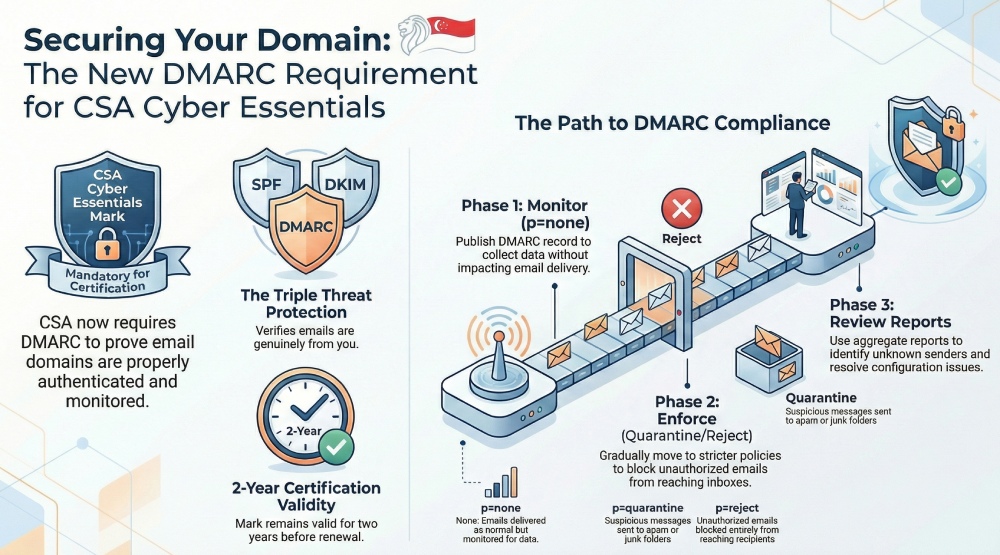
Cybersecurity requirements are evolving rapidly, and a clear trend is that email security is no longer optional. Organisations can have strong passwords, secure devices, and up-to-date systems, yet still face serious risks if attackers misuse their email domain. This is exactly why the Cyber Security Agency of Singapore has made DMARC mandatory for the Cyber Essentials Mark Certification.
Instead of focusing solely on advanced tools or complex security controls, this requirement highlights a more practical approach. Email authentication is foundational to everyday business communication. When domains are not protected, attackers can send spoofed messages that look legitimate, damaging trust and exposing businesses to phishing and fraud.
The update signals a shift from basic awareness to measurable action. Organisations applying for certification must now prove that their email domains are properly authenticated and monitored. For many teams, this is an opportunity to strengthen security and improve email reliability.
In this blog, we will explore what the Cyber Essentials Mark Certification is, how DMARC works, why it matters for email security, and the practical steps organisations can follow to meet the new requirement smoothly.
What Is the Cyber Essentials Mark Certification?
The Cyber Essentials Mark Certification is a cybersecurity certification created by the Cyber Security Agency of Singapore (CSA). It helps organisations put basic security measures in place to protect themselves from common cyber threats.It is designed primarily for businesses seeking a simple, practical starting point to improve security, especially small and medium-sized companies that may not have large cybersecurity teams.
In simple terms, the certification focuses on basic cybersecurity practices. These include things like malware protection, secure system settings, access controls, incident response planning, and data protection. The goal is not to build advanced security overnight, but to make sure organisations have strong fundamentals to reduce everyday cyber risks.
The certification process usually starts with a self-assessment, followed by a review from an independent assessor approved by CSA. Once the requirements are met, the organisation receives the Cyber Essentials Mark to show that it follows the required security standards.
The certification remains valid for two years. After that, organisations need to renew it to make sure their security practices stay updated as cyber threats continue to change.
Understanding DMARC
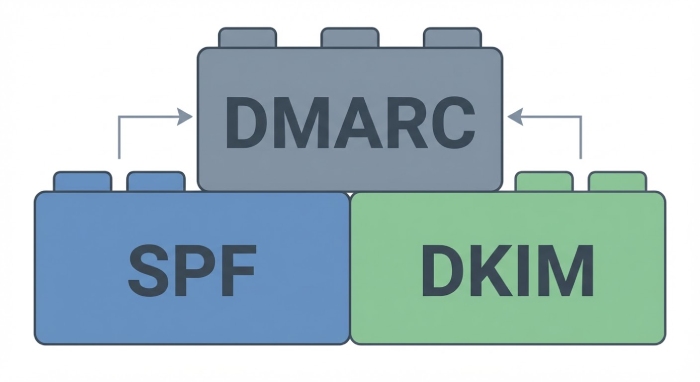
DMARC, short for Domain-based Message Authentication, Reporting, and Conformance, is an email security protocol designed to protect domains from misuse. It helps organisations prevent email spoofing, phishing attempts, and impersonation attacks by verifying whether messages are truly sent from the domain they claim to come from.
To do this, DMARC works together with two existing authentication standards called SPF and DKIM. These checks help confirm sender legitimacy and ensure that fake emails cannot easily pretend to be from trusted organisations.
In simple terms, DMARC gives clear instructions to receiving mail servers on what to do when an email fails authentication checks. It also provides reporting features that give domain owners visibility into who is sending emails on their behalf. This combination helps organisations control their email ecosystem and reduce fraudulent activity.

DMARC is especially important because email continues to be one of the most common ways attackers target businesses. Without proper authentication, cybercriminals can send convincing fake messages that damage trust and put users at risk. DMARC helps stop these messages before they reach inboxes.
How DMARC authentication works
DMARC starts with the domain owner publishing a policy in DNS. When an email arrives, the receiving mail server performs SPF and DKIM checks to confirm authenticity. DMARC then evaluates whether at least one of these results aligns with the domain shown in the sender’s “From” address. The final action depends on the policy chosen by the domain owner.
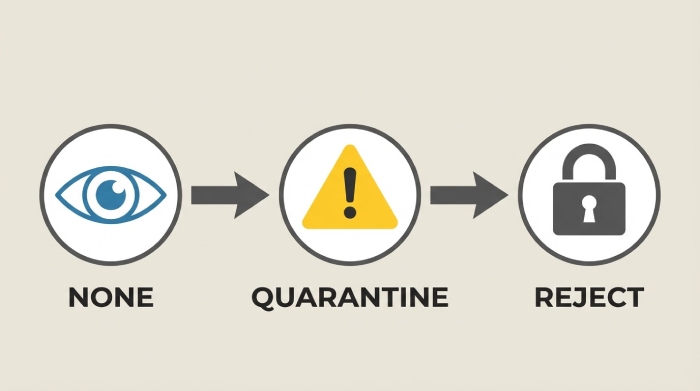
If the message passes DMARC checks, it is delivered to the inbox as normal. If it fails, the receiving server follows the defined policy.
- With a ‘none’ policy, emails are allowed but monitored.
- The ‘quarantine’ policy sends suspicious messages to spam or junk folders.
- The ‘reject’ policy blocks failed emails completely from reaching recipients.
DMARC also includes reporting capabilities. Receiving servers send feedback reports showing which messages passed or failed authentication. These reports help organisations monitor email activity, detect unauthorised senders, and gradually strengthen email security while keeping legitimate communication flowing smoothly.
How DMARC improves email security
Here is how DMARC improves email security by giving domain owners more control over how emails are verified and how suspicious messages are treated by receiving mail servers:
Stops domain spoofing
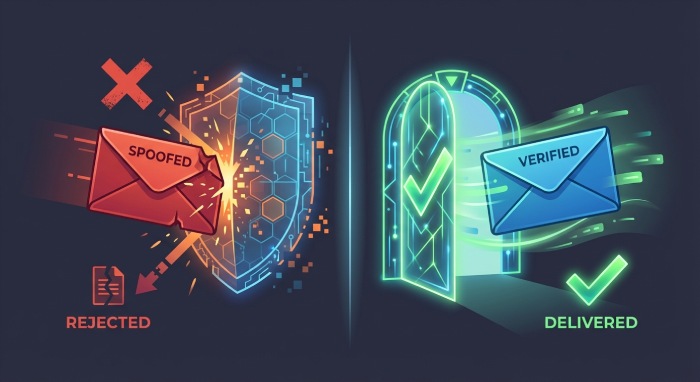
DMARC helps prevent attackers from sending emails that pretend to come from your domain. By checking SPF and DKIM authentication, it allows only approved senders to use your domain name. This reduces fake emails that try to mislead customers, employees, or business partners.
Lowers phishing attempts
Many phishing emails rely on pretending to be a trusted brand. DMARC allows domain owners to tell mail providers to quarantine or reject emails that fail authentication. This reduces the number of harmful messages reaching inboxes and helps protect users from scams.
Improves email delivery
When DMARC is correctly set up, mailbox providers view your domain as more reliable. As a result, genuine emails are more likely to reach inboxes instead of spam folders. This improves communication consistency and helps maintain a strong sender reputation.
Provides useful email reports
DMARC gives organisations detailed reports showing which emails passed or failed authentication checks. These insights help teams understand email activity, identify unknown senders, and resolve issues before they escalate into larger security problems.

Helps meet security requirements
Many cybersecurity standards and frameworks now expect proper email authentication. Using DMARC helps organisations meet these expectations and show that they are taking practical steps to reduce common cyber risks.
Builds trust with customers
When fake emails are blocked, customers are less likely to see scams pretending to be your brand. This protects your reputation and increases confidence in your emails, helping to strengthen long-term trust with customers and partners.
Steps to meet this requirement
To align with CSA’s Cyber Essentials DMARC requirement, organisations can follow a clear and practical approach:
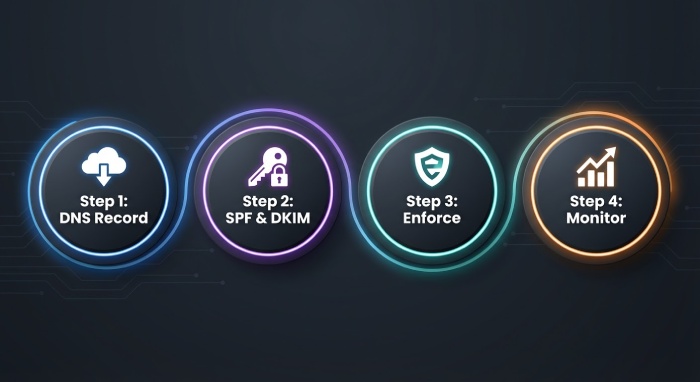
Add a DMARC record to DNS
Begin by publishing a DMARC record using a monitoring policy (p=none). This helps you collect data and understand how emails are being sent from your domain without impacting normal email delivery.
Configure SPF and DKIM correctly
Check that your SPF record includes all approved email sending platforms. At the same time, enable DKIM signing so outgoing emails can be verified and trusted by receiving mail servers.
Gradually apply stricter policies
After confirming that your authentication setup is stable, move to a stronger DMARC policy, such as p=quarantine or p=reject. These policies help block suspicious or unauthorised emails more effectively.
Monitor DMARC reports consistently
Regularly review aggregate and forensic reports to track authentication results. These insights help you detect unknown senders, fix configuration issues, and improve email security over time.
Final thoughts
Making DMARC mandatory for Cyber Essentials Mark Certification highlights how critical email security has become within modern cybersecurity practices. Since email continues to be a major attack path, organisations need stronger protection than basic spam filtering alone.
When DMARC is implemented together with SPF and DKIM, businesses can significantly reduce spoofing and phishing risks while also improving email trust and deliverability. It also shows that the organisation follows recognised security practices that match today’s threat landscape.
For organisations working toward the Cyber Essentials Mark, this requirement should be seen as more than compliance. It is a practical step toward building stronger security, protecting brand reputation, and creating safer communication for customers and employees. Starting early, monitoring results, and moving gradually toward enforcement will make the entire certification process smoother and more effective.
Contact DMARCReport to get started with SPF, DKIM, and DMARC.